
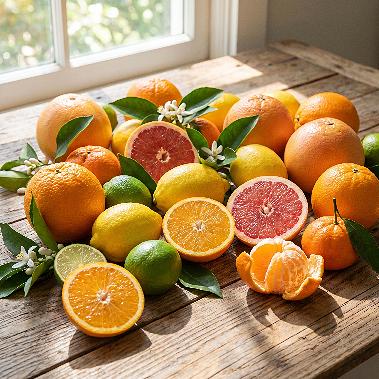
Citrus
Lemons, limes, oranges, grapefruits — the acid backbone of cooking worldwide and the most vitamin C-rich fruits.
Choose citrus that is heavy for its size — heaviness indicates high juice content. The skin should be smooth and firm. Avoid any with soft spots or excessively thick, puffy skin (indicates dry flesh inside).
For lemons and limes, thinner skin generally means more juice. Roll the fruit firmly on the counter before juicing — this breaks down cell walls and increases juice yield significantly. Room-temperature citrus produces far more juice than cold — microwave for 10–15 seconds before juicing if refrigerated.
Citrus fruits range from intensely tart to honey-sweet. Here are the most essential types for cooking and eating:
Lemon
The most essential citrus in cooking — bright, intensely sour, with aromatic zest used as much as the juice.
Lime
More floral and slightly more bitter than lemon. Essential in Mexican, Thai, Vietnamese, and Caribbean cooking.
Orange
Sweet, juicy, and versatile — navel for eating fresh, Valencia for juicing, blood orange for its dramatic color and berry notes.
Grapefruit
Bittersweet, complex, and bracing. Pink and Ruby Red are sweeter; white grapefruits are more bitter.
Mandarin / Clementine
Easy-peel, sweet, and mild. A snacking citrus par excellence — Satsuma, Clementine, Tangerine are all mandarins.
Yuzu
Japanese citrus — impossibly aromatic zest, tart juice. Used primarily for its extraordinary fragrance in Japanese cuisine.
The zest (outer colored layer) contains the aromatic essential oils — far more concentrated in flavor than the juice. A teaspoon of lemon zest can add more citrus flavor than a tablespoon of juice. Always zest before juicing.
The white pith beneath the zest is intensely bitter — avoid including it. A microplane grater is the ideal tool, producing fine, fluffy zest that incorporates easily into batters and dressings.
Store citrus at room temperature up to 1 week, or refrigerate for 3–4 weeks. Unlike most fruit, citrus does not ripen after harvest — refrigeration simply slows degradation.
Zest before juicing — always. Citrus zest can be frozen in small portions (ice cube trays work well) and retains virtually all of its flavor. Frozen zest is one of the most useful pantry items.
Cut citrus should be wrapped tightly and refrigerated; use within 3–4 days.
Acid in Savory Cooking: A squeeze of lemon or lime at the end of cooking brightens virtually any savory dish — soups, pastas, roasted vegetables, grilled fish. Acid perception is one of the most powerful flavor modulators in cooking.
Ceviche: Citrus juice 'cooks' raw fish through acid denaturation — the proteins denature and turn opaque without heat. The foundation of Latin American ceviche.
Curd: Lemon curd — cooked egg, butter, sugar, and lemon juice — is one of the great pastry preparations. Intensely flavored, silky, and perfectly balanced between sweet and tart.
Preserved Lemons: Lemons fermented in salt for weeks — a North African staple that adds funky, intensely aromatic depth to tagines, grain salads, and dressings. The rind (not the pulp) is the prized ingredient.
Vinaigrette: Citrus juice replaces or supplements vinegar in dressings — brighter and more aromatic, with flavor variation across the different types.
Preserved Lemons: Pack whole or quartered lemons in coarse salt and lemon juice, ferment 4 weeks at room temperature. Transformative ingredient — the salt and fermentation mellows the bitterness and concentrates the aromatic oils.
Marmalade: Sliced citrus with peel cooked with sugar into a jelly — the most complex of all fruit preserves. The bitter peel, fruit, and pectin-rich white pith all contribute to the extraordinary flavor.
Limoncello / Citrus Liqueur: Citrus peel steeped in high-proof alcohol then sweetened with syrup — a traditional Italian preparation made in every coastal village in southern Italy.
Dehydrating: Citrus slices dehydrated until dry — beautiful cocktail garnishes and decorations with concentrated flavor.
Citrus fruits are the most vitamin C-rich foods in the common diet. One medium orange provides 116% of the daily value for vitamin C; a medium lemon provides 88%. Vitamin C is essential for collagen synthesis, immune function, and iron absorption from plant foods.
Citrus fruits are also rich in flavonoids — including hesperidin (in oranges), naringenin (in grapefruit), and eriocitrin (in lemons) — that have demonstrated anti-inflammatory, cholesterol-lowering, and cardiovascular-protective effects in research.
The white pith contains significant soluble fiber (pectin), which lowers LDL cholesterol and feeds beneficial gut bacteria. The zest contains the highest concentration of aromatic compounds and antioxidant flavones — a compelling reason to zest your citrus before juicing.
Most citrus fruits in common use today are actually hybrids — there are only three 'original' citrus species: the citron, the pomelo, and the mandarin. Lemons, limes, oranges, grapefruits, and virtually all other citrus are hybrids of these three parents, developed over thousands of years through both natural hybridization and human cultivation.
The grapefruit is a surprisingly recent fruit — it was first documented in Barbados in 1750 as a natural hybrid of the pomelo and the sweet orange. Before this, no grapefruit existed anywhere in the world.
Florida produces more orange juice than anywhere in the US, but the majority of the world's orange juice comes from Brazil. The US market for orange juice has declined significantly since the 1990s — consumption has dropped by more than 50% as consumers have shifted away from juice and toward whole fruit.
Citrus production in the US (primarily Florida and California) faces significant sustainability challenges. Florida's citrus industry has been devastated by citrus greening disease (HLB) — a bacterial disease spread by a psyllid insect — that has reduced Florida orange production by about 75% since 2005. There is no known cure.
California citrus faces water scarcity challenges as the state manages increasing drought conditions. Drip irrigation and water-efficient techniques have reduced water use significantly.
Organic citrus is increasingly available and worth seeking out — the thick skin reduces pesticide exposure to the flesh, but the zest (which is consumed) has direct contact with anything applied to the surface. Always wash citrus thoroughly before zesting.
In-Season Recipes with Citrus
Seasonal recipes featuring Citrus right now
Coming Soon
All Other Recipes with Citrus
Coming Soon