
Citrus · Year-Round
Lemon
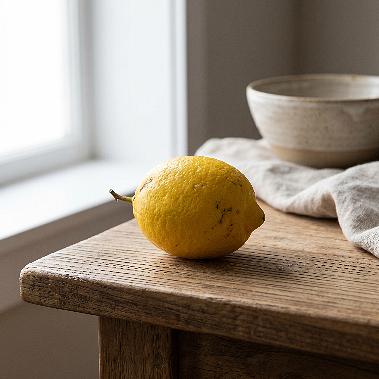
The most essential citrus in the kitchen — bright, intensely sour, with aromatic zest used as much as the juice. Lemons are the acid backbone of cooking worldwide, capable of brightening nearly any savory dish and balancing flavors across cuisines. Thinner-skinned lemons yield more juice; always zest before juicing and store zest frozen in ice cube trays.
Buying: Choose lemons heavy for their size — heaviness indicates juice content. The skin should be smooth and firm. Thinner skin generally means more juice. Room-temperature lemons yield more juice than cold — microwave for 10–15 seconds before juicing if refrigerated.
Storage: Store at room temperature up to 1 week, or refrigerate for 3–4 weeks. Zest before juicing and freeze zest in small portions. Cut lemons should be wrapped tightly and used within 3–4 days.
Finishing Touch: A squeeze of lemon at the end of cooking brightens virtually any savory dish — soups, pastas, roasted vegetables, grilled fish. Acid perception is one of the most powerful flavor modulators in cooking.
Lemon Curd: Cooked egg, butter, sugar, and lemon juice creates one of the great pastry preparations — intensely flavored, silky, and perfectly balanced between sweet and tart.
Preserved Lemons: Lemons fermented in salt for weeks become a North African staple, adding funky, intensely aromatic depth to tagines, grain salads, and dressings. The rind (not the pulp) is the prized ingredient.
Vinaigrette: Lemon juice can replace or supplement vinegar in dressings — brighter and more aromatic than vinegar alone.
Preserved Lemons: Pack whole or quartered lemons in coarse salt and lemon juice, ferment 4 weeks at room temperature. The salt and fermentation mellow the bitterness and concentrate aromatic oils.
Limoncello: Lemon peel steeped in high-proof alcohol then sweetened with syrup — a traditional Italian preparation.
Dehydrating: Lemon slices dehydrated until dry make beautiful cocktail garnishes and decorations with concentrated flavor.
Frozen Zest: Freeze zest in ice cube trays for year-round use in cooking and baking.
A medium lemon provides 88% of the daily value for vitamin C, essential for collagen synthesis, immune function, and iron absorption. Lemons are rich in eriocitrin, a flavonoid with demonstrated anti-inflammatory and cardiovascular-protective effects.
The white pith contains significant soluble fiber (pectin), which lowers LDL cholesterol and feeds beneficial gut bacteria. The zest contains the highest concentration of aromatic compounds and antioxidant flavones.
Lemons are hybrids of the citron and the bitter orange, developed over thousands of years through natural and human cultivation. Most citrus fruits in common use are actually hybrids of three original species: the citron, pomelo, and mandarin.
Lemons are between five and six percent citric acid — that's why they are so mouth-puckeringly tart. Lemon juice has a pH around 2, acidic enough to denature proteins, which is why lemon juice "cooks" fish in ceviche without heat.
The first known reference to lemons in print was in a 10th-century Arab treatise on agriculture, alchemy, astrology, and magic. The Eureka lemon is the most commonly grown cultivar in the US, favored for its year-round growing season and lack of thorns.
Lemon juice has long been used as a natural hair bleach and deodorant. Lemons are also great natural cleaners — their low pH makes the juice antibacterial, effective at deodorizing, disinfecting, and cutting through grease.
Citrus Greening Disease: The citrus industry faces a serious threat from Huanglongbing (citrus greening), a blight spread by insects that is ravaging groves across the world. Producers are fighting back by quarantining affected trees or using intensive treatments, making the long-term health of lemon orchards uncertain.
Pesticides: Conventional lemons are treated with the fungicide imazalil after harvest to prevent mold and stem rot, plus a coating of wax (often petroleum- or shellac-based). The EPA has labeled imazalil as "likely to be carcinogenic." A study in the journal Food Additives & Contaminants found that 95% of sampled citrus tested positive for pesticides. Buy organic when possible, and always scrub lemons thoroughly before zesting.
Geography: In the US, lemons are predominantly grown in California, followed by Arizona and Texas. Globally, the US ranks behind China, India, Mexico, Argentina, and Brazil in lemon production. Lemon trees thrive in warm, sunny, subtropical and Mediterranean climates.
Seasonality: Due to global imports and the dominance of the year-round Eureka and Lisbon varieties, lemons are available in supermarkets all year. The Meyer lemon is typically available from December through May.