Legumes, Beans & Nuts · Fall
Peanuts
Arachis hypogaea · Also: Groundnut, Goober, Monkey Nut
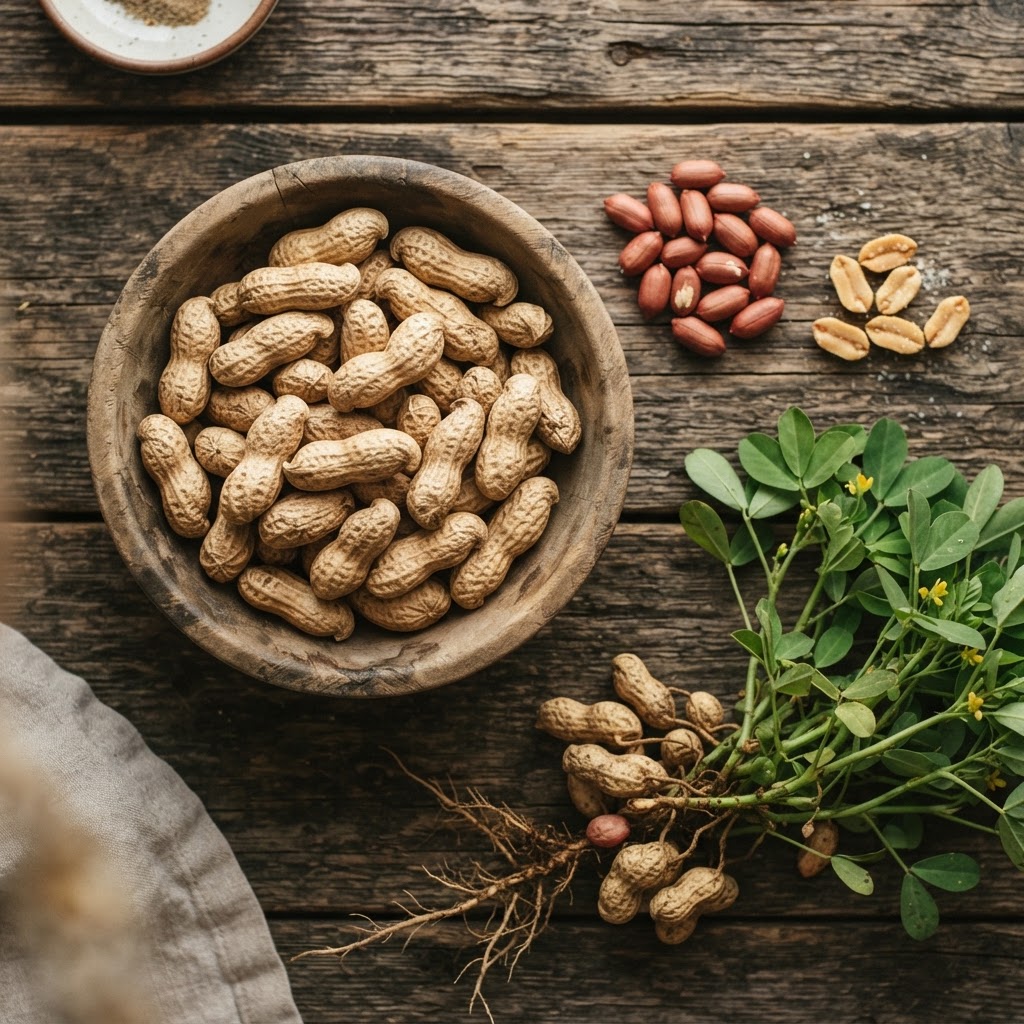
Peanuts are one of the culinary world's great surprises: not a true nut at all, but a legume. After their yellow flowers are pollinated, the plant sends a stalk down into the soil, where the pods mature underground — which is why peanuts are also called groundnuts.
Native to South America, peanuts were carried to Africa, Asia, and the American South, where they became cornerstones of each region's cooking: West African peanut stews, Indonesian satay sauces, Chinese boil-fries, and the American South's boiled peanuts and peanut butter. Roasting transforms their mild, raw flavour into the rich, nutty taste the world loves; peanut oil is a prized high-heat frying fat. Cheap, protein-dense, and endlessly versatile, the humble peanut is a global staple and a multi-billion-dollar crop — despite being, botanically, a bean that buries itself.
Virginia (Pod Type)
Large-podded peanuts with 1–2 big kernels per pod — the classic roasting and in-shell snacking peanut, the big crunchy nut of ballparks and holiday bowls.
Runner
The dominant U.S. commercial type — medium kernels, uniform size, ideal for peanut butter; the majority of peanuts grown in the American South are runners.
Spanish
Smaller, reddish-skinned peanuts with a nuttier, sweeter flavor and higher oil content — prized for peanut candies, boiled peanuts, and roasted snacks.
Valencia
Small, sweet peanuts, often three or more to a pod, with a bright-red skin — the favorite for boiled peanuts and the iconic peanut of the American South and Southwest.
Red-Skin (Raw)
Shelled peanuts with the thin red skin intact — sold raw for roasting at home, used whole in sweets, or for making peanut brittle and candies.
Blanched / Skinned
Shelled peanuts with the skins removed — pale and clean, the form used for peanut butter, flours, and baking where color and bitterness matter.
Buy in-shell peanuts that feel heavy for their size with clean, intact shells — avoid rattling, split, or stained pods, which mean old or damaged kernels. For shelled peanuts, look for plump, unbroken kernels with no musty smell.
Choose vacuum-sealed or fresh bulk peanuts from a high-volume shop — peanuts' high oil content makes them prone to rancidity once exposed to air and light.
For peanut butter, check the label: the best varieties contain only peanuts (and perhaps salt), with no hydrogenated oils or added sugar.
In-shell peanuts keep for months in a cool, dry place; shelled peanuts are best refrigerated in an airtight container for up to 6 months, or frozen for a year. Peanut butter keeps for several months at room temperature (natural separates; stir before use) and longer refrigerated. Peanut oil keeps a year sealed in a cool, dark cupboard.
Shelling: Crack the shell along its seam to release the 1–3 kernels inside. Boiled peanuts are the rare dish cooked in the shell.
Skinning (blanching): Roast or blanch shelled peanuts in boiling water for a minute, then rub in a towel to slip off the thin red skins, leaving clean pale kernels.
Roasting: Roast shelled peanuts at 175°C (350°F) for 10–15 minutes, stirring once, until golden and fragrant — this toasting step unlocks their signature nutty flavour.
Peanut Butter
Blend roasted peanuts with a little salt (and a touch of honey or oil) until smooth — the American staple, invented in the 19th century and now eaten worldwide.
Boiled Peanuts
A beloved Southern U.S. snack — green (fresh) peanuts boiled for hours in heavily salted water until soft, briny, and bean-like, sold at roadside stands.
Peanut Satay Sauce
Indonesian and Southeast Asian peanut sauce of ground peanuts, coconut milk, soy, and spices, served with grilled skewers — the signature of satay.
West African Peanut Stew (Maafe)
A rich stew of ground peanuts or peanut butter with tomato, meat, and vegetables — a comforting staple across West Africa, known as maafe or groundnut stew.
Roasted & Salted
The classic snack — oil-roasted or dry-roasted peanuts with salt, eaten by the handful or with drinks; the ballpark and pub favorite.
Peanut Brittle & Candies
Caramelised sugar and peanuts hardened into brittle, or the many peanut candies (chocolate-covered, honey-roasted) loved worldwide.
Drying & curing: Fresh-dug peanuts must be cured (dried) for 2–4 weeks before storage or roasting — the traditional farm step that stabilizes them for the pantry.
Freezing: Roasted or raw shelled peanuts freeze well for a year in airtight bags, preserving their oils and flavour.
Peanut oil & butter: Pressed peanut oil keeps for a year sealed; peanut butter keeps for months — both are traditional ways to preserve the crop as shelf-stable fats and spreads.
Peanuts are nutritionally a legume, not a nut: about 25 g of protein and 16 g of fat per 100 g, plus fiber, folate, niacin, manganese, and vitamin E — a dense, affordable source of plant protein.
Rich in heart-healthy monounsaturated fats and resveratrol (the same compound as in red wine), regular peanut consumption is linked to lower heart disease risk and steady blood sugar.
Note: Peanut allergy is one of the most common and severe food allergies, often lifelong — even trace amounts can trigger anaphylaxis in sensitive individuals, making label-reading critical.
Peanuts are not nuts at all — they are legumes, cousins of beans and lentils, and the only common legume whose pods mature underground after the plant buries its own fertilised flowers.
Native to South America, peanuts were carried by Spanish and Portuguese traders to Africa and Asia in the 1500s, and enslaved Africans brought them to the American South — the origin of the Southern peanut tradition.
George Washington Carver, the American agricultural scientist, popularised the peanut in the early 1900s by developing hundreds of uses for it, helping shift the South from cotton monoculture and rescue its soil.
The average American eats roughly 3 lb (1.4 kg) of peanut butter per year, and peanut butter sandwiches are a lunchbox staple; a single acre of peanuts makes about 30,000 peanut-butter sandwiches.
The American South loves a peanut festival, each one marking the autumn harvest:
National Peanut Festival
Dothan, Alabama, USA
🗓 November 2026 (annual)
Dothan, the Peanut Capital of the World, hosts a week-long festival each November celebrating the southern peanut harvest with pageants, peanut-boiling contests, a parade, and every peanut treat imaginable.
Peanut Festival
Suffolk, Virginia, USA
🗓 September–October 2026 (annual)
Suffolk's four-day Peanut Festival honors Virginia's peanut-growing heritage with carnival rides, a peanut-butter sculpture contest, and mountains of the region's famous large Virginia peanuts.
Peanut Butter Lovers' Month
USA, nationwide
🗓 November 2026
November is celebrated as Peanut Butter Lovers' Month across the U.S., marking the autumn harvest and the iconic American spread — a peanut-butter sandwich is eaten by the average American child hundreds of times a year.
Nitrogen-fixing: As a legume, peanuts fix their own nitrogen, enriching soil and reducing fertilizer needs — an excellent rotation and intercrop in the American South and across West Africa.
Water-thrifty & soil-building: Peanuts tolerate sandy, hot soils and need less water than tree nuts, and their roots improve soil structure — making them a relatively sustainable protein source, though they do demand a long warm growing season.
Global range: China and India are the world's largest peanut producers, followed by the U.S., Nigeria, and Senegal — peanuts thrive across warm temperate and tropical regions on six continents, from southern farm belts to West African village fields.
In-Season Recipes with Peanuts
Seasonal recipes featuring Peanuts right now
Coming Soon
All Other Recipes with Peanuts
1 recipe featuring Peanuts