
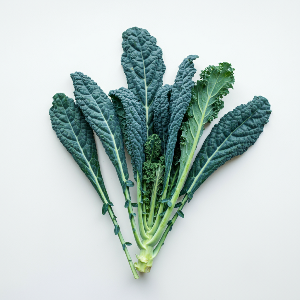
Kale
A hardy, ruffly Brassica that has evolved from highway median beauty to nutritional superstar. Descendant of ancient wild cabbage over 2,000 years old, kale is the more primitive ancestor of headed cabbage. Known as country people's 'ordinary greenstuff' throughout Europe until the Middle Ages, this frost-resistant green scores a perfect 1000 on the Aggregate Nutrient Density Index—making it one of the most nutrient-dense foods on the planet.
From the ruffled curly kale beloved in American salads to the dark, bumpy Lacinato kale of Tuscan ribollita, kale comes in a remarkable range of forms — each with its own texture, flavor intensity, and best culinary uses. Cold weather makes all kale sweeter and more tender.
Stay clear of wilted or browning leaves. Leaves and stalks should be firm and dry versus wilted and mushy. Available fresh bunched or pre-bagged (rinse bagged kale thoroughly). Multiple varieties available: curly kale, lacinato (dinosaur) kale, red Russian kale. Young spring leaves more tender. Frost-sweetened kale available in cold months. Look for vibrant green color (or purple/red in colored varieties). Seek organic or talk to farmers about growing methods.
Kale varieties differ widely in texture, flavor intensity, and best uses. Click any variety to explore its character and how to use it.
Curly Kale
The most common supermarket kale — ruffled, hearty leaves with a robust, slightly bitter flavor
Lacinato / Dinosaur
Dark, bumpy, strap-like leaves with a sweeter, more tender texture — the Tuscan kale classic
Red Russian
Flat, deeply lobed leaves with purple-red stems — the most tender and mildest-flavored kale
Baby Kale
Young, small leaves of any kale variety — tender enough to eat raw, mild and salad-ready
Siberian Kale
Extra-cold-hardy variety with broad, smooth leaves — sweeter after frost, great cooked or raw
Ornamental Kale
Stunning pink, white, and purple decorative varieties — fully edible with a mild, tender flavor
Keep moisture to minimum in refrigerator. Store in loosely closed bag or sealed container. Overwinters nicely in gardens, readily sprouts young tender leaves with spring arrival. For longer storage: separate stalks from florets, parboil three minutes, shock in ice water bath, drain well, pat dry, place in freezer bags.
Steamed: Gentle cooking preserves nutrients. Stir-fried: Quick high-heat preparation. Roasted: Kale chips and roasted preparations. Raw: Massaged kale salads. Smoothies: Blended with fruits for nutrient boost. Wilted: Added to soups and stews. Mashed: Combined with potatoes. Pesto: Blended with nuts, oil, cheese. Sautéed: Quick pan cooking with garlic.
Freezing: Parboil three minutes, shock in ice water bath, drain, pat dry, place in freezer bags. Kale pesto: Great preservation method storing well in freezer. Use on sandwiches, pizza dough, pasta, smeared onto roasted vegetables. Dehydrating: Kale chips for shelf-stable snacking.
Scores perfect 1000 on Aggregate Nutrient Density Index (ANDI)—nutrients per calorie measurement implemented by Whole Foods Market. Along with collards, mustard greens, and watercress, kale achieves highest possible nutritional score. Anti-inflammatories: Omega-3 fatty acids and Vitamin K. Antioxidants: carotenoids (linked to positive mental outlook), Vitamins C and E, dozens of flavonoids in pigments. Cancer-fighting glucosinolates. One cup (36 calories) contains: three grams fiber, 93mg calcium, 2.5 grams protein. Caveat: high oxalate levels possible concern for people with kidney stones. 'Goitrogenic' claims overblown; does not interfere with thyroid function contrary to popular belief. Check with doctor if concerns.
Referred to as 'cole' in England, 'kail' in Scotland where everyone had 'kailyard' feeding humans and livestock. 'Come to kail' common Scottish expression referring to main meal of day. Thomas Jefferson experimented with several kale varieties at Monticello estate in early 1800s. Central to Britain's Dig for Victory campaign during WWII encouraging Britons to turn lawns into edible gardens. Earliest cultivated cabbage record (Greek literature around 600 BCE) actually reference to kale. First clear reference to head cabbage not until 16th century Paris. More primitive ancestor of headed cabbage; country people's ordinary greenstuff throughout Europe until Middle Ages when headed cabbages bred.
Available Near You
Enter your ZIP code to find farms with kale near you.
Recipes with Kale
Coming Soon