
Melon Variety · Summer
Canary Melon
Also: Juan Canario, Amarillo · Cucumis melo var. inodorus
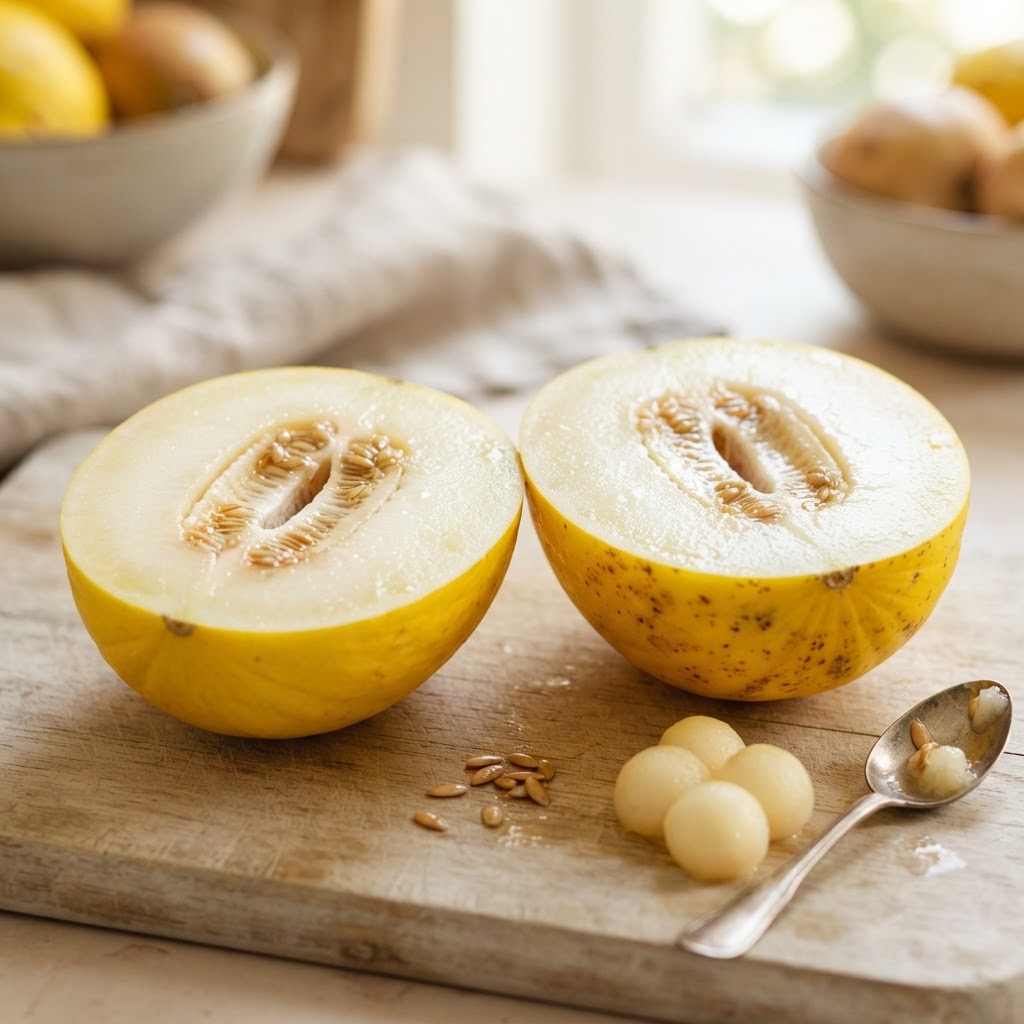
Named for its brilliant bright yellow color resembling a canary bird, this elongated smooth-skinned melon has ivory-white to pale yellow flesh with a mild, sweet flavor and a slight tang. Enormously popular in Spain and throughout the Mediterranean, it's increasingly available in US farmers' markets. Belongs to the same winter melon family as honeydew and casaba.
A ripe Canary melon is uniformly bright yellow — not greenish or pale. The rind should feel firm. Press the blossom end: slight give indicates ripeness. The fragrance is subtler than cantaloupe but should be faintly sweet and pleasant.
Unlike cantaloupe, the Canary melon will continue to develop sweetness after harvest to some degree, but the best flavor comes from field-ripened fruit.
Ivory-white flesh that is crisp and juicy when slightly underripe, becoming softer and more yielding at peak ripeness. The flavor is mild and sweet with a distinctive slight tang or tartness — less musky than cantaloupe and more interesting than honeydew. Sometimes described as a cross between a pear and a honeydew.
Tapas: In Spain, Canary melon is served simply sliced or wrapped in jamón serrano — the Spanish equivalent of prosciutto e melone.
Fruit Salads: Its bright yellow exterior and white flesh are visually striking in fruit salads and platters.
Sorbets: Mild sweetness makes it ideal for elegant sorbets and granitas with lime or mint.
Salads: Cubed Canary melon in a salad with arugula, prosciutto, burrata, and balsamic is a stunning summer dish.
Canary melons have good shelf life compared to cantaloupes — whole melons keep up to 2 weeks refrigerated or 5–7 days at room temperature. The smooth rind is lower food safety risk than cantaloupe. Store cut melon in an airtight container in the refrigerator.
In-Season Recipes with canary melon
Seasonal recipes featuring canary melon right now
Coming Soon
All Other Recipes with canary melon
Coming Soon