Legumes, Beans & Nuts · Late Summer–Fall
Almonds
Prunus dulcis · Also: Sweet Almond, Bitter Almond
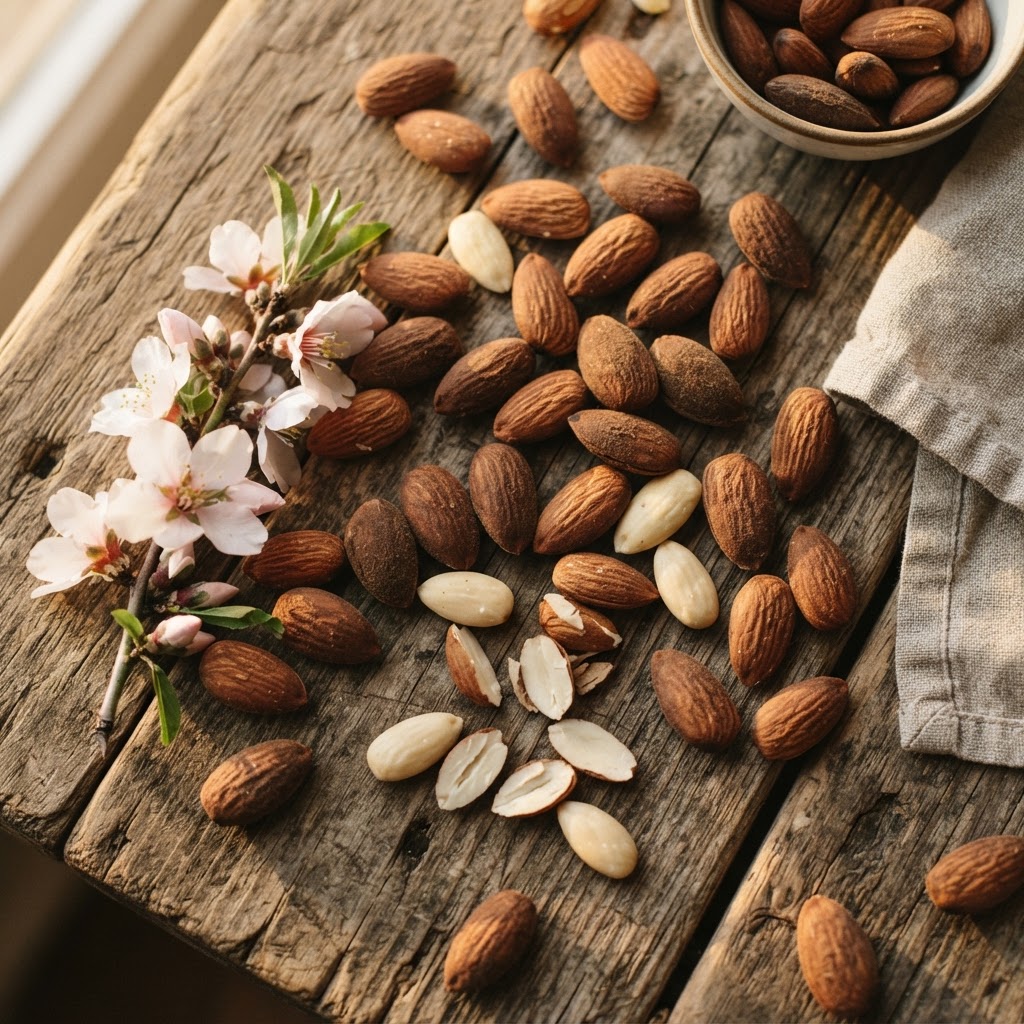
Almonds are the seeds of the almond tree's stone fruit — technically a drupe, not a true nut. Cultivated for thousands of years from the Mediterranean to Central Asia, they are one of the world's most beloved nuts, prized for their sweet, milky flavor and remarkable versatility.
California's Central Valley grows roughly 80% of the global supply, and the almond harvest runs from August through October. From almond milk and marzipan to almond flour pastries and roasted snacks, the almond carries a gentle sweetness that defines cuisines from Spain to the Levant to California.
Nonpareil
The dominant California variety — thin, papery shells and a flat, pale kernel with a mild, sweet flavor. Easy to blanch and the standard for snacking and baking.
Marcona
The queen of Spanish almonds — shorter, rounder, and sweeter than California types. Traditionally fried in olive oil and salted; the classic tapas almond.
Carmel
A popular California pollinator variety with a slightly darker, richer skin and soft shell. Often sold as a whole-nut snack or used for roasting.
Mission
A smaller, darker-skinned almond with a strong, robust flavor. Holds its shape and crunch well, making it a favorite for roasting and almond butter.
Spanish / Valencia
Rougher, thicker-shelled Mediterranean almonds used extensively in Spanish turron and marzipan; prized for intense flavor.
Bitter Almond
A separate variety (Prunus dulcis var. amara) containing amygdalin, which releases cyanide — never eaten raw but used in tiny amounts to make almond extract and amaretto.
Look for almonds that feel heavy and plump with intact, unbroken skins. Avoid any that look shriveled, oily, or dusty — a sign of rancidity, since almonds' high oil content makes them perishable once shelled.
Whole almonds in the shell keep longest; shelled almonds should smell faintly sweet and nutty, never bitter or paint-like. For baking, sliced and slivered almonds should be pale and crisp with no dark spotting.
Peak harvest runs August through October, and freshly harvested almonds are noticeably sweeter and moister than the long-stored supply the rest of the year.
Almonds turn rancid quickly at room temperature once shelled. Store them in an airtight container in a cool, dark cupboard for up to a month, refrigerate for up to six months, or freeze for a year or more. Almond flour and meal are even more perishable — always keep them refrigerated or frozen.
Blanching: Drop shelled almonds into boiling water for one minute, then slip off the brown skins by pinching — the kernels pop right out. This yields smooth, pale nuts ideal for marzipan and fine almond flour.
Almond flour vs. meal: Blanch and grind to a fine powder for almond flour (used in macarons and delicate cakes). Almond meal is ground with the skin, coarser and darker, ideal for rustic baking and coatings.
Almond milk: Soak raw almonds overnight, blend with water, and strain through a nut-milk bag for fresh, creamy almond milk — far richer than the store-bought kind.
Roasting: Toast almonds in a dry skillet or a 350°F oven for 8–10 minutes to deepen their flavor and crisp the texture before snacking or baking.
Roasted Snack
Toss almonds in olive oil and salt and roast until golden — the classic Spanish Marcona preparation and a staple of tapas boards worldwide.
Almond Milk
Blend soaked almonds with water and strain for fresh dairy-free milk; sweeten with dates or honey and flavor with a touch of vanilla.
Marzipan
Grind blanched almonds with sugar and a little egg white or rose water into a pliable paste — sculpted into fruits in Spain and central Europe.
Almond Flour Baking
Use finely ground almond flour in macarons, financier cakes, and gluten-free pastries for a tender, moist, nutty crumb.
Almond Butter
Blend roasted almonds until smooth and creamy for a rich spread — a peanut-butter alternative that's naturally paleo-friendly.
Crust & Topping
Crush almonds for a crunchy coating on fish or chicken, or sprinkle sliced almonds over salads, grain bowls, and tarts.
Freezing: Whole or sliced almonds freeze perfectly for a year or more — measure out portions and thaw as needed for baking and snacking.
Flour & meal: Keep almond flour in the freezer to protect its delicate oils; it bakes straight from frozen with no need to thaw.
Candied (Garrapiñadas): Coat almonds in sugar and a splash of water, cooking until caramelized — a traditional Spanish preserve that lasts weeks in a tin.
Almonds are nutrient-dense — a quarter cup provides about 6 grams of protein, 3.5 grams of fiber, and a generous dose of heart-healthy monounsaturated fat, the same type found in olive oil.
They are one of the best dietary sources of vitamin E (an antioxidant), and supply magnesium, manganese, calcium, and riboflavin.
Regular almond consumption is linked to improved cholesterol, steadier blood sugar, and satiety — and almond milk is a naturally lactose-free, dairy-free alternative, though it's lower in protein than cow's milk unless fortified.
Almonds aren't true nuts at all — they're the seed inside the fruit of the almond tree, a close relative of peaches, cherries, and apricots.
Bitter almonds contain amygdalin, which releases cyanide when chewed raw, so they're banned from sale as whole nuts in many countries and used only to make extract and amaretto liqueur.
California grows roughly 80% of the world's almonds, and the almond is the state's top agricultural export.
The almond tree's pale pink-and-white blossoms herald spring across the Mediterranean — Mallorca and Provence celebrate their bloom with dedicated festivals each February.
Almond blossoms and harvests inspire festivals across the Mediterranean and California:
California Almond Festival
Escalon & the Central Valley, CA, USA
🗓 February 2026 (annual)
Held during the almond blossom season, celebrating California's billion-dollar crop with orchard tours, almond-based cooking contests, and tastings of everything from almond butter to marzipan.
Festa de la Flor d'Ametller (Almond Blossom Festival)
Mallorca, Spain
🗓 Late January – February 2026
The island's almond groves explode into pink-and-white bloom each winter. Towns like Son Servera celebrate with blossom walks, local almond sweets (gato d'ametlla), and markets.
Feria de la Almendra (Almond Fair)
Alicante & Andalusia, Spain
🗓 October 2026 (harvest season)
Harvest-time fairs across southern Spain honor the prized Marcona almond, with tastings of turron, almendras garrapiñadas (candied almonds), and traditional almond cakes.
Water use: Almonds are a high-water crop — a single almond requires roughly a gallon of water to grow, raising sustainability concerns in drought-prone California. Efficient drip irrigation and groundwater management are key to reducing impact.
Bee dependence: Almond pollination is the largest managed-pollination event on earth, drawing more than half of all U.S. honeybee hives to California each February — making bee health central to the almond supply.
Global range: Almonds flourish across the Mediterranean (Spain, Italy, Morocco) and California, thriving in mild winters, hot dry summers, and well-drained soils.
In-Season Recipes with Almonds
Seasonal recipes featuring Almonds right now
Coming Soon
All Other Recipes with Almonds
Coming Soon