Grains & Seeds · Late Summer & Fall
Wild Rice
Zizania spp. · Also: Manoomin, Canadian Rice, Indian Rice, Water Oats, Cinnamon Rice
Wild rice is the sacred grain of the North American lakes — a tall, graceful aquatic grass that grows in the shallow waters of the Great Lakes and northern wetlands, bearing long, slender, dark brownish-black grains that have sustained Indigenous peoples for millennia. Not true rice (which is Asian Oryza sativa), wild rice is instead a group of native North American grasses (Zizania) — four species, three annual and one perennial — gathered from the wild by canoe and knock-stick, and increasingly cultivated in paddies as 'paddy-grown wild rice,' though the truly wild, hand-harvested grain remains the prized original. Manoomin, as the Anishinaabe call it, is a sacred gift, the 'food that grows on the water,' the grain at the center of an Indigenous foodway and a prophecy.
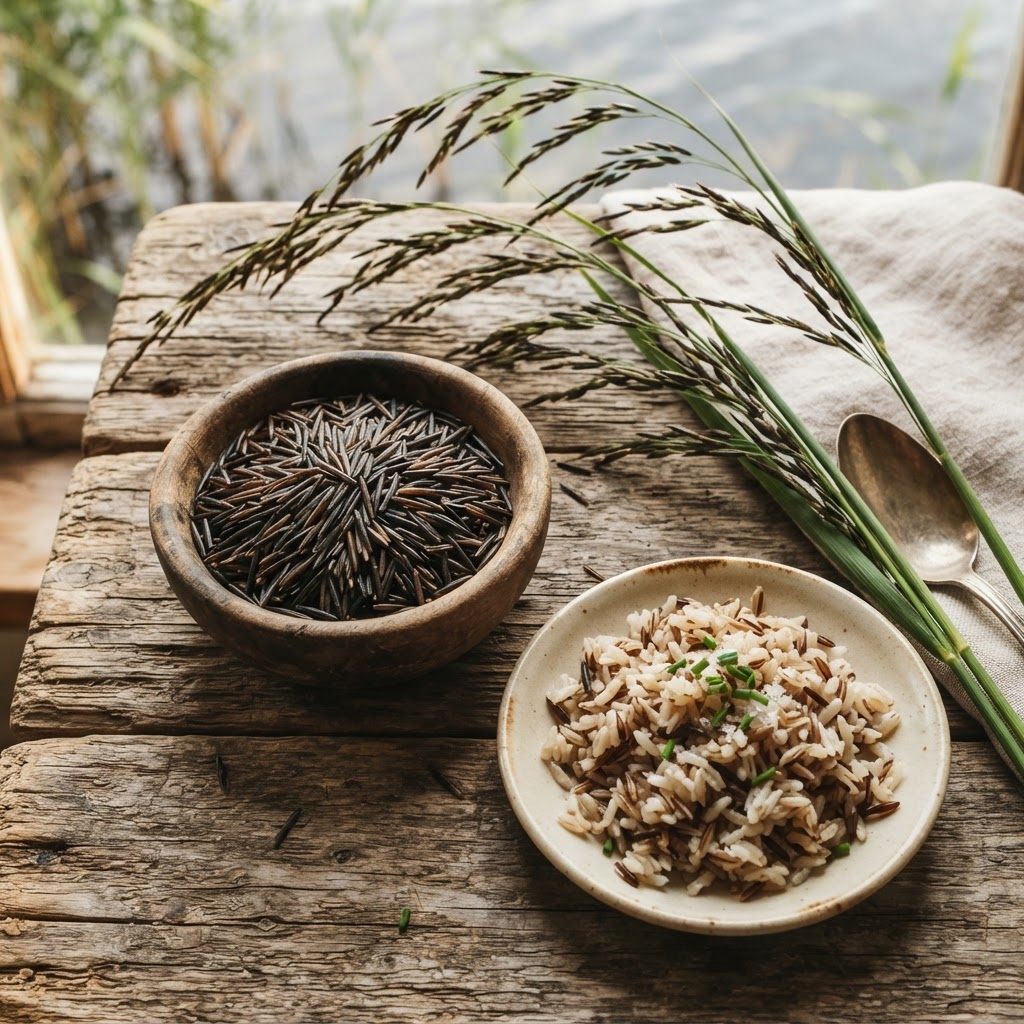
The long, dark grains cook into a chewy, nutty, earthy dish with a deep, almost smoky flavor and a striking dark color that holds its own in soups, salads, pilafs, and stuffings — often blended with white rice for color and contrast, or eaten on its own as a luxurious, full-flavored grain. Wild rice takes longer to cook than white rice, splitting open to reveal the pale interior when tender, and it is rich in protein, fiber, and minerals. It is the grain of the Northwoods harvest, of autumn canoes and golden leaves, and a uniquely North American cereal — a grain gathered from the wild by peoples who have stewarded the rice lakes for thousands of years, and a sacred food whose harvest is both sustenance and ceremony.
Northern Wild Rice (Zizania palustris)
The classic, hand-harvested wild rice of the Great Lakes — long, slender, very dark brown to black grains with a chewy texture and deep, nutty, smoky flavor; the most prized form, gathered by canoe from the lakes of Minnesota, Wisconsin, Ontario, and Manitoba; the sacred manoomin of the Anishinaabe and the grain most people mean by 'wild rice.'
Paddy-Grown Wild Rice (Cultivated)
Wild rice grown in man-made paddies and mechanically harvested — shorter, more uniform grains with a milder, less smoky flavor than truly wild rice; widely available and more affordable, though lacking the depth and story of the hand-harvested grain; often labeled simply 'wild rice' and sold mixed with the wild-harvested form.
Texas Wild Rice (Zizania texana)
A rare, endangered perennial species found only in the San Marcos River of Texas — slender, long-leaved and not typically harvested for food; a conservation priority, showing the diversity of the wild rice grasses and their dependence on clean, flowing water.
White Wild Rice (Zizania aquatica var. latifolia)
An annual species of the eastern United States with lighter-colored grains and a milder flavor than northern wild rice; less commonly harvested and more often a wetland plant, but occasionally gathered and eaten historically.
Manchurian Wild Rice (Zizania latifolia)
An East Asian relative grown not for its grain but for its swollen, edible stems — infected by a fungus, the stems swell into the crisp, tender vegetable called 'water bamboo' or 'coba,' prized in Chinese and Japanese cooking; the grains are rarely eaten, but the plant shows the far reach of the wild rice family.
Cooked & Blended Wild Rice
Wild rice is often sold cooked (frozen or canned) or pre-blended with white or brown rice in 'wild rice blends' for ease and visual contrast; the blends stretch the costly wild rice and pair its dark, nutty grains with milder rice for pilafs and stuffings.
For the true, hand-harvested wild rice, look for long, uneven, very dark brown to near-black grains sold as 'hand-harvested,' 'canoe-harvested,' or 'lake wild rice' — often from Indigenous harvesters, tribal cooperatives, or specialty suppliers of Minnesota, Wisconsin, and Ontario. The hand-harvested grain is more expensive but has a deeper, smoky, nutty flavor and a chewy texture that paddy-grown rice cannot match.
Paddy-grown wild rice is shorter, more uniform, and milder; widely sold in supermarkets, it is a good everyday option for soups, salads, and stuffings. Read the label — 'cultivated' or 'paddy' indicates the farmed grain. True wild rice may be labeled 'wild,' 'hand-harvested,' 'canoe-harvested,' or 'Minnesota wild rice' and often carries the name of the lake or tribal cooperative.
Season: the wild harvest runs late August through September, and the fresh-dried grain is available in autumn and year-round from specialty sellers; paddy-grown wild rice is available year-round. Seek out tribal and local sources for the most authentic and best-tasting grain, and to support the harvesters who steward the rice lakes.
Keep dried wild rice in an airtight container in a cool, dry, dark place — the fully dried grain keeps for a year or more, and the hand-harvested grain stores especially well, a reliable food for the long northern winter. Cooked wild rice keeps 4–6 days refrigerated and freezes well for months; freeze in portions for easy use in soups, salads, and stuffings. Because wild rice is a whole grain, it keeps its nutrition and flavor far longer than polished white rice.
Harvesting (ricing): The traditional harvest is done by canoe — two people paddle into the shallow lakes at dawn, one working the canoe through the rice beds while the other uses two cedar 'knocking sticks' to gently bend the tall stalks over the boat and tap the ripe grains into the canoe. Only ripe grains fall; the unripe are left to ripen for the next pass, and some grains always fall back into the lake to seed the next year. This gentle, selective harvest has sustained the rice beds and the people for millennia.
Curing & parching: The freshly harvested grain is 'green' and must be cured — traditionally spread on birch or canvas to dry in the sun, then parched over a slow fire or in a parcher, roasting the grain and drying it fully. Parching gives wild rice its characteristic smoky, nutty flavor and dark color, and preserves the grain for long storage. Hand-parched, hand-harvested wild rice carries the smoke and the story of the harvest.
Hulling & winnowing: The parched grain is hulled (the outer husk removed) by dancing, treading, or rubbing — traditionally in a pit — and then winnowed in a birch-bark tray, tossing the grain in the wind so the chaff flies away and the clean grains remain. The finished grain is the long, dark, glossy wild rice ready for the pot. Paddy-grown wild rice is processed mechanically, without the fire and the hands that give the wild grain its depth.
Simmered (Basic)
Rinse 1 cup wild rice and simmer in 3–4 cups water or broth for 45–60 minutes until the grains split open and curl to reveal the pale interior; drain any excess. The result is chewy, nutty, and deep-flavored — serve simply with butter and salt, or use as a base for pilafs, salads, and bowls.
Wild Rice Soup
The classic Northwoods dish — wild rice simmered in a creamy broth with mushrooms, celery, onions, and often chicken or turkey, finished with cream; a warming autumn and winter soup that showcases the grain's nutty depth, beloved in Minnesota and across the Upper Midwest.
Pilafs & Blends
Wild rice cooked with sautéed aromatics, mushrooms, and broth, often blended with white or brown rice for color and contrast; a festive side dish for holidays and a natural pairing with poultry, game, and autumn vegetables, the dark grains a striking accent.
Salads & Grain Bowls
Cooked, cooled wild rice tossed with greens, dried fruit, toasted nuts (pecans, walnuts), and a vinaigrette — its chewy texture and nutty flavor hold up beautifully to bold dressings, and the dark grains are a stunning visual in salads and grain bowls.
Stuffings & Dressings
Wild rice is a classic holiday stuffing grain — mixed with onion, celery, sage, broth, and sometimes sausage or oysters; a traditional Thanksgiving and game-night stuffing, and a natural with roast turkey, duck, and goose, the grain's depth complementing the savory bird.
Wild Rice Cereal & Porridge
Cooked wild rice simmered into a warm breakfast porridge with maple syrup, cream, and berries — a nod to Indigenous breakfasts and a rich, nutty alternative to oatmeal; the grain's depth makes a warming, sustaining morning dish.
Drying & parching: The parched, fully dried wild rice keeps for a year or more — a reliable food for the long northern winter and the journey; Indigenous peoples stored wild rice in birch-bark containers and caches, and the grain was a key winter food and trade good. Parching was both preservation and flavor — the slow roast that makes wild rice wild rice.
Freezing cooked: Cooked wild rice freezes well for months in airtight containers — a practical way to keep the cooked grain on hand for soups, salads, and stuffings; freeze in portions for quick use, since the long cooking time makes it worth cooking a big batch at once.
Canning & soup: Wild rice soup and prepared dishes can be frozen or pressure-canned for shelf-stable storage; the grain holds its texture well in soup and reheats beautifully, making wild rice soup a popular make-ahead and freezer meal across the Northwoods.
Wild rice is one of the most nutritious of all grains — higher in protein than white rice, rich in dietary fiber, and a good source of B vitamins (especially niacin, riboflavin, and thiamin) and minerals including magnesium, phosphorus, zinc, and potassium; it is also notably high in antioxidants, giving it anti-inflammatory and heart-protective benefits.
Wild rice is naturally gluten-free and has a lower glycemic index than white rice, providing slow, sustained energy — a sustaining grain for the northern winter and a nutritious whole grain for everyday eating. Its dark color signals high antioxidant content, particularly anthocyanins, the same compounds found in dark berries.
As a whole, unrefined grain, wild rice supports digestion, blood sugar control, and heart health; it is low in fat and sodium and high in complex carbohydrates and fiber, and its protein content (around 14 g per cooked cup) is unusually high for a grain — a key reason it has sustained the peoples of the northern lakes for thousands of years.
Wild rice is not actually rice — it is a group of four native North American grasses (Zizania), only distantly related to Asian rice (Oryza sativa); the name 'wild rice' comes from its appearance and aquatic habit, but botanically it is a cousin, not a sibling, of the rice of Asia.
For the Anishinaabe (Ojibwe) and Menominee peoples, wild rice (manoomin) is a sacred gift from the Creator and the center of their culture and migration story; the Anishinaabe prophecy told them to travel west until they found 'the food that grows on the water,' and when they reached the wild rice lakes of the Great Lakes region, they knew they were home — manoomin is both food and relative, and its harvest is a sacred act.
The traditional wild rice harvest is done by canoe with cedar knocking sticks — two people per canoe, one poling through the rice beds at dawn and the other bending the stalks and tapping the ripe grains into the boat; the gentle, selective harvest leaves unripe grains to ripen and lets some seed fall back to the lake, sustaining the beds year after year, a harvest practiced for thousands of years.
Wild rice is the state grain of Minnesota and a defining food of the Upper Midwest; the hand-harvested grain is darker, longer, and more flavorful than the paddy-grown rice, and the two are easily told apart — the wild grain is uneven and smoky, the paddy grain uniform and milder. Manoomin remains a living tradition, harvested by tribal members and sold through cooperatives that protect both the grain and the lakes it grows in.
From the sacred manoomin harvest to Northwoods autumn festivals, wild rice is celebrated across the Great Lakes:
Manoomin Harvest (Wild Rice Gathering)
Great Lakes region (Minnesota, Wisconsin, Ontario, Manitoba)
🗓 Late August–September 2026
For the Anishinaabe (Ojibwe), Menominee, and other Indigenous peoples of the Great Lakes, the manoomin (wild rice) harvest is the most sacred and central event of the year. Families paddle canoes through the shallow lakes at dawn, using cedar knocking sticks to bend the tall stalks over the boat and tap the ripened grains into the canoe — the ancient, gentle harvest called 'ricing.' The harvest is both a physical gathering and a spiritual ceremony; manoomin is considered a sacred gift from the Creator, and its harvest is woven into songs, stories, and the identity of the people. The opening of the harvest is marked by ceremony and thanksgiving.
Wild Rice Festivals of the Northwoods
United States (Minnesota & Wisconsin)
🗓 September 2026
Across northern Minnesota and Wisconsin, autumn brings wild rice festivals that celebrate both the Indigenous harvest and the Northwoods tradition — communities gather for wild rice cooking, canoe ricing demonstrations, music, and feasts. Towns like Cass Lake, Deer River, and the White Earth and Leech Lake reservations hold events honoring manoomin, the grain that has sustained the people and the wetlands for millennia. These festivals are both a harvest celebration and a gathering to protect the wild rice waters.
Manoomin & the Anishinaabe Migration Prophecy
Great Lakes & Eastern Canada
🗓 Spiritual — tied to harvest season
The Anishinaabe migration story tells of a prophecy to travel west until they found 'the food that grows on the water' — manoomin, wild rice — and there they would make their home. Finding the wild rice lakes of the Great Lakes region, the Anishinaabe settled there, and wild rice became the center of their culture and sustenance. The harvest remains a spiritual and cultural keystone, a living connection to the prophecy and the land, and manoomin is honored in ceremonies and daily life as a sacred relative.
Wild & wetland-dependent: True wild rice grows only in the shallow waters of clean lakes and slow rivers — it depends on clear, unpolluted water and natural lake levels, making it sensitive to pollution, dams, and water-level changes; protecting the rice lakes means protecting the water, and the harvest is a measure of the health of the wetlands.
Indigenous stewardship: The wild rice harvest has been stewarded by Indigenous peoples for thousands of years, and the traditional canoe harvest is itself a form of conservation — selective, gentle, and in balance with the rice beds; supporting hand-harvested, Indigenous-sourced wild rice supports both the harvesters and the wetlands they protect, and the continuation of a sacred foodway.
Paddy-grown vs. wild: Paddy-grown wild rice is more sustainable in yield and availability but lacks the habitat and cultural value of the wild grain; the wild harvest is lower-impact but limited, and the two systems serve different needs — the paddy grain for everyday, the wild grain for ceremony and depth. Choose wild when you can, to support the lakes and the people.
Global range: Wild rice is native to North America and East Asia; the northern wild rice (Zizania palustris) of the Great Lakes is the main harvested grain, with related species in the eastern U.S., the San Marcos River of Texas (endangered), and East Asia (where the stems, not the grains, are eaten); it is a uniquely North American staple, the grain of the Northwoods and the northern waters.
In-Season Recipes with Wild Rice
Seasonal recipes featuring Wild Rice right now
Coming Soon
All Other Recipes with Wild Rice
Coming Soon