Legumes, Beans & Nuts · Fall
Walnuts
Juglans regia · Also: English Walnut, Persian Walnut, Common Walnut
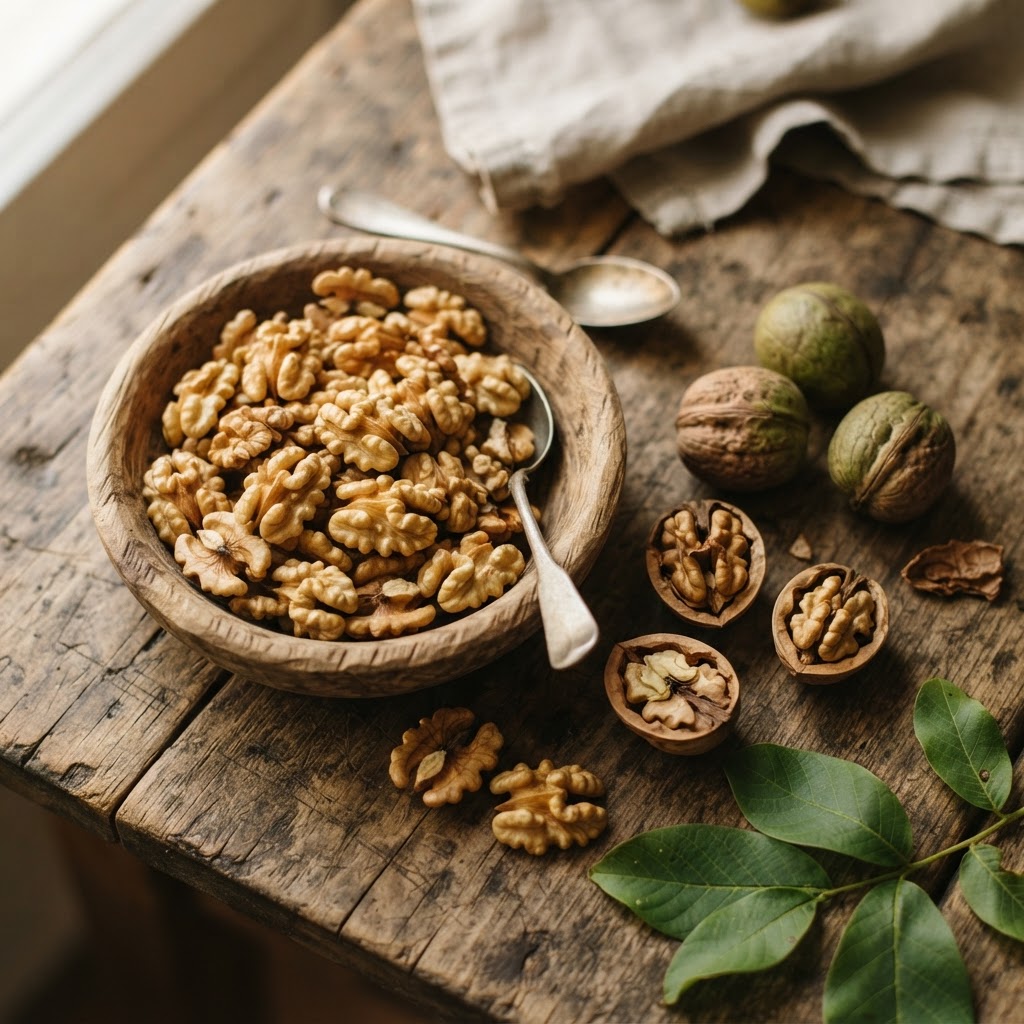
Walnuts are the wrinkled, brain-shaped seeds of one of the oldest nut trees in the world — native to Persia and Central Asia, where walnut forests have grown for millennia. The English (Persian) walnut is the everyday walnut of bakers and cooks: a pale golden kernel in a hard shell, buttery and slightly bitter, rich in oil and unmistakably nutty.
Walnuts are a cornerstone of autumn baking — the nut of brownies, banana bread, and walnut cake — and of savory dishes from Italy's walnut sauce (salsa di noci) for pasta to France's AOP Périgord walnuts and walnut oil. They are harvested in autumn when the green husk splits and the shell hardens, then dried and cured for months. From the ancient walnut forests of Kyrgyzstan to the orchards of California — now the world's largest producer — the walnut's rich, oily, earthy flavor and tender crunch make it one of the most beloved and versatile nuts of the harvest season.
Chandler (California)
The dominant California walnut — light, plump kernels with mild, buttery flavor and thin shells; the workhorse of commercial walnuts, harvested in late autumn.
Franquette (French)
A classic French heirloom walnut of the Périgord — elongated, with a rich, complex flavor and thicker shell; one of the AOP Périgord walnut varieties, prized for eating out of hand.
Corne & Grandjean (Périgord AOP)
The protected AOP Périgord varieties — large, tender, and sweet, with the protected designation of origin; considered among the finest table walnuts in the world.
Sorrento (Italian)
The famous Italian walnut of the Sorrento peninsula — tender, sweet, and pale; the traditional walnut of Italian walnut cake, liqueur (nocino), and ravioli fillings.
Black Walnut (American)
A distinct species (Juglans nigra) native to eastern North America — small, intensely flavored, and hard-shelled; prized for baking and for its strong, wild, earthy flavor, but difficult to shell.
Hartley
An older California variety — large, well-sealed shells and light kernels; still grown and valued for its classic walnut flavor and reliable harvest.
Buy in-shell walnuts that feel heavy for their size, with clean, uncracked shells and no signs of mold or weevil holes; shake a walnut — a rattling kernel means it has dried out and is stale. For shelled walnuts, choose plump, pale-golden halves with smooth, unblemished surfaces; avoid shriveled, dark, or oily kernels.
Walnuts turn rancid faster than most nuts because of their high polyunsaturated oil — smell them for freshness: a sweet, nutty aroma is good, a painty or bitter smell means rancidity. Buy from a shop with high turnover and, for the best quality, seek out fresh-harvest walnuts in autumn and winter.
Season: fresh walnuts are harvested in autumn (September–October) and cure through the winter; the freshest walnuts are available from late autumn to early spring, with older stock dominating the market through summer.
Walnuts are fragile — their high oil content makes them the most perishable of common nuts. Keep in-shell walnuts in a cool, dry place for up to 3 months; shelled walnuts in an airtight container in the fridge for up to 6 months, or in the freezer for up to a year. Always store away from light, heat, and air, and taste-test older walnuts before baking — rancid walnuts will ruin a cake.
Harvesting: Walnuts are harvested in autumn when the green outer husk splits and the hard shell inside darkens; growers shake the branches (or wait for the nuts to fall) and gather the fallen nuts to be hulled and dried.
Hulling & drying: The green husk is removed (it stains everything brown — historically used as a dye), then the in-shell walnuts are washed and dried to about 8% moisture for long storage; California walnuts are mechanically dried in large dehydrators.
Shelling & toasting: Walnuts are cracked and sorted into halves and pieces for sale; for cooking, a brief toasting in a dry pan or oven (8–10 minutes at 175°C / 350°F) brings out their aroma and removes the slight bitterness of the papery skin.
Baking (Brownies, Cakes, Bread)
The classic walnut use — folded into brownies, banana bread, carrot cake, and coffee cake, and the base of French walnut cake (torte de noix) and Italian torta di noci; toasting before baking deepens the flavor.
Salsa di Noci (Walnut Sauce)
A classic Italian sauce of ground walnuts, garlic, bread, and olive oil — the Ligurian cousin of pesto, served with pasta (especially pansoti and ravioli) and a hallmark of northern Italian cooking.
Walnut Oil & Vinaigrette
Cold-pressed walnut oil — rich, nutty, and deeply aromatic — is drizzled over salads, especially with endive, pear, and blue cheese; pressed in Périgord and Burgundy, it is a prized finishing oil.
Toasted & Salted
Toasted walnuts, lightly salted, are eaten out of hand or scattered over salads, roasted vegetables, and cheeses; toasting tames the skin's bitterness and brings out the buttery, aromatic flavor.
Nocino (Walnut Liqueur)
An Italian digestif made by steeping green unripe walnuts in alcohol with spices and sugar — dark, bittersweet, and aromatic; traditionally started on St. John's Day (June 24) and bottled for winter sipping.
Stuffings & Savory Dishes
Chopped toasted walnuts add crunch to stuffings, roasted Brussels sprouts, grain salads, and Middle-Eastern rice pilafs; a savory counterpart to their usual sweet-baking role.
Drying & curing: Fresh-harvested walnuts are dried to low moisture and cured for weeks, stabilizing their oils and developing flavor — the dried in-shell nuts keep for months in a cool, dry place.
Pressing into oil: Walnuts are cold-pressed to yield a rich, fragrant oil prized for finishing; the pressed oil keeps 6–12 months refrigerated and is both a preservation method and a delicacy in its own right.
Steeping in alcohol: Green unripe walnuts are steeped in alcohol for nocino and walnut wine — a centuries-old method of preserving the harvest as a digestif, bottled for winter and aged for years.
Walnuts are the highest-omega-3 of all nuts — about 65% of their oil is polyunsaturated, rich in alpha-linolenic acid (ALA), the plant form of omega-3; a handful a day supports heart and brain health.
They supply about 15 g of protein and 7 g of fiber per 100 g, plus significant magnesium, phosphorus, copper, and manganese, and are one of the best nut sources of antioxidants — especially in their papery skin.
Regular walnut consumption is linked to lower cholesterol, improved blood-vessel function, and reduced inflammation — among the most heart-healthy nuts, and the subject of more nutrition research than any other nut.
Walnuts are one of the oldest tree foods — archaeological evidence shows walnuts were eaten in Persia and the Mediterranean over 9,000 years ago, and the walnut's native range stretches from the Balkans to the Himalayas.
The walnut's wrinkled, brain-like shape led medieval and Renaissance physicians to prescribe it for brain ailments under the "Doctrine of Signatures" — the belief that a plant's shape revealed its medicinal use. Modern science has since linked walnut consumption to brain health, a coincidence the ancients intuited.
The world's largest walnut forests are in Kyrgyzstan — especially the Arslanbob walnut forest, covering 11,000 hectares of wild walnut trees; local villagers harvest the nuts each autumn in a tradition unchanged for centuries.
California produces nearly three-quarters of the world's walnuts, yet the walnut is not native to North America — it was brought by Spanish missionaries in the 18th century, and the Central Valley proved ideal for the Persian walnut's cultivation.
Walnuts are celebrated at autumn harvests across France, Italy, California, and Central Asia:
Walnut Harvest Festivals
California, USA & France (Périgord)
🗓 September–October 2026 (autumn harvest)
Walnut harvest is celebrated across the world's walnut regions — from California's Central Valley, where mechanical shakers knock the nuts onto catching frames, to the Périgord in southwestern France, where AOP walnuts are harvested by hand and honored at autumn fêtes and village markets.
Fête de la Noix
Périgord, France
🗓 October 2026 (annual)
The Périgord walnut — protected by AOP status — has its own autumn fête, celebrating the Corne, Grandjean, and Franquette varieties; villagers crack fresh walnuts, press walnut oil, and serve walnut cake and walnut wine at long harvest tables.
Italian Walnut Traditions
Sorrento & Campania, Italy
🗓 September–October 2026
Sorrento walnuts, prized for their tender, sweet kernels, are celebrated in autumn — folded into walnut cakes (torta di noci), walnut liqueur (nocino), and the ravioli stuffed with walnuts and ricotta of northern Italy.
Persian & Central Asian Walnut Harvests
Iran, Kyrgyzstan, Tajikistan
🗓 September–October 2026
The walnut originated in Persia and Central Asia, where ancient walnut forests — especially the walnut groves of Kyrgyzstan's Arslanbob — are harvested in autumn; villagers gather the fallen nuts, press oil, and celebrate the harvest that has sustained the region for millennia.
Long-lived & productive: A walnut tree can bear for a century or more, and the deep-rooted trees stabilize soil and provide shade; walnut orchards are a long-term landscape investment, valued for both nuts and timber.
Walnut allelopathy: Walnut trees release juglone, a compound that inhibits some neighboring plants — a natural defense that shapes what can be grown near walnut orchards and a unique consideration in sustainable walnut cultivation.
Global range: California dominates world production, followed by China, Iran, and Turkey; the walnut originated in Persia and Central Asia, and the ancient walnut forests of Kyrgyzstan remain a genetic treasure and a UNESCO-recognized landscape.
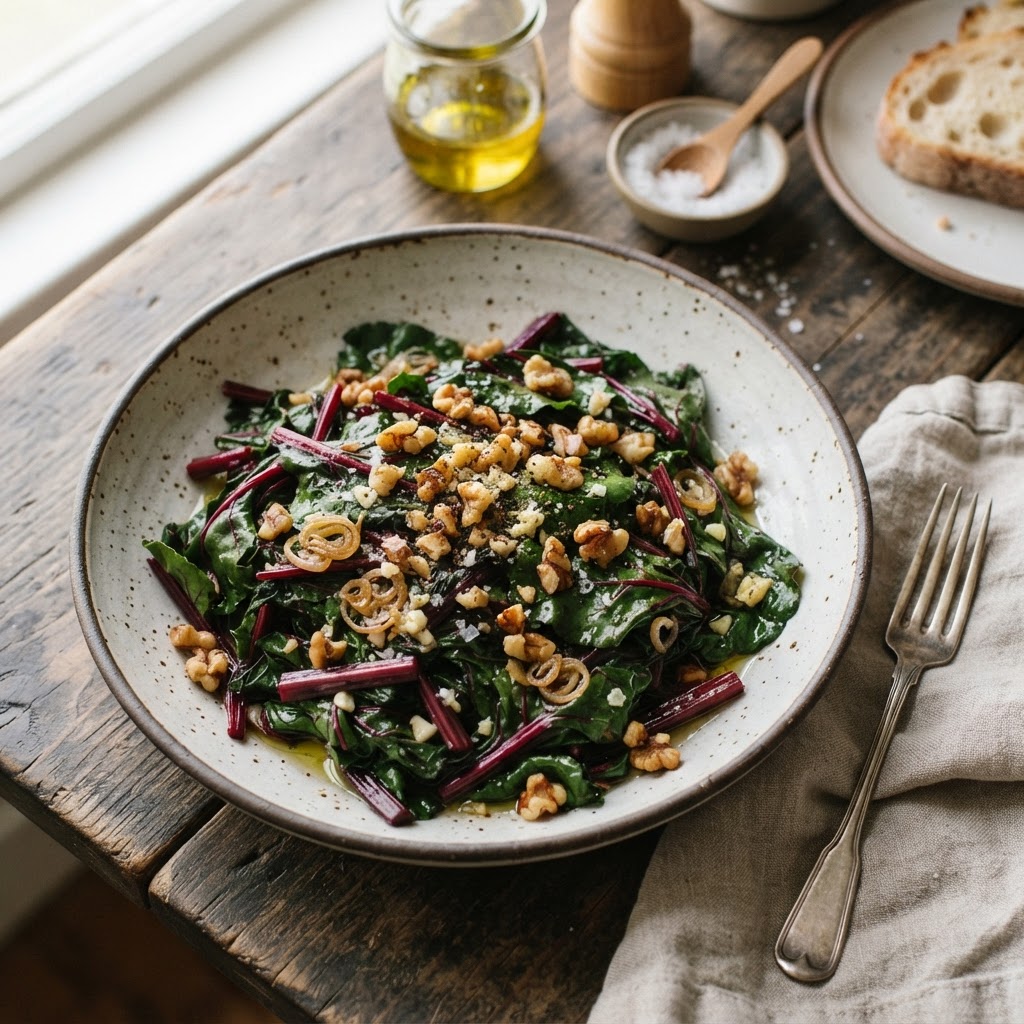
In-Season Recipes with Walnuts
Seasonal recipes featuring Walnuts right now
All Other Recipes with Walnuts
Coming Soon