
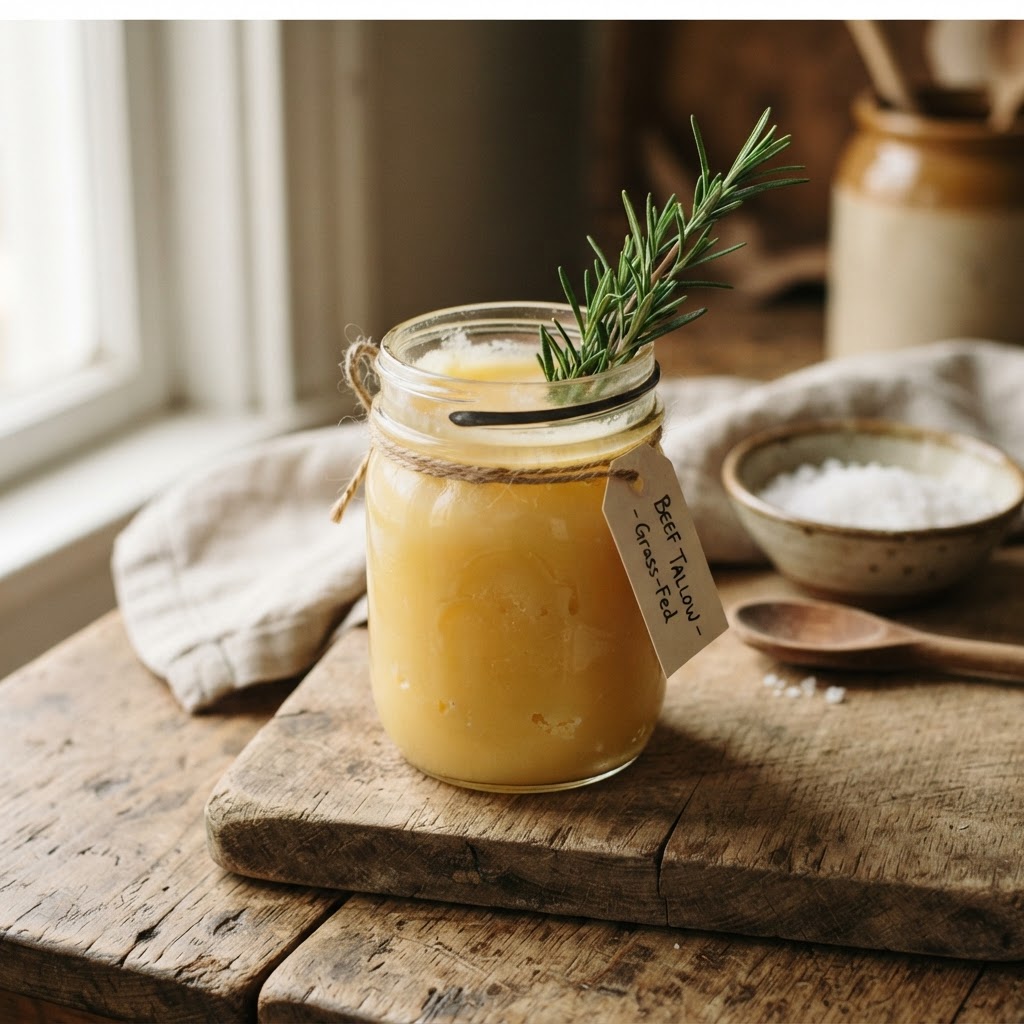
Tallow
Tallow is rendered beef or mutton fat, a traditional cooking fat and the original frying fat for french fries and much classic cooking. It is solid at room temperature, has a high smoke point, and a rich, savory flavor. Like lard, it was largely replaced by vegetable oils in the 20th century but is making a comeback among traditional cooks.
Seek out tallow from grass-fed, pasture-raised cattle for the best flavor and nutrient profile — it is richer in beneficial nutrients than tallow from grain-fed cattle. Look for it at butchers, farmers' markets, or render your own from beef suet (kidney fat).
Avoid industrially processed tallow, which may be bleached or deodorized. Fresh, properly rendered tallow is clean-tasting and golden. Suet (raw kidney fat) is the best starting point for rendering high-quality tallow.
Tallow is also used for soap-making and skincare, so look for food-grade tallow for cooking.
Tallow is very stable — its high saturated fat content resists oxidation. Store rendered tallow in the refrigerator for up to a year, or at cool room temperature for several months. Freeze for longer storage.
Keep it sealed and away from strong odors. Properly rendered tallow should be neutral and clean; if it smells rancid or off, discard it.
Tallow is a superb high-heat cooking fat.
Deep-Frying: Tallow is the traditional fat for french fries — McDonald's used beef tallow until 1990 — and produces crisp, golden, richly flavored fries. Its high smoke point makes it excellent for frying.
Searing & Roasting: Tallow is ideal for searing steaks and roasting vegetables — its high smoke point and savory flavor enhance meat dishes.
Roasting Potatoes: Beef tallow roasted potatoes are a British classic — crisp, golden, and deeply savory.
Sautéing: A traditional fat for savory cooking, especially in British, French, and traditional American cuisine.
Baking: Used in some traditional savory pastry and pie crusts, where its savory flavor complements meat pies.
Pemmican: Tallow is a key ingredient in pemmican, the traditional Native American and frontier survival food of dried meat and fat.
Rendering: Rendering tallow from suet is a preservation method — rendered tallow keeps far longer than fresh fat, without refrigeration. This was essential before refrigeration.
Confiting: Tallow is used for confit and pot-roasting, where meat submerged in fat keeps for extended periods — a traditional preservation method.
Pemmican: Tallow mixed with dried meat makes pemmican, which keeps for months or years without refrigeration — one of the most durable preserved foods.
Tallow is about 50% saturated fat, 42% monounsaturated fat (oleic acid), and 4% polyunsaturated fat. Like lard, it is higher in monounsaturated fat than many people assume.
Grass-fed tallow is a good source of fat-soluble vitamins A, D, E, and K, and conjugated linoleic acid (CLA), a beneficial fatty acid. It also contains stearic acid, a saturated fat that does not raise LDL cholesterol.
A tablespoon provides about 115 calories and 13g of fat. Tallow, like lard, was demonized in the 20th century but has been partially rehabilitated — it is a stable, traditional fat that, from grass-fed animals, offers beneficial nutrients. Use in moderation.
Tallow was the original frying fat for french fries — McDonald's cooked its fries in beef tallow until 1990, when it switched to vegetable oil. Many people credit the switch with a decline in fry flavor.
Tallow is one of the oldest cooking fats — humans have been rendering animal fat for cooking for tens of thousands of years. Before vegetable oils, animal fats were the primary cooking fats in most of the world.
Tallow was historically used for candles and soap as well as cooking — 'tallow candles' were the standard candle before paraffin. The word 'tallow' comes from the Latin for fat.
Pemmican — dried meat pounded and mixed with tallow — was the survival food of Native Americans, fur traders, and Arctic explorers, keeping for months without refrigeration. It is one of the most energy-dense preserved foods ever devised.
Tallow is a byproduct of beef production, making efficient use of the whole animal — a sustainable practice that reduces waste. Using tallow turns a waste product into a valuable cooking fat, supporting whole-animal utilization.
Choosing tallow from grass-fed, pasture-raised cattle supports better animal welfare and more sustainable farming. Grass-fed tallow is also more nutritious than grain-fed.
By using tallow instead of industrially processed vegetable oils, you reduce demand for heavily processed fats and support traditional, low-processing cooking. It is a stable fat with a long shelf life, reducing waste.
Available Near You
Enter your ZIP code to find farms with tallow near you.
Recipes with Tallow
Coming Soon