
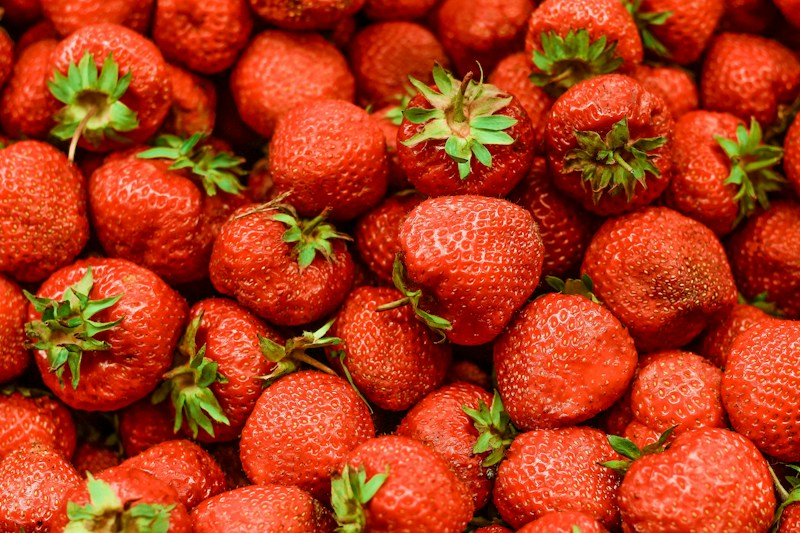
Strawberries
The strawberry is arguably the world's most beloved berry — universally recognized by its vibrant red color, distinctive fragrance, and sweet-tart flavor. Technically not a true berry but an accessory fruit. A spring and early summer treasure — the best strawberry you'll ever eat is one you just picked.
The best strawberries are small to medium, deeply fragrant, uniformly red to the center (no white or green shoulders), and eaten the day they're purchased. Fragrance is the single best indicator of flavor — a strawberry with no smell will have no taste.
The giant, uniform, white-shouldered supermarket strawberries are bred for appearance and shelf life — not flavor. Seek out smaller local varieties at farmers' markets in May–July; the flavor difference is extraordinary. Peak season is late spring through early summer.
Do not wash strawberries until ready to eat — moisture dramatically accelerates mold growth. Store in a paper towel-lined container in the refrigerator and use within 3–5 days of purchase.
If any berries show mold, remove immediately and use the rest right away. For maximum freshness, store in a single layer rather than piled up.
Fresh with Sugar (Maceration): Slice strawberries, sprinkle with a little sugar and lemon juice, let rest 30 minutes. The sugar draws out the juice and intensifies flavor — far better than plain cut berries. A splash of balsamic vinegar adds extraordinary depth.
Jam & Preserves: Strawberry jam captures peak season flavor in a jar. Strawberries have moderate pectin — adding lemon juice provides acidity and helps the set. Short-cook, fresh jam tastes dramatically more vibrant than long-cooked commercial jam.
Shortcake & Desserts: The classic American preparation — flaky biscuits or sponge cake, macerated strawberries, whipped cream. Simple perfection.
Roasting: Roast whole at 400°F until jammy and lightly caramelized — intensifies flavor dramatically and makes subpar strawberries taste exceptional. Great on yogurt, ice cream, toast, and cheesecake.
Sorbet: Blended and frozen with a little sugar and lemon — one of the most vibrant-flavored sorbets possible.
Freezing: Hull, slice (or leave whole), spread on a sheet pan in a single layer, freeze until solid, then bag. Lasts 6–12 months. Perfect for smoothies, sauces, and baking. No blanching needed.
Jam: Strawberries + sugar + lemon juice + pectin (or long cooking to concentrate natural pectin). Short-cook jam retains the most fresh flavor.
Dehydrating: Sliced strawberries dehydrated at low heat until leathery — a concentrated, chewy snack with intense flavor. Also excellent crumbled over cereal, oatmeal, and yogurt.
Strawberries are one of the most vitamin C-rich foods available — a single cup provides 97mg of vitamin C, well over the daily recommended intake. They are also rich in folate, potassium, and manganese.
The deep red color comes from anthocyanins — powerful antioxidants associated with reduced inflammation, improved heart health, and potential cancer-protective effects. Strawberries rank among the highest antioxidant fruits per serving.
At just 49 calories per cup, strawberries are one of the most nutrient-dense low-calorie foods available.
Strawberries are not true berries — they are 'accessory fruits' or 'false fruits.' The fleshy, red part we eat develops from the receptacle (the stem end of the flower), not from the ovary. The actual 'fruits' are the tiny yellow seeds (achenes) on the outside.
True berries, by botanical definition, include bananas, avocados, grapes, kiwis, and tomatoes. Raspberries and blackberries are aggregate drupes. Strawberries are uniquely classified as accessory fruits.
The average strawberry has about 200 seeds on its outer surface.
Strawberry production is one of the most pesticide-intensive forms of agriculture — strawberries consistently appear on the Environmental Working Group's 'Dirty Dozen' list. California produces 90% of US strawberries.
Organic strawberries are worth the premium cost, particularly for children and those who eat them frequently. Local farmers' market strawberries are often grown with minimal pesticides even without organic certification.
Strawberry plants are perennials that can produce for several years, reducing the environmental cost of replanting.
Available Near You
Enter your ZIP code to find farms with strawberries near you.
Recipes with Strawberries
Coming Soon