
Legumes, Beans & Nuts · Summer & Fall
Shell Beans
Phaseolus vulgaris · Also: Fresh Shelling Beans, Cranberry, Borlotti, Cannellini
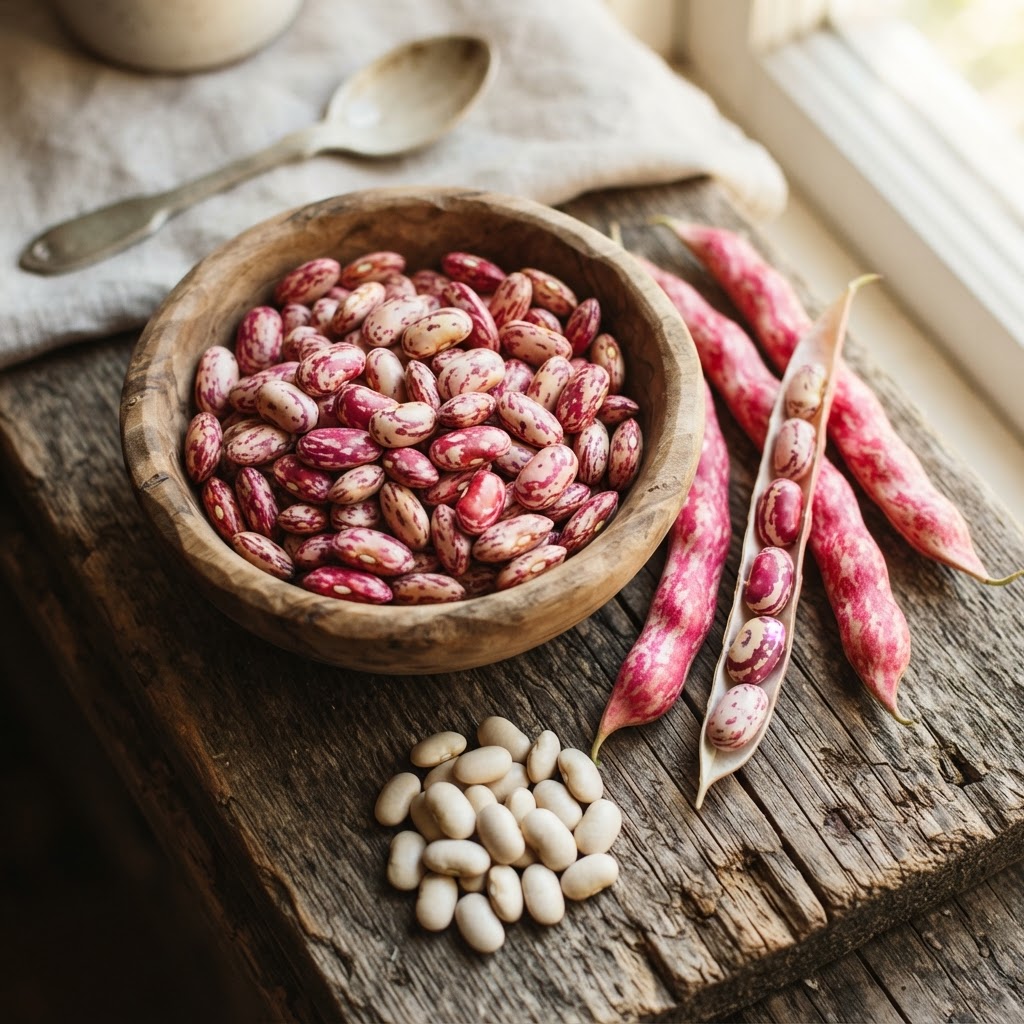
"Shell beans" are bean varieties eaten at the in-between stage — the tender, moist seeds shelled from their pods before they dry, a fleeting seasonal treat that comes between fresh snap beans and fully dried beans. Eaten fresh, their skins are soft, their interiors creamy, and their flavor sweet and beany in a way dried beans never quite match.
Italians treasure fresh shell beans above all — borlotti (cranberry) with their pink-streaked coats, white cannellini, buttery Corona, and the prized Lamon of the Dolomites — simmered simply with olive oil, garlic, and sage, or folded into pasta e fagioli. In the Americas, shell beans give New England baked beans, Mexican frijoles, and the cranberry beans of autumn markets. Late summer through early fall is shell-bean season, when farmers heap their just-shelled buckets at market and cooks buy them by the pound to simmer into the earthy, comforting dishes of the harvest.
Borlotti / Cranberry
The classic Italian shell bean — plump, cream with pink-red streaks that fade to brown when cooked; creamy, nutty, and the star of pasta e fagioli and Italian soups.
Cannellini
Tuscany's beloved white kidney bean — pale, slender, and creamy; the bean of Italian minestrone and fagioli all'uccelletto, eaten fresh in late summer.
Corona / Gigande
A large, flat white Greek-Italian shell bean — huge, buttery, and meaty; often baked in tomato sauce and prized for its dramatic size and creamy texture.
Flageolet
A pale-green French shell bean — tender, delicate, and sweet; the classic accompaniment to lamb, flageolets are harvested young and sold fresh or dried.
Lima / Butter Bean
Large, flat green or white shell beans (butter beans in the American South) — creamy and starchy; Fordhook and baby limas are shelled fresh in summer.
Navy / Pea Bean
Small white shell beans — the bean of New England baked beans, shelled fresh in late summer and slow-baked with molasses and salt pork in the classic tradition.
Tongue of Fire
An Italian borlotti type — pods streaked red, beans cream splashed with red; beautiful fresh, they cook to the same creamy texture as standard borlotti.
Black / Turtle
Small black shell beans of Latin America — eaten fresh in late summer in Mexico and the Caribbean, and the base of frijoles negros and black-bean soup.
Buy shell beans in the pod at late-summer farmers' markets — look for plump, filled pods with no browning or shrivelling, and feel the beans inside to confirm they are full and firm. The pods should be leathery (not fresh and snap-crisp) and may be slightly yellowing — a sign the beans inside are mature and ready to shell.
For pre-shelled beans, choose those that look plump and smooth-skinned with vibrant, characteristic color (pink-streaked borlotti, pale cannellini); avoid shrivelled, dull, or spotted beans and any with a sour smell.
Fresh shell beans are seasonal — August through October in most temperate regions; outside that window, frozen shelled beans and good-quality dried beans of the same varieties are the best alternatives, with the fresh pods a special late-summer treat.
Fresh shell beans are a perishable treat — keep them in the pod in a paper bag in the fridge for up to a week, and shell them only just before cooking. Once shelled, the raw beans keep 2–3 days refrigerated in a sealed container. For longer storage, shell and freeze the raw beans in a single layer, or cook them first and freeze the cooked beans in their liquid; dried shell beans keep for a year or more in an airtight jar.
Shelling: Snap the stem end of a pod and pull down to unzip the string, then press the pod open along its seam and run a thumb to tip the 4–6 beans into a bowl — the satisfying work of late summer.
Blanching: Fresh shell beans cook faster than dried — simmer in water or broth 20–40 minutes until creamy; no soaking needed, and their skins soften without the long cooking dried beans require.
Drying: Any shell bean can be left on the plant to dry fully into a dried bean — the same variety, simply cured longer, yielding the familiar dried bean for winter storage.
Pasta e Fagioli
Italy's iconic bean-and-pasta soup — fresh borlotti or cannellini simmered with tomato, garlic, and rosemary, then mixed with short pasta; a humble dish that's a national treasure.
Fagioli all'Uccelletto
Tuscan cannellini simmered in tomato, garlic, and sage — 'little bird style,' a classic side dish of Florence, served with crusty bread and Tuscan olive oil.
New England Baked Beans
Navy or pea beans slow-baked for hours with molasses, salt pork, and mustard — the traditional Saturday-night supper of New England, baked overnight in a bean pot or earthen bean hole.
Sautéed with Olive Oil & Sage
The simplest Italian treatment — fresh shell beans gently simmered or sautéed in good olive oil with garlic and sage until creamy; a side dish that showcases the fresh, beany flavor.
Frijoles de Olla
Mexican pot beans — fresh shell beans simmered with onion, garlic, and epazote into a brothy, comforting dish, mashed or eaten whole, the everyday pulse of Mexico.
Bean Salad & Stews
Fresh shell beans hold their shape beautifully — toss warm with olive oil, lemon, and herbs for salad, or simmer into autumn vegetable stews and succotash with corn and squash.
Drying: Leave pods on the plant to dry fully, or spread shelled beans on screens in a warm, dry spot until brittle — fully dried shell beans become the familiar dried beans of winter storage, keeping for over a year.
Freezing: Shell and freeze fresh beans raw on a tray, then bag — or blanch 2 minutes first; frozen fresh shell beans keep their creamy texture far better than rehydrated dried beans and are the best off-season substitute.
Canning: Cooked shell beans are pressure-canned in jars for shelf-stable storage — a traditional way to preserve the summer harvest for quick winter meals, especially baked beans and white beans in tomato sauce.
Shell beans are a nutrient-dense pulse — about 9 g of protein and 6 g of fiber per 100 g fresh (concentrating as they dry), making them a satisfying, low-glycemic staple.
They are a good source of folate, iron, magnesium, and potassium, and supply complex carbohydrates that release energy slowly — a filling, heart-healthy food eaten across cultures for centuries.
Fresh shell beans retain more of their water-soluble vitamins than dried beans cooked from dry, and their tender skins make them gentler to digest than rehydrated dried beans — a seasonal nutrition bonus.
Shell beans are simply beans harvested at the "shelling" stage — the same plant that gives us fresh snap beans, then shell beans, then dried beans, depending on when it's picked. They are the middle, fleeting stage most supermarket shoppers never see.
Italy protects dozens of shell beans by name and region — Lamon, Sorana, Cannellino, Corona, and Cuneo each have DOP or IGP status — reflecting how deeply fresh shell beans are woven into regional Italian cooking and pride.
New England baked beans began as a Native American dish of beans baked in earthen pits with maple and bear fat; Pilgrims adopted it with molasses and salt pork, and it became the Saturday-night supper of New England, baked overnight to avoid Sunday cooking.
Fresh shell beans fade as they cook — the vivid pink streaks of a raw borlotti dissolve into a uniform beige as they simmer, a small seasonal magic that surprises first-time shell-bean cooks every autumn.
Shell beans are celebrated at late-summer and autumn harvests across Italy and New England:
Bean Hole Days
New England, USA
🗓 Summer–Fall 2026 (community suppers)
New England bean suppers — baked beans slow-cooked overnight in earthen bean holes — are a centuries-old tradition; towns and churches hold Bean Hole Days each summer and fall, cooking navy and pea beans with molasses and salt pork in the ground.
Sagra del Fagiolo
Italy (Tuscany, Piedmont, Veneto)
🗓 September–October 2026 (annual)
Across Italy, autumn sagre celebrate fresh shell beans — Tuscany's Sorana and Cannellino, Piedmont's Cuneo, and Veneto's Lamon bean festivals feature fresh shelled beans with olive oil and rosemary, slow-cooked into fagioli all'uccelletto and pasta e fagioli.
Festa della Madonna & Bean Harvests
Tuscany & Lazio, Italy
🗓 September 2026 (harvest feasts)
Late-summer village feasts in central Italy bless the shell-bean harvest — fresh borlotti and cannellini are the centerpiece, simmered with garlic and sage in earthenware pots and served at long communal tables in the piazza.
Nitrogen-fixing & soil-building: Like all beans, shell beans fix atmospheric nitrogen through their root nodules, enriching the soil for the next crop — a cornerstone of crop rotation and intercropping across temperate agriculture.
Low-input & high-yield: Beans are a low-water, low-fertilizer, high-protein crop — one of the most efficient ways to produce protein from arable land, making them a sustainable and affordable staple worldwide.
Global range: Shell beans are grown wherever common beans grow — from Italy and France to the Americas, Africa, and Asia — with each region treasuring its own varieties: borlotti in Italy, flageolet in France, navy in New England, black beans in Mexico, and limas across the American South.
Available Near You
Enter your ZIP code to find farms with shell beans near you.
Recipes with Shell Beans
Coming Soon