
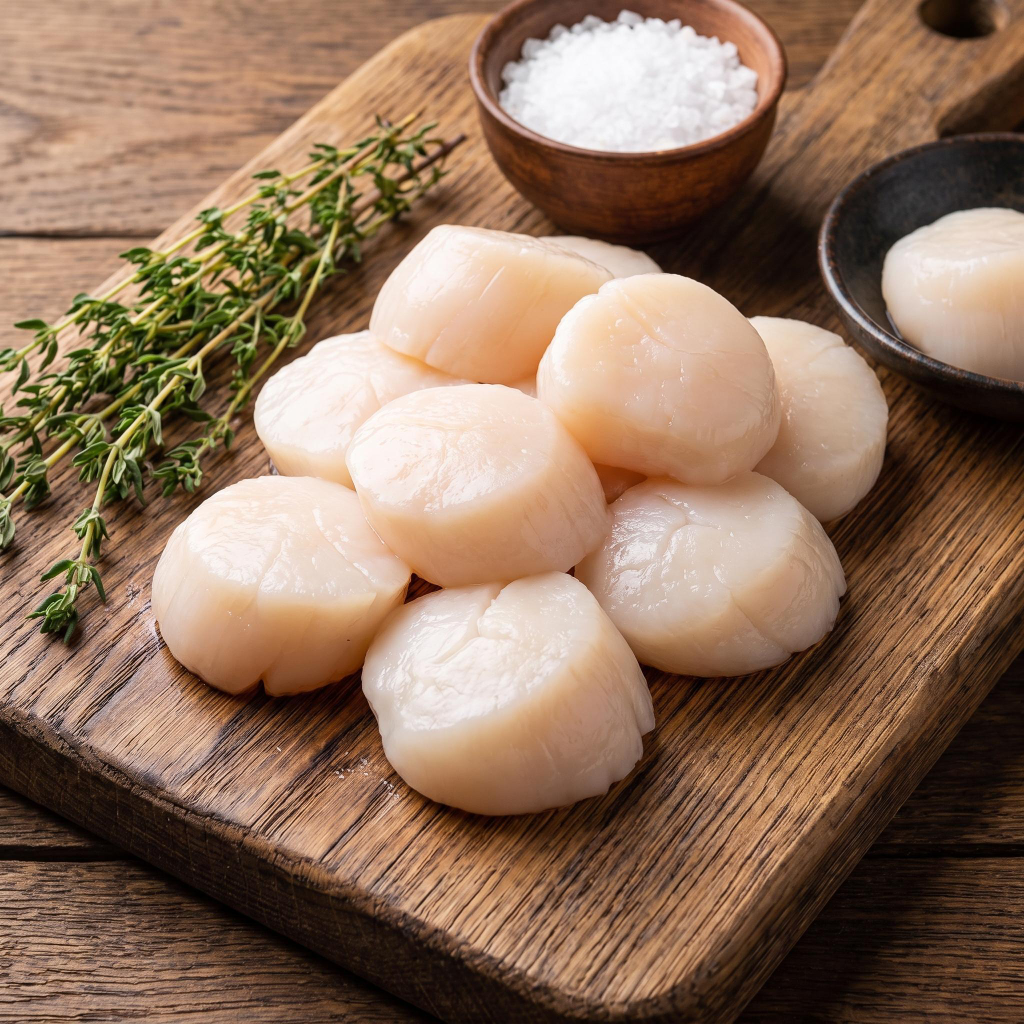
Scallops
Tender, succulent seafood with a subtle sweet flavor
Seek out 'dry' sea scallops — they are untreated and sear beautifully. 'Wet' scallops are soaked in a preservative solution (sodium tripolyphosphate) that makes them watery, prevents browning, and gives a soapy flavor. Ask your fishmonger; the label should say 'dry pack.'
Fresh scallops should smell clean and briny, not fishy, and be translucent and firm, not sitting in milky liquid. Diver scallops are the premium — hand-harvested and undamaged.
Plan on about ½ pound of sea scallops per person for a main course, or ¼ pound of bay scallops for a starter or pasta.
From large sea scallops to delicate bay scallops, each variety is suited to different preparations:
Sea Scallops
Large, sweet, and meaty — the most common scallop, sold as 'dry' (chemical-free) or 'wet' (treated); ideal for searing.
Bay Scallops
Small, sweet, and delicate — harvested from shallow bays; perfect for quick sautés, stews, and ceviche.
Diver Scallops
Hand-harvested by divers rather than dredged — the highest quality sea scallops, with intact, sweet meat and roe.
Calico
Small, sweet scallops from the Gulf and Southeast — often sold frozen; good for stews and pasta.
Patagonian / King
Very large, meaty scallops from South American waters — rich and sweet; often sold as roe-on.
Roe-on
Sea scallops sold with the bright orange roe (coral) attached — a delicacy prized in Europe and fine dining.
Scallops are highly perishable — keep them in the coldest part of the refrigerator (32°F) and use within 1–2 days. Keep them on ice in the fridge if possible.
If you cannot cook them immediately, freeze them. Pat dry, wrap tightly, and freeze for up to 3 months. Thaw overnight in the refrigerator.
Before cooking, pat scallops thoroughly dry with paper towels — moisture is the enemy of a good sear. Season just before cooking; salting too early draws out moisture.
Scallops cook in minutes — overcooking makes them tough and rubbery.
Pan-Searing: The classic method — pat dry, season, and sear in a very hot pan with oil or butter for 2–3 minutes per side until caramelized and just opaque. Do not move them; let the crust form.
Grilling & Broiling: Thread large sea scallops on skewers and grill or broil briefly for a smoky char.
Sautéing: Bay scallops are perfect for quick sautés with garlic, butter, and white wine — 2–3 minutes total.
Raw & Ceviche: Very fresh scallops are excellent raw — sliced thin with citrus, olive oil, and herbs for crudo or ceviche.
Soups & Stews: Scallops add sweetness to chowders, bisques, and seafood stews; add them last and cook briefly.
Freezing: Pat dry and freeze scallops for up to 3 months. Thaw in the refrigerator before cooking.
Ceviche: 'Cooked' in citrus juice, ceviche keeps refrigerated for a few hours; best eaten fresh.
Smoking: Smoked scallops, packed in oil, are a gourmet treat for antipasti.
Canning: Scallops are occasionally canned in butter or oil for rich, ready-to-use meat.
Pickling: Pickled scallops in escabeche are a traditional preserved preparation with bright, tangy flavor.
Scallops are a lean, high-protein seafood — about 20 grams of protein and only about 95 calories per 3-ounce serving, with very little fat.
They are rich in vitamin B12, selenium, phosphorus, and omega-3 fatty acids, supporting heart, brain, and bone health. Scallops are a good source of magnesium and potassium, which help regulate blood pressure.
Scallops are low in mercury and a lean, delicate protein, making them an excellent regular choice for a healthy diet.
Scallops have dozens of bright blue eyes along the edge of their shells — they can detect light, dark, and motion, helping them escape predators by swimming.
Scallops swim by rapidly clapping their shells together, jetting through the water — they are the only bivalves that 'fly' through the sea.
The scallop shell is the symbol of St. James and appears on the Camino de Santiago pilgrimage; the word 'coquille' (scallop shell) names the classic French dish cooked and served in the shell.
The muscle we eat is the adductor muscle — the single strong muscle that holds the shell closed and powers the scallop's swimming.
Sea scallops from U.S. and Canadian fisheries are generally well-managed and a good choice. Diver-caught scallops are the most sustainable — hand-harvested without damaging the seafloor, unlike dredge harvesting.
Bay scallops are smaller and more vulnerable to overfishing; farmed bay scallops are an emerging sustainable option.
Scallops are also farmed in some regions, often suspended on ropes in clean water — a low-impact method. Check a current seafood guide for the best choices in your region.
Available Near You
Enter your ZIP code to find farms with scallops near you.
Recipes with Scallops
Coming Soon