Grains & Seeds · Summer & Fall
Rye
Secale cereale · Also: Roggen, Rugiai, Ruis, Seigle, Rugbrød Grain, Rye Berries
Rye is the hardy grain of the cold north — a tough, resilient cereal that thrives in the poor soils, short summers, and bitter winters where wheat cannot grow, and that has fed the peoples of Northern and Eastern Europe for a thousand years. From the black breads of Russia and the pumpernickel of Germany to the crispbreads of Sweden and the ruisleipä of Finland, rye is the dark, dense, sourdough bread of the cold lands — a grain of survival, of peasants and soldiers, of long winters and hard soils, and of some of the most deeply flavored breads in the world.
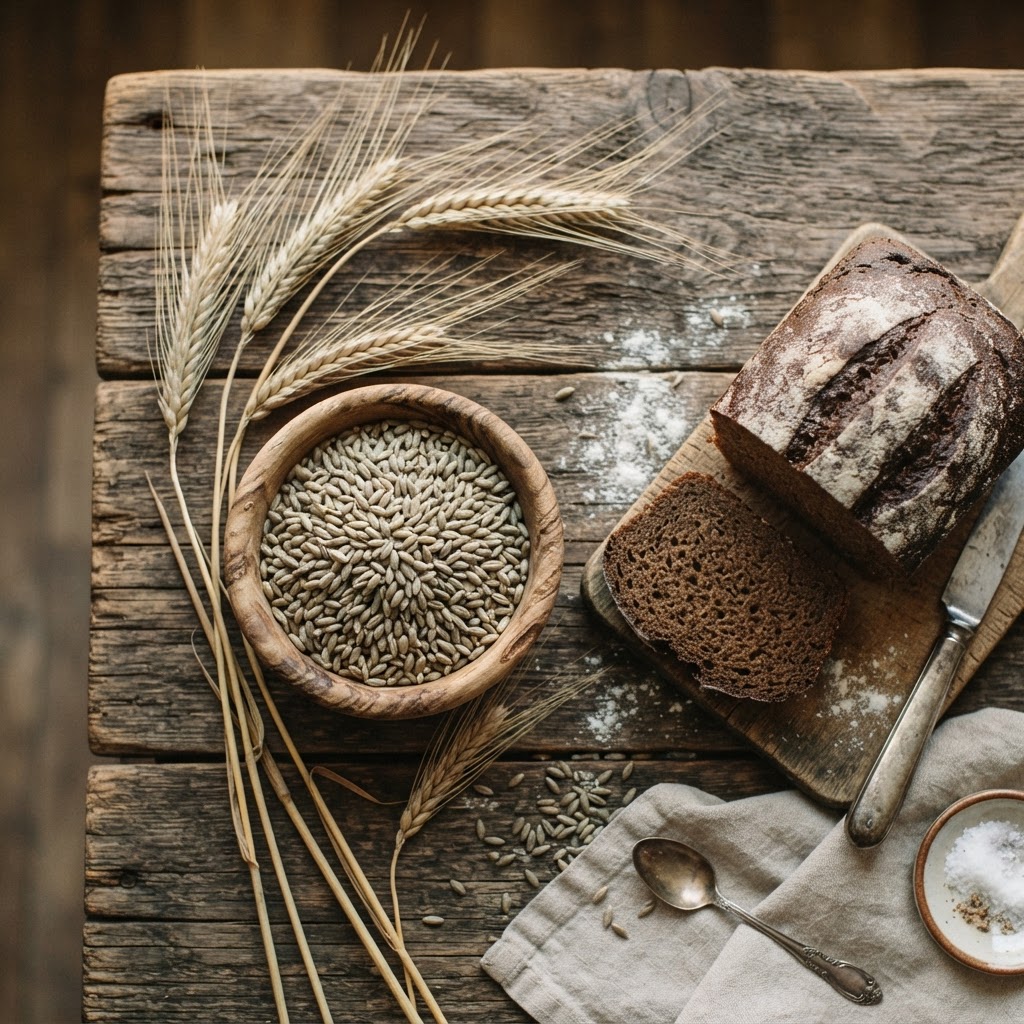
The grains are long, slender, and grey-green, harder and less plump than wheat, with a lower gluten content that makes rye bread dense, moist, and dark rather than light and airy — rye dough is sticky and soft, and rye breads are almost always made with a sourdough starter, which gives them their characteristic tangy, earthy flavor. The flavor of rye is deep, malty, and slightly sour — the most savory of grains, with a dark complexity that pairs naturally with caraway, dill, smoked fish, pickled vegetables, and cured meats. From the rye whiskey of the American frontier to the crispbread of Swedish farmhouses, the dark pumpernickel of Westphalia to the rugbrød of Denmark, rye is the grain of the north — humble, hardy, and profound.
Whole Rye Berries (Rye Groats)
The whole, unbroken rye grain with only the hull removed; the most nutritious form, high in fiber and minerals; cook like rice or barley in 45–60 minutes into a chewy, nutty grain for salads, bowls, and porridge; also used for rye 'coffee' (roasted rye drink).
Rye Flakes (Rolled Rye)
Whole rye grains steamed and rolled flat into flakes, like rolled oats; cook in 5–10 minutes into a creamy, earthy porridge, or use in granola, muesli, and baking; darker and more flavorful than oat flakes, with rye's signature malty depth.
Dark Rye Flour (Whole Rye Flour)
Whole rye milled with the bran and germ — dark, dense, and full-flavored; the flour of traditional dark rye breads, pumpernickel, and vollkornbrot; low in gluten, so it produces dense, moist, heavy loaves that are best made with a sourdough starter.
Light Rye Flour (White Rye Flour)
Rye milled with most of the bran and germ sifted out — lighter in color and milder in flavor than dark rye; used for lighter rye breads, Swedish limpa, and blended with wheat flour in softer rye loaves; the refined rye flour for less dense baking.
Pumpernickel & Cracked Rye
Coarsely cracked whole rye grains — the base of Westphalian pumpernickel, a long-steamed dark rye bread; also used in German vollkornbrot and Scandinavian rugbrød for their characteristic chewy, seedy texture; the coarsest cut of rye.
Rye Sourdough Starter
A naturally fermented rye starter (sauerteig) — the traditional way to leaven rye bread, since rye's low gluten cannot trap yeast gases the way wheat can; the starter gives rye bread its characteristic tangy, sour flavor and is the soul of rye baking across Northern and Eastern Europe.
For rye bread, choose between dark rye flour (whole grain, dense, full-flavored) for traditional dark pumpernickel-style loaves and light rye flour (milder, lighter) for softer Swedish-style limpa and blended rye breads; whole rye berries make a chewy grain for salads and bowls. For the best rye bread, look for sourdough-leavened loaves — the traditional and superior way to bake rye.
Look for fresh rye flour from a source with good turnover — rye's oils can go slightly rancid over time, and the flavor of fresh-milled rye is noticeably better. Stone-milled whole rye flour retains the most nutrition and flavor. For rye whiskey, seek out American rye (at least 51% rye grain) or European rye whiskies, which highlight the grain's spicy, savory character.
Season: rye is a winter-hardy cereal planted in fall (winter rye) or spring (spring rye) and harvested in late summer to early fall; the dried grains and flours are available year-round, with fresh-milled rye flour best from autumn mills.
Keep whole rye berries in an airtight container in a cool, dry, dark place for up to a year. Rye flour, with its oils exposed, is more perishable than wheat flour — store in the refrigerator for up to 6 months or the freezer for up to a year, especially whole (dark) rye flour. Rye sourdough starter is kept alive indefinitely with regular feeding, and rye bread — especially dense sourdough rye — keeps far longer than wheat bread, staying moist and good for a week or more, which is one reason it was the bread of the long northern winter.
Harvesting: Rye is a winter-hardy cereal planted in fall and harvested the following summer, or planted in spring and harvested in late summer; the tall, slender, bearded stalks are cut and threshed to release the long grey-green grains — rye is one of the hardiest cereals, surviving frosts, poor soils, and cold that would kill wheat, which is why it became the grain of the cold north.
Milling: The hull is removed, and the grain is milled into dark rye flour (whole grain, with bran and germ) or light rye flour (sifted, paler and milder); rye is also cracked (for pumpernickel) and rolled into flakes (for porridge and granola). Rye is harder to mill finely than wheat, and rye flour is naturally coarser and darker.
Sourdough & baking: Rye's low gluten cannot trap yeast gases the way wheat can, so rye bread is almost always leavened with a sourdough starter (sauerteig); the acids in the starter also help condition the rye starches and preserve the bread. Traditional rye breads are dense, moist, and sour, often baked in tins and steamed or long-baked for a dark, malty crumb.
Sourdough Rye Bread
The classic — rye flour leavened with a sourdough starter into dense, moist, tangy loaves; from Russian black bread and German pumpernickel to Danish rugbrød and Finnish ruisleipä; the bread of the cold north, best with butter, smoked fish, pickled herring, or cured meats, and the soul of rye cooking.
Crispbread (Knäckebröd)
Swedish and Nordic crispbread — thin, dry rye crackers baked until crisp and stored for months; the everyday bread of Sweden for centuries, traditionally hung on poles over the hearth to dry; eaten with butter, cheese, herring, and soup, and a cornerstone of the Nordic diet.
Rye Porridge & Flakes
Rye flakes or cracked rye simmered with water or milk into a creamy, earthy porridge, like oatmeal but darker and more savory; a traditional Nordic and Eastern European breakfast, often topped with berries, nuts, or butter — a warming grain for cold mornings.
Rye Berries & Salads
Whole rye berries cooked like rice or barley into a chewy, nutty grain for grain bowls, salads (like rye and beet salad), and side dishes; the whole grain retains all the fiber and minerals and has a satisfying, almost meaty chew.
Rye Whiskey & Vodka
Rye grain fermented and distilled into rye whiskey (American rye, at least 51% rye grain, spicy and bold) and into the vodka of Poland and Russia (where rye has long been the preferred grain); rye gives spirits a characteristic spicy, savory, peppery character distinct from corn or wheat spirits.
Rye 'Coffee' & Roasted Rye
Roasted rye grains brewed into a caffeine-free coffee substitute, popular in Eastern Europe during wartime shortages and still drunk as a traditional beverage; roasted rye also flavors malty drinks like kvass (a lightly fermented Russian rye bread drink) and German bierenbrot.
Drying: Whole rye berries keep for up to a year in a sealed, cool, dry place — the grain of the cold north stored through long winters; rye was a lifeline crop for the peasants of Northern and Eastern Europe, and its storage quality was part of why it was so vital.
Crispbread & long-keeping bread: Swedish crispbread (knäckebröd), dried until brittle, keeps for months or even a year — a preserving innovation that made rye last the winter; dense sourdough rye breads also keep far longer than wheat breads, staying moist and good for a week or more without mold, thanks to the acids from the sourdough starter.
Fermentation: Rye is fermented into sourdough bread (which preserves the bread), into rye beer (kvass, a lightly fermented Russian drink), and into rye whiskey and vodka — fermentation is one of the oldest ways to preserve rye's value and is central to rye's cultural traditions across the north.
Rye is one of the most nutritious of the common grains — higher in fiber than wheat, especially in the soluble fiber that lowers cholesterol and steadies blood sugar; whole rye has a lower glycemic index than wheat, giving slow, sustained energy, which is why rye bread keeps you full longer than wheat bread.
Rye is rich in minerals — manganese, phosphorus, magnesium, iron, and zinc — and in B vitamins; it is also high in lignans, plant compounds with antioxidant and hormone-balancing effects. The sourdough fermentation used in rye bread further improves its nutrition by breaking down phytic acid, which makes the minerals more absorbable.
Rye does contain gluten, though less than wheat, and its gluten is weaker and less elastic — which is why rye bread is dense rather than light; people with celiac disease should avoid rye, but some people with wheat sensitivity tolerate rye better than wheat. Rye is also notably more filling than wheat, which is why rye bread is often recommended for weight management and steady energy.
Rye was long considered a poor man's grain — wheat was the grain of the rich and the south, rye the grain of the peasants and the cold north; yet rye's deep, complex flavor and its ability to thrive where wheat cannot made it the defining grain of Russian, German, Scandinavian, and Baltic cuisines, and its breads are now prized as some of the most flavorful in the world.
Rye whiskey was the original whiskey of the American frontier and the Northeast — George Washington distilled rye whiskey at Mount Vernon, and rye was the dominant American whiskey until Prohibition, after which it was largely replaced by bourbon (corn whiskey); rye whiskey has seen a major revival in the 21st century for its bold, spicy character.
Rye is so hardy that it is often planted as a winter cover crop to protect and build soil — winter rye survives freezing temperatures that would kill almost any other grain, and its deep roots break up compacted soil and add organic matter; a grain that feeds the soil as well as the people.
In Lithuania, rye bread (duona) is so sacred that a dropped crumb is traditionally picked up and kissed; the rye harvest (rugpiūtis) was one of the most important festivals of the year, and the last sheaf of rye was dressed as the 'rye mother' — rye is not just a grain in the Baltic and the north but a symbol of life, sustenance, and the land itself.
From Lithuanian rugpiūtis to Swedish Midsommar and German rye bread festivals, rye is the celebrated grain of the cold north:
Roggenbrot & German Rye Bread Festivals
Germany & Eastern Europe
🗓 September–October 2026 (harvest)
Across Germany and the rye-growing lands of Eastern Europe, autumn harvest festivals celebrate the dark rye breads that have fed the region for centuries — pumpernickel, schwarzbrodt, and vollkornbrot; bakeries and villages honor the new rye harvest with fresh-baked loaves, and the grain that fed the peasants of the cold north is celebrated at the harvest table.
Midsommar & Swedish Harvest Traditions
Sweden & the Nordic countries
🗓 June 2026 (Midsommar); September 2026 (harvest)
Rye is the great grain of the Nordic countries, surviving where wheat cannot; Swedish Midsommar and the autumn harvest celebrate the rye that made knäckebröd (crispbread), limpa (sweet rye bread), and vörtbröd (wort rye bread); crispbread (knäckebröd) was the everyday bread of Sweden for centuries, hung on poles over the hearth to dry and last the winter.
Lithuanian Rugpiūtis (Rye Harvest)
Lithuania & the Baltic
🗓 July–August 2026 (rye harvest)
In Lithuania, where rye (rugiai) is the sacred national grain, the rye harvest (rugpiūtis) is one of the most important festivals of the year; the last sheaf of rye is ceremonially cut and dressed as 'the rye mother' (rugiu motina), and the new rye is baked into the dark rye bread (duona) that is the soul of Lithuanian cuisine and culture — bread is so revered that a dropped crumb is kissed.
Russian & Finnish Rye Bread Traditions
Russia & Finland
🗓 September 2026 (harvest)
In Russia and Finland, where the long winters demand a hardy grain, rye is the national bread — Russian black rye bread (chorny khleb) and Finnish ruisleipä (rye bread) have fed the people for a thousand years; the autumn harvest is marked by the baking of fresh rye loaves, and rye bread is so central to the cuisine that it appears in proverbs, songs, and daily life as the symbol of sustenance itself.
Cold-hardy & low-input: Rye thrives in poor soils, cold winters, and short growing seasons where wheat cannot — it needs less fertilizer and water than wheat and survives freezing that would kill most cereals; a resilient, low-input grain for marginal northern land, which is why it became the staple of the cold north.
Cover crop & soil builder: Rye is often planted as a winter cover crop to protect soil from erosion, suppress weeds, and add organic matter; its deep roots break up compacted soil and scavenge nutrients, making it a regenerative agriculture tool as well as a food crop — a grain that feeds the soil as well as the people.
Whole-grain nutrition: Because traditional rye breads are made with whole rye flour and sourdough, eating rye is a low-waste, high-nutrition use of the crop — the whole grain is retained, and the sourdough fermentation makes the nutrients more available; supporting whole-grain rye products keeps the full grain's value in the food supply.
Global range: Rye originated as a weed in wheat and barley fields in the Near East and spread north into Europe, where it thrived in the cold climates that wheat could not tolerate; today it is grown mainly in Russia, Poland, Germany, the Nordic countries, Belarus, and Canada — the great grain of the cold north, and a defining grain of Northern and Eastern European cuisine and culture.
In-Season Recipes with Rye
Seasonal recipes featuring Rye right now
Coming Soon
All Other Recipes with Rye
Coming Soon