Grains & Seeds · Year-round (harvested autumn)
Rice
Oryza sativa · Also: Asian Rice, Paddy Rice, Brown Rice, Jasmine, Basmati, Arborio, Sticky Rice
Rice is the grain that feeds half the world — the staple food of Asia, where it has been cultivated for nearly 10,000 years, and the daily bread of more people than any other crop on Earth. Domesticated in the river valleys of China and India from a wild grass, rice transformed the wet tropics and subtropics, turning swamps into paddies and feeding civilizations from the Yangtze to the Mekong, the Ganges to the Irrawaddy, the Nile to the Mississippi. It is the grain of sushi and congee, of biryani and risotto, of paella and jollof, of mango sticky rice and rice pudding — a single food that crosses a hundred cuisines.
The grains are small, hard, and translucent when raw, turning fluffy, sticky, or creamy when cooked depending on the variety — long-grain rice stays separate and fluffy, short-grain and sticky rice clings together, and medium-grain rice falls in between. Rice is sold brown (whole grain, with the bran and germ) or white (milled, with only the starchy endosperm), each with its own texture, flavor, and nutrition. From the sacred rice of Shinto and Hindu ritual to the everyday bowl that anchors a billion meals a day, rice is the most deeply woven grain in human culture — the grain of monsoon Asia, the soul of its cuisines, and the single most important food crop on the planet.
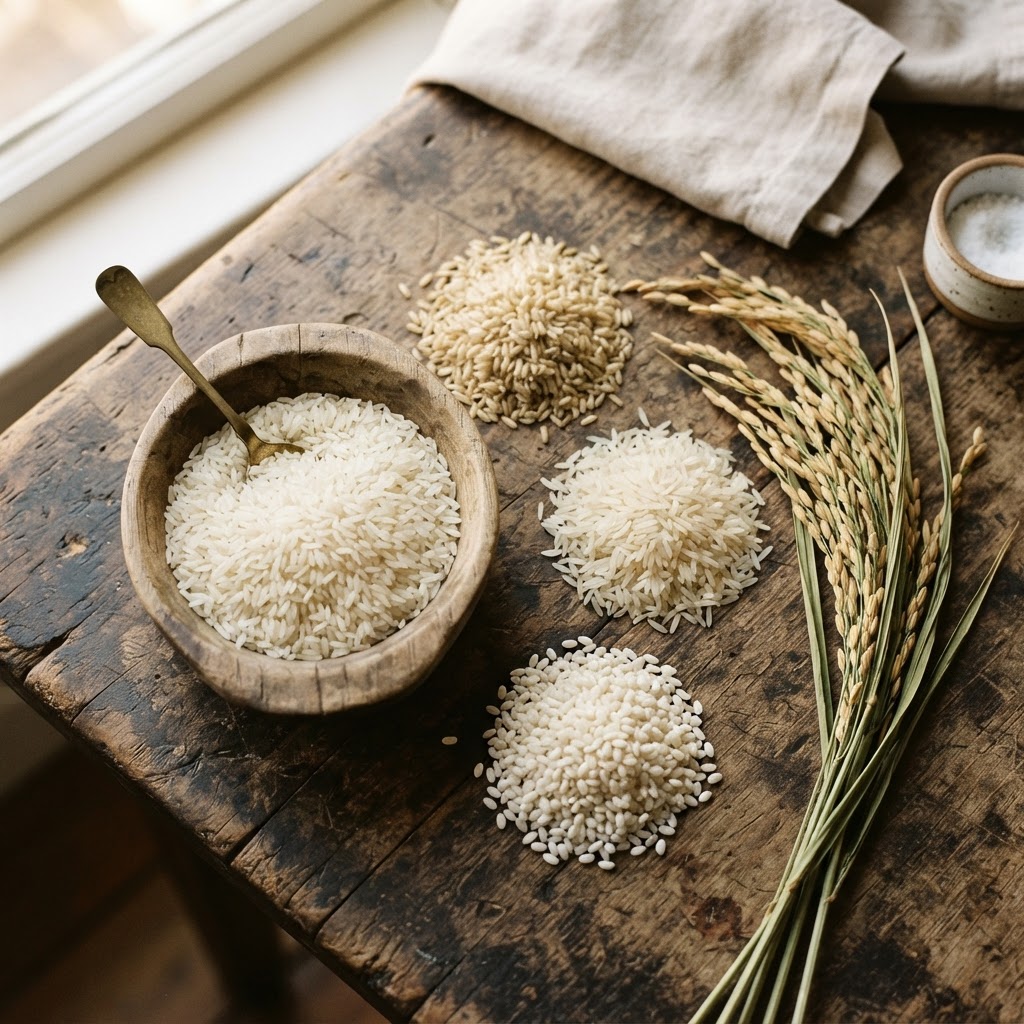
Long-Grain White Rice (Jasmine & Basmati)
Long, slender grains that cook up fluffy, separate, and aromatic — jasmine rice (Thailand, fragrant and slightly sticky) and basmati (India & Pakistan, nutty and dry) are the two most prized long-grain rices; the grain of pilafs, biryani, curries, and Thai cuisine; cooked by absorption or steaming.
Medium-Grain Rice (Calrose, Bomba)
Plump, medium-length grains that cook moist and tender with a slight cling; California Calrose (the rice of Korean and Japanese-American cooking), Spanish Bomba (the rice of paella), and Italian Carnaroli; versatile for everyday bowls, paella, and risotto.
Short-Grain & Sushi Rice
Short, plump, almost round grains that cook sticky and cling together — the rice of sushi, onigiri, and Japanese and Korean everyday meals; the high starch content makes it soft and slightly sweet, the ideal rice for chopsticks and for shaping.
Arborio, Carnaroli & Risotto Rices
Italian short- and medium-grain rices high in amylose starch, which releases slowly during cooking to give risotto its creamy, sauce-like texture without breaking down; Arborio is the most common, Carnaroli the most prized; the rice of risotto and arancini.
Sticky Rice (Glutinous Rice)
Short-grain glutinous rice (khao niao) that cooks up intensely sticky and slightly sweet; the staple of Laos and northern Thailand, eaten with the fingers in small balls; the rice of mango sticky rice, of Southeast Asian steamed dishes in banana leaf, and of Chinese zongzi and lo mai gai.
Brown Rice & Whole-Grain Rice
Rice with only the inedible hull removed, retaining the nutrient-rich bran and germ; nuttier, chewier, and more nutritious than white rice, but with a shorter shelf life (the bran oil goes rancid); available as brown long-, medium-, or short-grain, and the whole-grain option for everyday rice.
Black, Red & Forbidden Rice
Heirloom pigmented rices — black (Chinese 'forbidden rice', once reserved for emperors), red (Bhutanese and French Camargue), and purple — deeply nutty, chewy, and rich in antioxidants; striking on the plate and nutritionally superior to white rice; prized in modern whole-grain cooking.
Rice Flour, Noodles & Paper
Rice milled into flour for gluten-free baking, Asian rice noodles (rice vermicelli, pho noodles, banh pho), mochi and rice cakes, and edible rice paper (spring roll wrappers); rice flour is a staple of Asian and gluten-free kitchens, and the base of many traditional sweets and dumplings.
Match the rice to the dish — long-grain jasmine or basmati for fluffy pilafs and curries, short-grain or sushi rice for sticky sushi and Japanese meals, arborio or carnaroli for risotto, bomba for paella, and sticky rice for Southeast Asian dishes. Each rice is bred for a specific texture, and substituting one for another often changes the dish.
For everyday eating, choose between white rice (fluffy, quick-cooking, lower in nutrients) and brown rice (nutty, chewy, whole-grain, higher in fiber and minerals); both keep for a year or more dry. For special dishes, seek out aged basmati (1–2 years old, which cooks up drier and more fragrant), short-grain Italian risotto rice, or heirloom black or red rice.
Season: rice is planted in spring and harvested in autumn, with the new rice (shinmai in Japan, southeast Asia's 'new rice') prized in late autumn for its softer, sweeter texture; the dried grains are available year-round.
Keep dry white rice in an airtight container in a cool, dry, dark place for up to a year (or longer) — white rice is one of the best-storing dry staples. Brown rice, with its oil-rich bran and germ, is more perishable and is best used within 6 months, or refrigerated for up to a year; the bran oil goes rancid at room temperature. Cooked rice keeps 4–6 days refrigerated and freezes well; reheat with a splash of water to restore its texture.
Harvesting: Rice is planted in flooded paddies in spring and harvested in autumn when the grains turn from green to golden; the stalks are cut, dried, and threshed to release the rough rice (paddy), which is still enclosed in its inedible hull — a cycle of cultivation that has defined the calendar of monsoon Asia for millennia.
Milling: The hull is removed to produce brown rice (whole grain, with bran and germ); further milling removes the bran and germ to produce white rice (starchy endosperm only). Brown rice is more nutritious, white rice is fluffier and stores longer; the degree of milling determines the grain's texture, flavor, and shelf life.
Polishing & aging: White rice may be polished to a smooth, pearly finish; basmati rice is often aged for 1–2 years before sale to develop its characteristic dry, separate texture and aroma; some rices (like Japanese mochi rice and Thai sticky rice) are milled into flour for sweets and noodles.
Steaming & Absorption
The everyday method for most rices — rice cooked with a measured amount of water (about 1:2 for white, 1:2.5 for brown) until the water is absorbed and the grains are tender; the method of rice cookers and of everyday rice across Asia, the Middle East, and Latin America.
Pilaf, Biryani & Spiced Rice
Rice toasted in oil or ghee with spices, then cooked in broth — the method of Indian biryani, Persian polo, Middle Eastern pilafs, and Spanish arroz; toasting the grains keeps them separate and adds a nutty depth, while broth and spices infuse the rice with flavor.
Risotto & Creamy Rice
Italian risotto — arborio or carnaroli rice toasted, then cooked slowly with hot broth added ladle by ladle while stirring, releasing starches into a creamy, sauce-like dish; the method of risotto milanese, arancini, and rice pudding; a different way to cook rice, built on starch, not separation.
Paella & One-Pot Rice
Spanish paella and Latin American arroz — rice cooked in a wide, shallow pan with broth, saffron, vegetables, and seafood or meat, developing a crisp golden crust (socarrat) on the bottom; the one-pot rice of the Mediterranean and Latin America, from paella to arroz con pollo to jollof.
Congee, Rice Porridge & Soup
Rice simmered with plenty of water or broth until it breaks down into a soft, soothing porridge — Chinese congee (jook), Korean juk, Indian kanji, Southeast Asian lugaw; a comfort food across Asia, eaten for breakfast, for the sick, and as a base for savory toppings; the softest form of rice.
Sticky Rice, Sushi & Mochi
Glutinous rice steamed (not boiled) in a bamboo basket until sticky and clinging; the method of Thai sticky rice and Laotian food. Sushi rice seasoned with vinegar; Japanese mochi (pounded glutinous rice into chewy cakes); rice flour dumplings, noodles, and sweets — the sticky, sweet, and shaped uses of rice.
Drying: White rice is one of the best-storing dry staples — up to several years in a sealed, cool, dry place, which is why it has been a survival and stored crop for millennia; brown rice, with its bran oils, stores only 6 months at room temperature but keeps a year refrigerated or frozen.
Cooked & frozen: Cooked rice keeps 4–6 days refrigerated and freezes well for up to 3 months — cook a large batch for quick weeknight meals; reheat with a little water to restore the texture, and always cool cooked rice quickly to prevent food safety issues.
Milling & fermentation: Rice is milled into flour (for noodles, rice paper, mochi, and gluten-free baking) and fermented into rice wine (sake, mijiu, cheongju), rice vinegar, and rice beer; fermentation is one of the oldest rice traditions, turning the grain into the alcohol of East and Southeast Asia.
White rice is mostly starch — quick energy, easy to digest, and a staple for billions, but lower in fiber, protein, and minerals than whole grains. Brown rice retains the bran and germ and is significantly higher in fiber, B vitamins, magnesium, and antioxidants; it has a lower glycemic index and provides slower, steadier energy.
Rice is naturally gluten-free, making it safe for people with celiac disease; it is also one of the least allergenic of grains, which is why it is often the first solid food given to infants and a staple for people with multiple food sensitivities.
Heirloom pigmented rices — black, red, and purple — are rich in anthocyanins (the same antioxidants as in blueberries), giving them anti-inflammatory and heart-protective benefits; a handful of these dark rices in a bowl of white rice adds color, texture, and a nutritional boost.
Rice feeds more than half the world's population — over 3.5 billion people depend on rice as their staple food, and more than 90% of the world's rice is grown and eaten in Asia, where it has been cultivated for nearly 10,000 years; it is the most important food crop on Earth by number of people fed.
There are more than 40,000 varieties of cultivated rice worldwide — from fragrant basmati to sticky Thai khao niao to Italian arborio to heirloom black 'forbidden rice' once reserved for Chinese emperors; the diversity of rice is one of the great agricultural treasures of humanity, adapted to deserts, mountains, floodplains, and tropics.
Rice is so central to Asian cultures that the word for rice is often the word for 'food' or 'meal' itself — in Chinese, 饭 (fan) means both 'cooked rice' and 'meal'; in Japanese, ご飯 (gohan) means both 'cooked rice' and 'meal'; in Thai, กินข้าว (kin khao) means 'to eat rice' and 'to eat a meal.' The grain is not a side dish but the center of the meal itself.
Rice cultivation is one of the largest human uses of fresh water on Earth — a single kilogram of rice can require 2,000–5,000 liters of water to grow, mostly in flooded paddies that suppress weeds; rice paddies are also one of the largest human sources of methane, a powerful greenhouse gas, making rice cultivation both a climate challenge and a cultural treasure.
From Lunar New Year to the Royal Ploughing Ceremony, rice is the most deeply celebrated grain on Earth:
Chinese Lunar New Year & Spring Festival
China & East Asia (worldwide)
🗓 February 17, 2026 (Year of the Horse)
Rice is the centerpiece of the Chinese Lunar New Year — nian gao (glutinous rice cakes) for progress and growth, tang yuan (sweet rice balls) for family reunion, and steamed white rice at the reunion dinner; rice is the symbol of prosperity, abundance, and family in Chinese culture, the grain that has fed its civilization for 8,000 years.
Thai Rice Festival & Royal Ploughing Ceremony
Thailand & Southeast Asia
🗓 May 13, 2026 (Royal Ploughing Day)
The Royal Ploughing Ceremony (Phra Ratcha Phithi Charot Phra Nangkhan Raek Na Khwan) marks the start of the Thai rice-growing season with a Brahmin ceremony presided over by the King's representative; the sacred rice harvest (khao dok malai) is blessed, and the ceremony predicts the season's rainfall — rice is the soul of Thai culture, economy, and cuisine, honored at the national level.
Tsukimi (Moon Viewing) & Harvest Festivals
Japan
🗓 September 25, 2026 (mid-autumn moon)
Tsukimi, the Japanese moon-viewing festival, celebrates the autumn harvest and the full moon; rice plays a central role — tsukimi dango (rice flour dumplings) are offered to the moon, and new rice (shinmai) is eaten in thanksgiving; rice (kome) is the sacred grain of Shinto, offered to the gods and eaten at every meal, and the autumn harvest is marked across Japan with festivals thanking the kami for the new rice.
Onam & Pongal (Rice Harvest Festivals)
Southern India & Tamil Nadu
🗓 January 14, 2026 (Pongal); September 2026 (Onam)
Pongal is the Tamil rice harvest festival, named for the sweet rice and milk dish pongal boiled in new clay pots until it overflows — a symbol of abundance; Onam in Kerala celebrates the rice harvest with the grand feast onam sadya, served on banana leaves; rice is the staple grain of southern India, and its harvest is the most important festival of the farming year.
Diwali & Rice Traditions
India & across the Indian diaspora
🗓 November 1, 2026 (Diwali)
Rice is central to Diwali — the festival of lights — in the form of sweets (rice pudding, rice flour laddu), puffed rice, and rice flour designs (rangoli) drawn at the doorstep; rice is offered to Lakshmi, goddess of prosperity, and is the base of countless festival sweets and savories across the Indian subcontinent, where rice has been grown for 5,000 years.
Water & methane: Rice is a water-intensive crop — flooded paddies suppress weeds but consume large amounts of fresh water and produce methane, a powerful greenhouse gas; new methods like alternate wetting and drying (AWD), System of Rice Intensification (SRI), and drought-tolerant varieties are reducing water use and emissions while maintaining yields.
Smallholder farming: Most rice is grown by smallholder farmers on plots of less than 2 hectares across Asia and Africa; supporting fair-trade and sustainably grown rice supports these farming communities and preserves the thousands of traditional rice varieties that have been bred over millennia.
Biodiversity: The 40,000+ varieties of cultivated rice are a global biodiversity treasure, adapted to every rice-growing region on Earth; heirloom and pigmented rices (black, red, purple) preserve genetic diversity and are often more nutritious and resilient than modern white rices, and many are being revived by sustainable farmers.
Global range: Rice originated in the Yangtze valley of China and the Ganges valley of India and spread across monsoon Asia, the Mediterranean (via Arab traders), West Africa (a separate African rice, Oryza glaberrima, was domesticated in the Niger delta), and the Americas (via the slave trade and colonial agriculture); today it is grown on every continent except Antarctica, the grain that crossed the world.
In-Season Recipes with Rice
Seasonal recipes featuring Rice right now
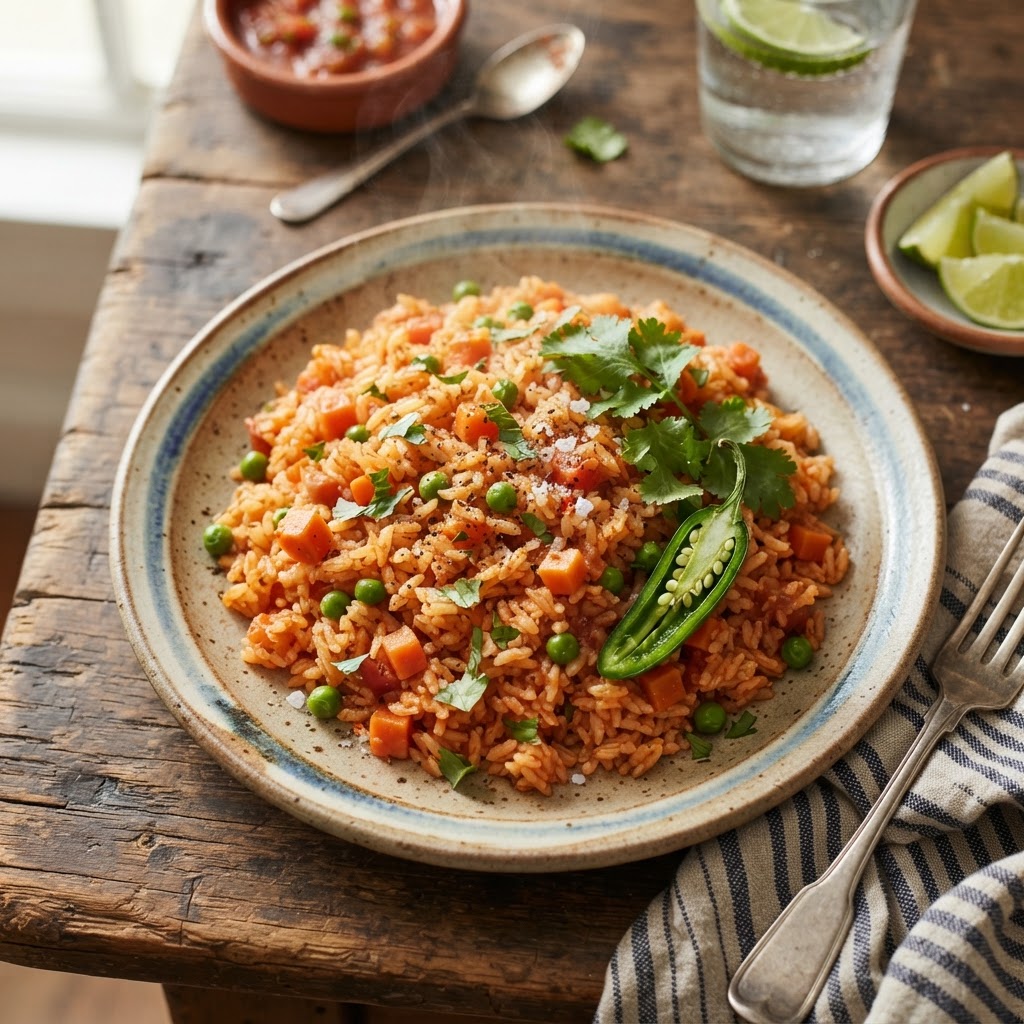
Arroz Rojo (Red Rice)
Bring a warm, festive glow to your table with this vibrant Arroz Rojo. Perfectly toasted rice simmered in a savory tomato-garlic broth creates a comforting side dish that celebrates every season.
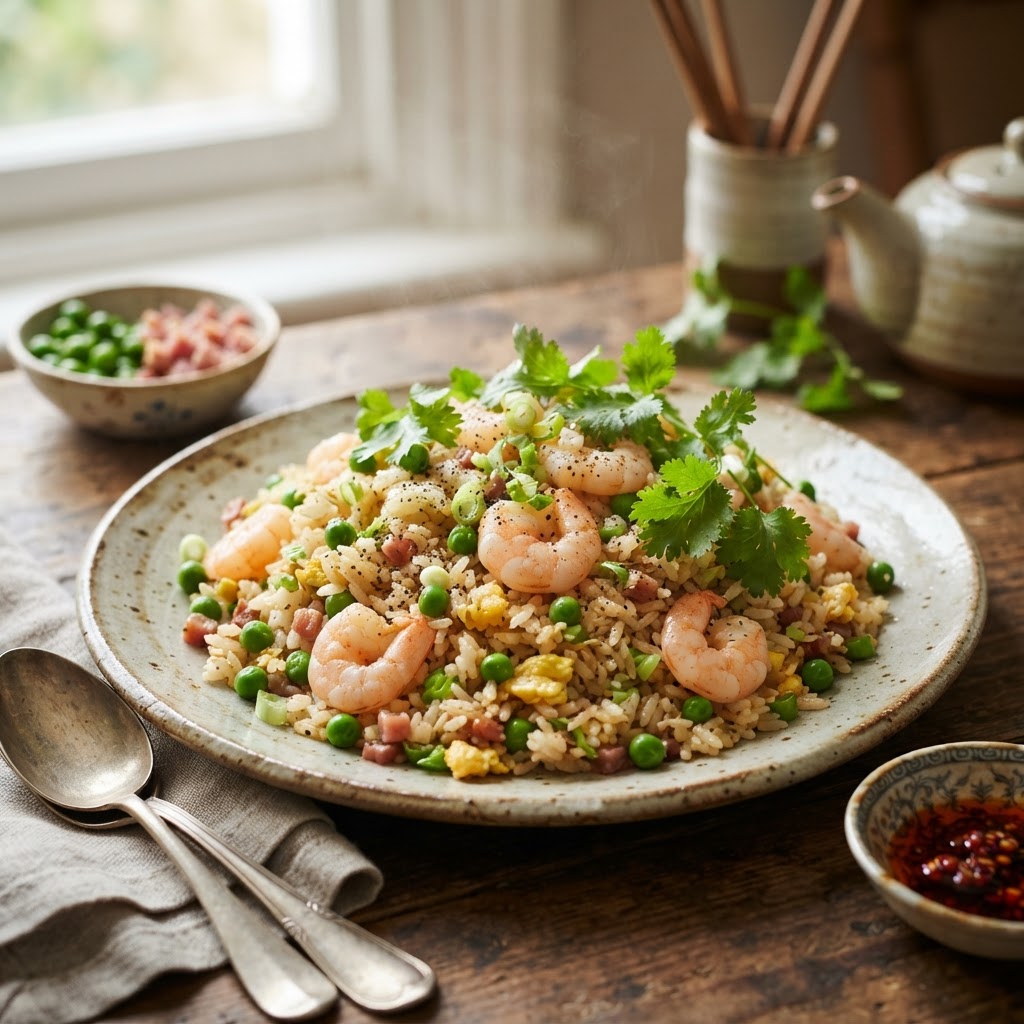
Yangzhou Fried Rice
Celebrate every season with this vibrant Yangzhou fried rice, where succulent shrimp and crisp peas dance in perfectly seasoned grains. It is a festive, savory bowl that brings pure kitchen joy to your table.
All Other Recipes with Rice
1 recipe featuring Rice