
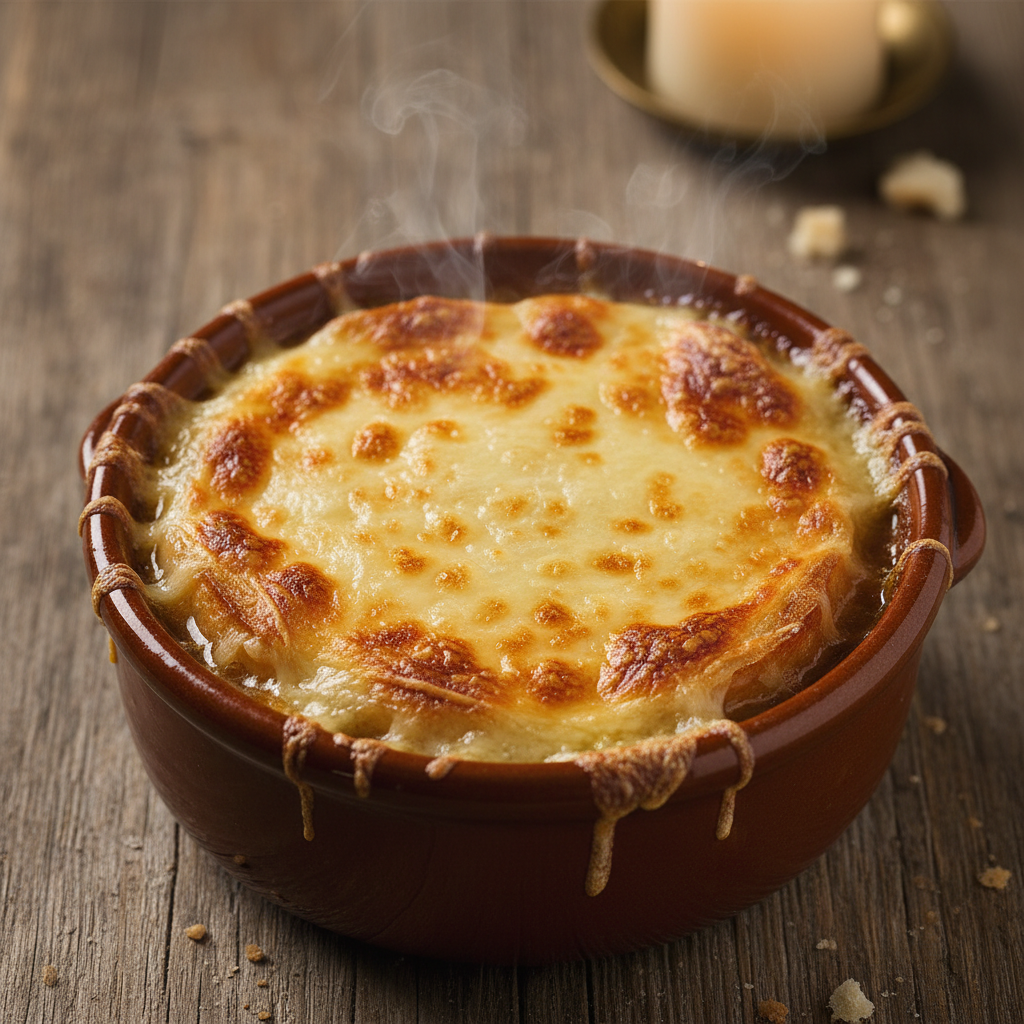
French Onion Soup
The Bowl That Changed Everything: A French Onion Soup Story
From Flint to the French Countryside
There are dishes that feed you, and then there are dishes that teach you. French onion soup belongs firmly in the second category. As someone who's traveled to over 50 countries, cooked in professional kitchens, and now tends an urban herb farm in Flint, Michigan, I can tell you that this seemingly simple bowl of caramelized onions and melted cheese has been one of my greatest culinary teachers.
My formal education—a bachelor's degree in International Business and studies toward two master's degrees—taught me to analyze, strategize, and understand complex systems. But it was a cold November evening in the French countryside, years after my restaurant days, that taught me the true meaning of patience in cooking. And it all started with onions.
The Earthship Experience
I was staying at an Earthship—one of those remarkable sustainable homes built into hillsides using recycled materials—just outside a small village in the Loire Valley. The owner, Marie-Claude, was a retired chef who had spent 40 years cooking in Lyon before retreating to this off-grid paradise. On my second night there, as rain drummed on the curved glass windows overlooking her greenhouse, she invited me to help prepare dinner.
"We make soupe à l'oignon," she announced, setting out what seemed like an impossibly large pile of onions on her reclaimed wood counter. "The real way. No shortcuts."
I had made French onion soup before, or so I thought. Quick weeknight versions from my restaurant days, where we'd speed up the caramelization with sugar or high heat. But Marie-Claude shook her head when I mentioned this. "Non, non. The onions must teach you patience. This is not fast food. This is meditation."
The Lesson in the Pot
For the next hour and a half, I stood at her vintage cast-iron stove, stirring onions. Just onions, butter, and time. Marie-Claude sat nearby, mending a wool sweater, occasionally glancing up to check my technique. "Not too fast," she'd remind me. "Let them speak to you. They will tell you when they are ready."
As someone who works with herbs and spices daily on my urban farm, I understood the language of aromatics. But this was different. The onions went through transformations I had never noticed before: first they released their moisture, crying into the pan. Then they softened, turning translucent like evening light through autumn leaves. Slowly, so slowly, they began to take on color—first at the edges, then spreading throughout, deepening from gold to amber to rich mahogany.
"Now you see," Marie-Claude said when the onions had finally reached that perfect state of jammy, deeply caramelized sweetness. "This color, this sweetness—you cannot buy this in a jar. You cannot rush this with sugar. The onions do this themselves, if you give them time and attention."
The Science Behind the Magic
Later, as we sat in her greenhouse-heated living room with steaming bowls of the finished soup, cheese still bubbling on top of thick-cut bread, she explained what I was tasting. The Maillard reaction, she called it—the complex chemical process that creates hundreds of new flavor compounds when proteins and sugars are heated slowly. This wasn't just caramelization; it was transformation.
My business background kicked in. I started thinking about this like a supply chain: input raw materials (onions, time, heat), process them correctly (low and slow), and get an exponentially more valuable output (deep, complex flavor). But it was more than that. This was about respecting the ingredient, understanding its nature, and working with it rather than against it.
Bringing It Home to Flint
When I returned to Flint and my urban farm, I looked at my herbs with new eyes. The thyme, rosemary, and lavender I was growing weren't just ingredients—they were teachers too, each with their own timeline, their own requirements, their own lessons to impart. I started developing my own version of Marie-Claude's soup, using the herbs I'd dried from my garden that summer.
The breakthrough came when I created what I now call Herbes de Hebron, my take on the classic herbes de Provence that Marie-Claude had used. Working with Asbury Farms, the nonprofit where I volunteer, I learned even more about the patience required to grow, harvest, and dry herbs properly. Just like those onions, herbs can't be rushed. The lavender needs to dry in darkness to preserve its color. The thyme must be bundled and hung just so to maintain its potency.
Teaching My Children the Art of Patience
Now, when I make French onion soup at home, my daughter and son take turns stirring the onions. At first, they'd complain—"Dad, this takes forever!" But over time, they've learned what Marie-Claude taught me. My daughter, who loves to cook, has developed an intuition for when the onions are ready. She can smell the shift from sharp to sweet, can see the exact moment when they need a splash of broth to deglaze the fond building on the bottom of the pot.
My son, meanwhile, has become the family's official bread toaster and cheese grater. He's learned that the baguette slices need to be cut on the bias—not straight across—to maximize surface area for the cheese. He knows that Gruyère, with its nutty, slightly sweet flavor, is the perfect match for the caramelized onions, creating a flavor bridge that ties the whole dish together.
Our dog, patient as ever, waits beneath the kitchen table during the long cooking process, knowing that scraps of cheese and bread will eventually come his way. Even he has learned that good things come to those who wait.
Why This Recipe Matters
French onion soup represents everything I believe about food and cooking. It's democratic—made from humble, inexpensive ingredients that are available to everyone. It's sustainable—I work with onions from local Michigan farms, bread from our neighborhood baker, and herbs from my own garden. It's educational—every time I make it, I learn something new about heat, timing, and flavor development.
But more than that, it's honest. You can't fake French onion soup. You can't take shortcuts without the final dish betraying you. Those onions will either be properly caramelized—sweet, complex, almost jammy in texture—or they won't. The broth will either be rich and balanced, or it will taste flat and one-dimensional. The cheese will either melt into golden, stretchy perfection under the broiler, or it will burn or stay rubbery.
The Vegetarian Advantage
My version is vegetarian, using rich vegetable broth instead of the traditional beef stock. This isn't a compromise—it's an evolution. When you caramelize onions properly and build flavor through wine, port, and a Parmigiano-Reggiano rind, you don't need meat to create depth. The vegetables speak for themselves, their flavors concentrated and intensified through patient cooking.
This approach also aligns with my work at Asbury Farms, where we focus on sustainable, plant-forward agriculture. We've learned that vegetables, when treated with respect and proper technique, can be just as satisfying and flavorful as any meat-based dish.
The Technical Details That Matter
After making this soup dozens of times, I've learned the details that separate good from transcendent:
The Onion Choice: I use a mix of red onions and shallots. Red onions provide sweetness and color, while shallots add a delicate, almost garlicky complexity. Some recipes call for yellow onions exclusively, but I find the combination more interesting.
The Herb Blend: Herbes de Hebron (or traditional herbes de Provence) isn't just thrown in—it's bloomed in the fat at the beginning. This releases the essential oils in the dried herbs, perfuming the entire dish from the start. The lavender in particular adds a subtle floral note that most people can't identify but everyone notices.
The Wine Strategy: Port and red wine aren't interchangeable in this recipe. The port adds sweetness and body, while the red wine (I prefer Merlot or a Merlot blend) provides acidity and tannins that cut through the richness. Together, they create a more complex flavor than either could alone.
The Bread Technique: Toasting the bread first, then adding cheese and broiling, ensures you get crispy bread that doesn't turn soggy in the soup. It's a small step that makes a huge difference in texture.
A Dish for All Seasons
While I've marked this as a fall recipe on Seasons of Yum—and it is perfect for those cool autumn evenings when the onions from summer are still plentiful—the truth is that French onion soup works year-round. In winter, it's warming and substantial. In spring, it's a way to use up storage onions before the new harvest. In summer, believe it or not, a bowl of this soup after a day of hiking (another passion of mine, along with scuba diving) hits differently than you'd expect—satisfying and grounding.
The Restaurant Connection
During my time cooking in restaurants while pursuing my degrees, I learned that French onion soup is often the dish that separates serious kitchens from mediocre ones. It can't be entirely prepped ahead. The onions can be caramelized in advance, yes, but the final assembly—the broth, the bread, the cheese—must be executed to order. It requires timing, attention, and care.
I've seen line cooks rush the onions, trying to shave 20 minutes off the cooking time. The result is always disappointing: onions that are brown on the outside but raw-tasting inside, lacking that deep, developed sweetness that defines the dish. There's no shortcut. The soup knows if you've cheated.
Beyond Technique: The Soul of the Dish
What Marie-Claude taught me in that Earthship, beyond technique, was that cooking is an act of attention. When you stand at the stove for 40 minutes, stirring onions, you're not just cooking—you're meditating. You're practicing presence. You're learning patience.
This lesson has carried over into every aspect of my life. On my urban farm, I don't rush the herbs. At Asbury Farms, we don't push the soil beyond its capacity. With my children in the kitchen, I don't hurry them through the steps. And when we finally sit down together to eat—our family favorite might be Yaka Mein, but French onion soup holds a special place—we savor it.
Making It Your Own
I encourage you to make this recipe your own. If you don't have Herbes de Hebron, use herbes de Provence or even just thyme and a bay leaf. If you can't find Gruyère, try a good Swiss or even aged cheddar. If you don't drink, replace the wine and port with extra vegetable broth and a splash of balsamic vinegar for acidity.
But don't skip the long, slow caramelization of the onions. Don't rush that step. That's where the magic happens. That's where the onions transform from sharp and pungent to sweet and complex. That's where you learn patience, if you're willing.
The Final Bowl
When you finally ladle that deeply colored broth into a bowl, when you top it with the crispy, cheese-covered bread, when you take that first spoonful and taste all the layers of flavor—the sweet onions, the rich broth, the herbs, the tangy cheese—you'll understand why this soup has endured for centuries.
It's not because it's fancy or complicated. It's because it's honest. It asks for your time and attention, and in return, it gives you something profound: a bowl of soup that tastes like patience itself, like care made edible, like a cold November evening in the French countryside, rain on the windows, and the wisdom of a retired chef who understood that the best recipes aren't just about food—they're about life.
Make this soup. Take your time. Let the onions teach you. And when you serve it to people you love, tell them the story. Because food is always better when you know where it came from—not just the ingredients, but the knowledge, the experience, and the care that went into making it.
That's what cooking is really about. And that's what this bowl of French onion soup, more than almost any other dish I know, has taught me.
From my farm in Flint to your kitchen, from that Earthship in the Loire Valley to wherever you're reading this—may your onions caramelize perfectly, may your patience be rewarded, and may your bowl overflow with warmth.
Ingredients
- 2 tbsp Unsalted butter
- 1 tbsp Olive oil
- ½ tsp, plus more if needed Freshly ground black pepper
- ½ tsp Herbes de Hebron or herbes de Provence
- Pinch to ¼ tsp Red pepper flakes
- 3 medium Red onions, halved and thinly sliced
- 2 large Shallots, halved and thinly sliced
- 1 tbsp, plus more if needed Kosher salt
- 3 Garlic cloves, finely minced
- ¼ cup (60 ml) Port
- ¼ cup (60 ml) Red wine, preferably Merlot or Merlot blend
- 6½ cups (1.5 L), plus more if needed Warm vegetable broth
- 2 cups (480 ml) Water
- 1 small Parmigiano-Reggiano rind (optional)
- 1 Baguette
- For drizzling Extra-virgin olive oil
- 1 cup (100g) Grated Gruyère cheese
Instructions
- 1
Heat the butter with the olive oil in a large Dutch oven or soup pot over medium heat. Once the butter is melted, add the pepper, Herbes de Hebron and red pepper flakes, cooking the spices until fragrant, stirring occasionally, 1 to 2 minutes.
- 2
Stir in the onions, shallots, and salt. Once the onions are just starting to brown around the edges (3 to 5 minutes), add the garlic. Reduce the heat to medium-low and cook, stirring every few minutes, until the mixture is deeply browned and crispy, about 40 minutes. If the mixture begins to get too dark, splash the pan with vegetable broth to loosen the browned bits.
- 3
Pour in the port and red wine, stirring and scraping the bottom of the pan to release the browned bits. Simmer until the liquid is absorbed by the onions but the pan is still wet, about 30 seconds.
- 4
Add the warm vegetable broth, water, and Parmigiano-Reggiano rind (if using) and bring to a boil. Reduce the heat to medium-low and gently simmer for 30 minutes. Taste for seasoning, adding more salt and pepper if necessary.
- 5
While the soup cooks, adjust an oven rack to the upper-middle position and heat the broiler to high. Slice the baguette on the bias into ¼-inch to 6mm-thick slices. Place the slices on an aluminum foil-lined baking sheet and drizzle with extra-virgin olive oil. Broil until browned and toasted, about 1 minute.
- 6
Remove from the oven, turn the slices over, and sprinkle the untoasted side with Gruyère cheese. Broil until the cheese is browned and bubbly, 1 to 2 minutes.
- 7
Divide the hot soup into bowls. Place a few slices of Gruyère toast, cheese-side up, in each bowl and serve immediately.
Ingredients available from local farms near you
Enter your ZIP code to find local farms that have this recipe's ingredients available.
My Notes
Log in to save your own notes for this recipe — tweak ideas, swaps, and reminders just for you.