
Grains & Seeds · Year-round (harvested autumn in the Andes)
Quinoa
Chenopodium quinoa · Also: Quinua, Mother Grain, Gold of the Incas, Tricolor Quinoa, Red Quinoa, Black Quinoa
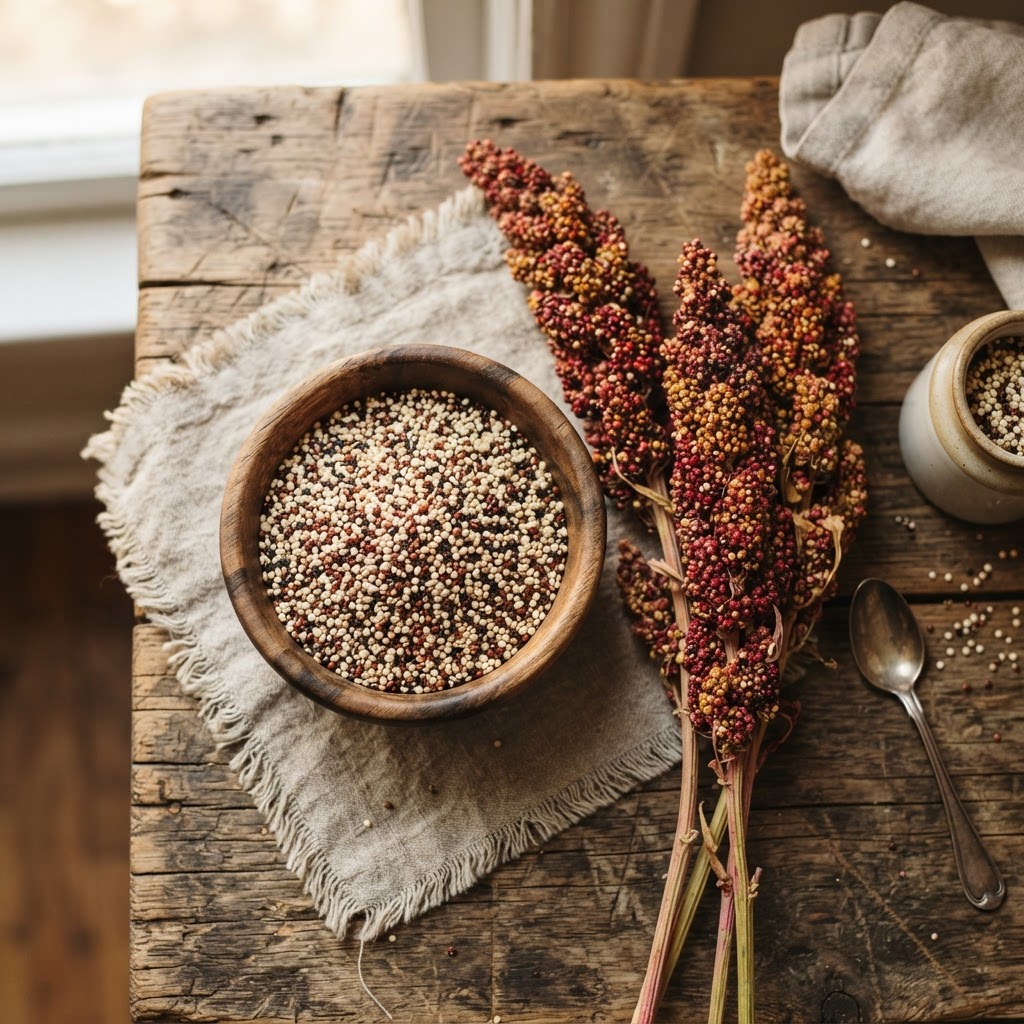
Quinoa is the ancient 'mother grain' of the Andes — a sacred seed domesticated in the high Altiplano of Bolivia and Peru some 5,000 years ago and revered by the Inca as the 'mother of all grains' (mama jata). Planted at 12,000 feet, where few crops survive, quinoa thrives in the thin air, intense sun, and frosty nights of the Andes, producing vivid red, gold, black, and white seed heads that turn the high fields into a rainbow at harvest.
Though cooked and eaten like a grain, quinoa is technically a seed — a 'pseudocereal' related to spinach, chard, and amaranth — and it is one of the few plant foods that is a complete protein, with all nine essential amino acids. Tiny and bead-like, quinoa has a mild, nutty flavor and a distinctive fluffy, slightly crunchy texture with a tender bite and a tiny curly tail (the germ) that unfurls when cooked. It is high in protein, fiber, iron, and magnesium, naturally gluten-free, and quick to cook — a nutritional powerhouse that the UN honored with its own International Year. From Inca offerings to Pachamama to modern bowls, salads, and gluten-free baking, quinoa is the seed that crossed from an ancient Andean sacred crop to a global superfood in a single generation.
White Quinoa (Golden Quinoa)
The most common and mildest variety — pale ivory when cooked, light and fluffy with a soft, slightly nutty flavor; the all-purpose quinoa for salads, bowls, soups, and sides; quick-cooking (15 minutes) and the most widely available.
Red Quinoa
Deep red-brown seeds that hold their shape and crunch when cooked, with a slightly earthier, nuttier flavor than white; prized for salads, pilafs, and stuffed vegetables where texture matters; often used in tricolor blends.
Black Quinoa
Small black seeds with the deepest, earthiest flavor and the firmest texture; sweeter and crunchier than white or red; holds its shape beautifully in salads and grain bowls; grown in the Bolivian and Peruvian highlands.
Tricolor (Rainbow) Quinoa
A blend of white, red, and black quinoa that cooks into a colorful, textured mix — fluffy white, crunchy red, earthy black; the most visually striking and texturally varied form, popular for salads and grain bowls.
Quinoa Flakes
Quinoa seeds rolled flat into quick-cooking flakes, like rolled oats; used for hot quinoa porridge, in baking, and as a gluten-free coating; cook in a minute or two and have a mild, slightly sweet flavor.
Quinoa Flour
Finely milled quinoa seeds — a high-protein, gluten-free flour with a slightly nutty, earthy flavor; used in gluten-free baking, pancakes, and as a protein boost in baked goods, often blended with other gluten-free flours.
Buy quinoa as whole seeds (white, red, black, or tricolor), flakes, or flour; for everyday cooking, white quinoa is the most versatile and mildest, while red, black, and tricolor add texture and color to salads and bowls. Most quinoa sold today is pre-rinsed to remove the bitter saponin coating, but a quick rinse before cooking is still recommended.
Look for plump, clean seeds with no dust or bitterness in smell; pre-rinsed brands save a step, but unwashed quinoa (often from Bolivian cooperatives) may need thorough rinsing to remove the natural saponin, a bitter soap-like coating that protects the seed from birds and pests. Fair-trade and organic quinoa supports the Andean farming communities that have grown it for millennia.
Season: quinoa is planted in the Andean spring and harvested in autumn (April–June in the southern hemisphere); the dried seeds and flours are available year-round worldwide.
Keep dry quinoa seeds in an airtight container in a cool, dry, dark place for up to a year — the seeds store well, like other dry grains. Quinoa flour, with its oils exposed, is more perishable; refrigerate or freeze and use within a few months. Cooked quinoa keeps 5–7 days refrigerated and freezes well for up to 3 months, which makes it convenient for meal prep and quick weeknight bowls.
Harvesting: Quinoa is planted in the Andean spring and harvested in autumn when the seed heads turn from green to vivid red, gold, or deep red; the tall stalks are cut by hand, dried, and threshed to release the tiny seeds — a labor of high-altitude farming that has changed little in thousands of years.
Removing the saponin: Each quinoa seed is coated in saponin, a bitter, soap-like compound that naturally protects the seed from birds and pests; the saponin must be removed by washing or polishing before eating. Most commercial quinoa is pre-rinsed, but a quick rinse at home removes any remaining bitterness.
Cooking: Quinoa is cooked like rice or pasta — one part quinoa to two parts liquid, simmered 15 minutes until the seeds unfurl their tiny white germ (the 'tail') and become tender and fluffy; rinse before cooking to remove bitterness and any residual saponin.
Quinoa Bowls & Salads
The classic modern use — fluffy cooked quinoa as a base for grain bowls, salads (like tabbouleh-style quinoa salads), and Buddha bowls; its nutty flavor and slight crunch make it a satisfying, protein-rich alternative to rice or couscous, and it holds dressings beautifully.
Quinoa Pilafs & Side Dishes
Quinoa cooked with broth, vegetables, herbs, and spices as a pilaf; the seeds absorb flavors well and stay fluffy and separate, making it a versatile side for roasted vegetables, grilled meats, and stews — a lighter, higher-protein alternative to rice pilaf.
Quinoa Soups & Stews
Quinoa added to soups, stews, and chowders for protein and body — in Andean quinoa soups (sopa de quinoa), in Latin American stews, and in modern vegetable soups; the seeds soften but keep their shape and add a gentle, nutty thickness.
Quinoa Porridge & Breakfast Bowls
Quinoa flakes or cooked quinoa simmered with milk and sweetened into a creamy porridge, like oatmeal; topped with fruit, nuts, and honey; a high-protein, gluten-free breakfast alternative to oats.
Quinoa Burgers, Veggie Balls & Fritters
Cooked quinoa bound with egg and vegetables into veggie burgers, meatballs, fritters, and patties; its stickiness and protein make it an excellent binder and a satisfying base for vegetarian and gluten-free dishes.
Quinoa Flour Baking & Gluten-Free Cooking
Quinoa flour in gluten-free pancakes, muffins, breads, and cookies for a high-protein, nutty lift; quinoa flakes in granola and as a gluten-free coating for fish and chicken; a protein-boosting flour in everyday baking.
Drying: Quinoa seeds keep for up to a year in a sealed, cool, dry place — the high-altitude crop was a traditional staple stored in village stores through the Andean winter; the dry, hard seeds store as well as any grain.
Cooked & frozen: Cooked quinoa keeps 5–7 days refrigerated and freezes for up to 3 months — cook a large batch and freeze portions for quick weeknight bowls, a modern meal-prep use of the ancient grain.
Milling: Quinoa flour is more perishable than whole seeds and is best kept in the fridge or freezer; home-milling whole quinoa into fresh flour gives the best flavor and nutrition, but the bitter saponin must be fully removed before milling.
Quinoa is one of the few plant foods that is a complete protein — it contains all nine essential amino acids, including lysine, which most grains lack; this is why it was so vital to Andean peoples who relied on it as a protein source, and why it is prized by vegetarians, vegans, and gluten-free eaters today.
Quinoa is high in fiber, iron, magnesium, phosphorus, manganese, folate, and antioxidants; it has a lower glycemic index than most grains, giving slow, sustained energy, and is naturally gluten-free, making it safe for people with celiac disease.
Quinoa is also rich in quercetin and kaempferol — plant antioxidants (flavonoids) in higher amounts than in high-antioxidant berries like cranberries — which have anti-inflammatory and heart-protective effects; a nutritional profile that earned it the name 'gold of the Incas' and a UN International Year.
Quinoa was sacred to the Inca, who called it the 'mother of all grains' (chisaya mama) and planted the first seeds of the season with golden ceremonial tools; the Spanish conquistadors banned its cultivation and forced the Andean peoples to grow wheat instead, but quinoa survived in high-altitude villages for 500 years until its modern rediscovery.
The United Nations declared 2013 the International Year of Quinoa, recognizing its potential to improve food security worldwide; Bolivian and Peruvian farmers who had grown it for millennia suddenly found their ancient crop in demand from New York to Tokyo — a rare story of an Indigenous crop returning to the global table.
Quinoa is not a true grain but a 'pseudocereal' — a seed cooked and eaten like a grain, botanically related to spinach, chard, and amaranth; the leaves of the quinoa plant are also edible and were traditionally eaten as a vegetable, like its cousin spinach.
Quinoa can grow at altitudes up to 13,000 feet, surviving frosts, droughts, and poor soils where almost no other crop will — which is why it became the staple of the high Andes; NASA has studied quinoa as a potential crop for long-duration space missions because of its complete protein and hardiness.
From Inca solstice ceremonies to the UN International Year of Quinoa, the 'mother grain' of the Andes is celebrated worldwide:
National Quinoa Day
Worldwide (origin: Bolivia, Peru, Ecuador)
🗓 January 16, 2026
National Quinoa Day (January 16) celebrates the ancient grain of the Andes; the United Nations declared 2013 the International Year of Quinoa, recognizing its role in food security and its revival after centuries of suppression; quinoa is honored as the 'mother grain' of the Andean peoples.
Inti Raymi & Willkakuti (Festival of the Sun)
Cusco, Peru & the Andean highlands
🗓 June 24, 2026 (winter solstice in the Andes)
The Inca festival of Inti Raymi, the Festival of the Sun, falls on the Andean winter solstice and honors Inti, the sun god, with ceremonies that include quinoa and other sacred Andean crops; quinoa (kinua in Quechua) was the 'mother grain' (mama jata) of the Inca, planted and harvested with ritual offerings to Pachamama, the Earth Mother.
Aymara New Year & Willkakuti
Tiwanaku, Bolivia & the Aymara Andes
🗓 June 21, 2026 (southern winter solstice)
The Aymara New Year (Willkakuti), celebrated at the pre-Columbian site of Tiwanaku on the June 21 winter solstice, marks the return of the sun; quinoa, along with potatoes and chuño, is shared at the sunrise ceremonies, honoring the ancient Andean trinity of grains that has sustained the highlands for thousands of years.
Quinoa Harvest Festivals
Bolivian Altiplano & Peruvian Andes
🗓 April–June 2026 (Andean autumn harvest)
The quinoa harvest on the high Altiplano of Bolivia and Peru is marked by village festivals celebrating the 'golden grain of the Andes'; families harvest the vivid red, gold, and white seed heads by hand, share quinoa stews and chicha, and offer the first fruits to Pachamama in a ritual of thanks that goes back to before the Incas.
High-altitude & low-input: Quinoa thrives in the harsh, high-altitude conditions of the Andes — frosty nights, intense sun, poor soils, and little rain — where it needs far less water and fertilizer than most grains; a resilient, low-input crop suited to marginal land that other crops cannot use.
Andean farming communities: Quinoa is grown mainly by smallholder Aymara and Quechua farmers on the Bolivian and Peruvian Altiplano; fair-trade and organic quinoa supports these communities and preserves the traditional farming methods that have sustained the crop for millennia, though the global boom has also raised concerns about land and water pressure.
Biodiversity: There are over 3,000 varieties of quinoa, adapted to different altitudes, soils, and climates — a genetic diversity that is a global agricultural treasure and is being preserved by Andean seed banks and farming communities; this diversity is the crop's insurance against climate change.
Global range: Quinoa originated in the Andes around Lake Titicaca and is still grown mainly in Bolivia, Peru, and Ecuador; it is now also cultivated in the US, Canada, Europe, and India as its global demand has grown — but the highest-quality and most traditional quinoa still comes from the high Altiplano, the 'mother grain' of the Andean peoples.
Available Near You
Enter your ZIP code to find farms with quinoa near you.
Recipes with Quinoa
Coming Soon