
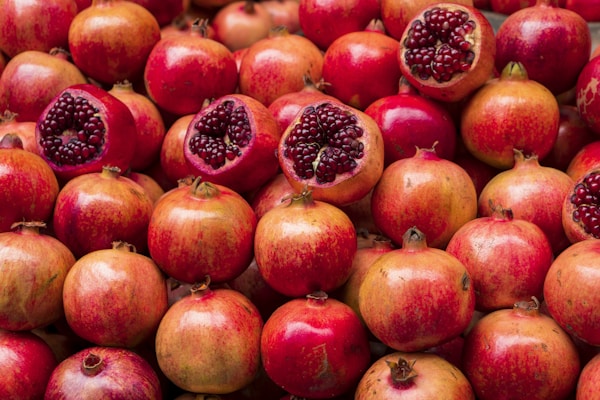
Pomegranate
Ancient, jewel-like, and complex — tart, sweet arils packed with antioxidants and culinary versatility.
Choose pomegranates that are heavy for their size — weight indicates more juice. The skin should be taut, leathery, and blemish-free; a flat or angular shape (rather than perfectly round) is normal and even indicates larger, juicier arils inside. Skin color varies from pink to deep red-purple and is not a strong ripeness indicator.
Peak season is October through January in North America. Pomegranates store well — a whole pomegranate can be kept at room temperature for 1–2 weeks, or refrigerated for up to 2 months.
Water Method: Score the skin in quarters from crown to base without cutting into the arils, then submerge in a bowl of cold water and break apart — arils sink, bitter white pith floats. Drain and use.
Spoon Method: Halve the pomegranate and tap firmly with a wooden spoon over a bowl — arils fall out quickly. Wear an apron — pomegranate juice stains permanently.
Whole pomegranates store remarkably well: at room temperature for 1–2 weeks, or refrigerated for up to 2 months. The leathery skin protects the arils inside.
Extracted arils can be refrigerated in an airtight container for 5–7 days, or frozen for up to 3 months. Frozen arils retain their color, flavor, and nutritional value well. Pomegranate juice should be refrigerated and used within 5 days, or frozen in ice cube trays for longer storage.
Pomegranate Molasses: Pomegranate juice simmered with sugar and lemon until thick and syrupy — the essential ingredient of Persian and Levantine cooking. Used in fesenjan (walnut-pomegranate stew), muhammara (roasted pepper dip), and countless salad dressings. Available commercially; worth making from scratch.
Salad Garnish: Arils scattered over salads, grain bowls, and yogurt — they add color, crunch, sweetness, and tartness simultaneously. A standard garnish in Middle Eastern cuisine.
Sauce for Meat: Reduced pomegranate juice with red wine and stock as a sauce for duck, lamb, venison, and game — the tartness cuts through rich meats beautifully and the deep color is visually stunning.
Cocktails: The juice adds a vivid red color and complex flavor to cocktails — the classic Shirley Temple uses grenadine, which is traditionally pomegranate-based.
Juice: Extract arils, then press in a citrus juicer or pulse in a blender and strain. Fresh pomegranate juice freezes well in ice cube trays.
Pomegranate Molasses: Simmer 4 cups of juice with ¼ cup sugar and ¼ cup lemon juice until reduced by two-thirds into a thick syrup. Stores in the refrigerator for months.
Grenadine: Traditional grenadine is made from pomegranate juice — a sweeter version of pomegranate molasses used in cocktails. Most commercial grenadine contains no real pomegranate.
Freeze Arils: Spread on a sheet pan, freeze until solid, then bag. Perfect for smoothies, sauces, and garnishes year-round.
Pomegranate has one of the highest antioxidant capacities of any fruit — three times the antioxidant activity of red wine and green tea. The primary antioxidants are punicalagins (unique to pomegranate) and anthocyanins, which give the arils their deep red color.
One cup of arils provides 30% of the daily value for vitamin K, 17% for vitamin C, 16% for folate, and 12% for potassium at 144 calories. Research has demonstrated pomegranate's ability to reduce blood pressure, lower LDL cholesterol, reduce inflammation, and potentially slow prostate cancer progression.
Pomegranate is one of the most scientifically studied fruits for its health benefits. The juice has been shown in multiple studies to reduce arterial plaque and improve blood flow in patients with cardiovascular disease.
Pomegranates are among the oldest cultivated fruits in human history. Archaeological evidence of pomegranate cultivation in Iran dates to 5,000 BCE. They appear in ancient Egyptian tomb paintings, are mentioned in the Bible, the Quran, and the Talmud, and feature prominently in Greek mythology as the fruit that bound Persephone to the underworld.
The word 'pomegranate' comes from the Old French 'pomme garnete' — 'seeded apple.' The fruit's name in Latin, 'malum granatum,' inspired the Spanish city name Granada and the English word 'grenade' (for the hand-thrown weapon, which resembles the fruit's shape and explosive scattering of seeds).
A single pomegranate contains an average of 613 seeds, though the range is 200–1,400. Each seed is surrounded by a juice-filled aril — technically the edible part is the aril, not the seed itself (the seed is the hard white pit inside the aril).
Iran, India, China, and the United States (primarily California) are the major pomegranate producers. Pomegranate trees are drought-tolerant once established — an important characteristic as climate change makes water scarcity more prevalent in traditional growing regions.
The fruit is harvested by hand, providing important seasonal employment in agricultural communities. The entire fruit is usable: juice, arils, rind (used in tanning and as a natural dye), and even the flowers.
Pomegranate trees are long-lived — they can produce fruit for over 200 years — making orchards an extremely durable agricultural investment with minimal annual soil disturbance.
In-Season Recipes with Pomegranate
Seasonal recipes featuring Pomegranate right now
Coming Soon
All Other Recipes with Pomegranate
Coming Soon