Legumes, Beans & Nuts · Fall
Pistachios
Pistacia vera · Also: Green Gold, Pesteh, Foustik
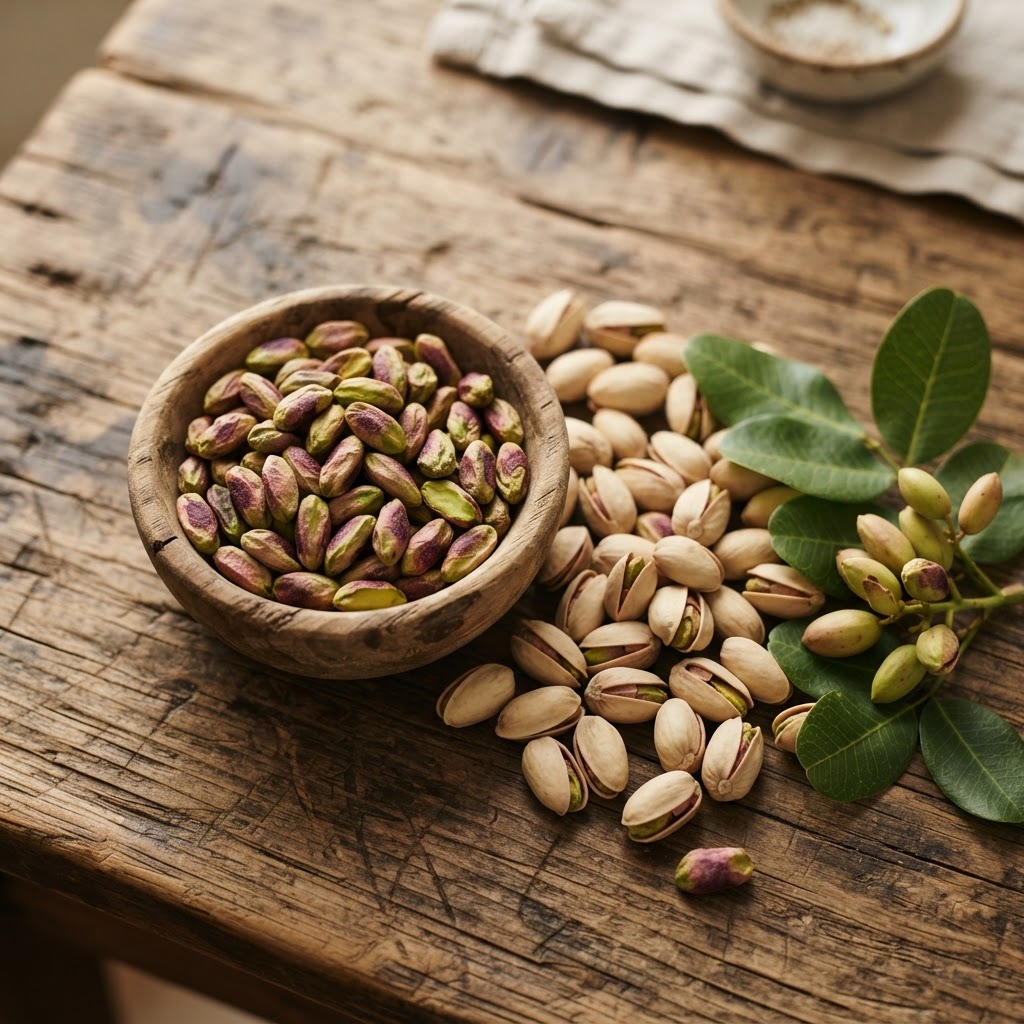
Pistachios are the pale-green seeds of a small desert tree native to the Middle East — one of the oldest nut crops in the world, eaten and traded for at least 9,000 years. The shell splits open naturally on the tree as the nut ripens, revealing the brilliantly green kernel within — so vivid the pistachio gives its name to the color "pistachio green."
Native to Iran and Central Asia, pistachios are the signature nut of Persian cooking, studding rice, gaz nougat, and sweets; the topping of Lebanese and Turkish pastries like baklava; and the pride of Sicilian Bronte, where the DOP pistachio of Mount Etna flavors gelato, granita, and pasta. Today California, Iran, and Turkey dominate world production, and the pistachio's buttery, resinous sweetness — eaten roasted and salted, ground into paste, or scattered over sweets — has made it one of the most beloved and valuable of all nuts.
Kerman
The classic Iranian-origin variety, the most widely grown in California — large, high-split, and creamy, with a mild, buttery flavor and pale-green kernel.
Kaleh Ghouchi (Iranian)
A prized Iranian variety — large, round, and richly flavored, with a deep green kernel; one of the most beloved table pistachios of the Kerman region.
Akbari (Iranian)
A premium long Iranian pistachio — long, large, and bright green, prized for export and for snacking, with a rich, intense pistachio flavor.
Bronte / Sicilian DOP
The prized pistachio of Mount Etna in Sicily — small, intensely green, and resinous; harvested every two years (alternating) and protected by a DOP designation as 'green gold.'
Antep / Turkish
The small, intensely flavored pistachio of southeastern Turkey (Gaziantep) — the traditional pistachio of Turkish baklava, with a deep green color and concentrated flavor.
Lost Hills / Golden Hills
Newer University of California varieties with high split rates and early harvest — gaining ground in California's Central Valley alongside the classic Kerman.
Buy in-shell pistachios that have naturally split open on the tree — look for shells cracked along their seam, clean shells with no dark spots, and vivid green kernels visible at the split; closed shells mean an immature nut.
For shelled pistachios, look for brilliant, bright-green kernels with the thin purplish skin intact and a fresh, sweet smell — the greener the kernel, the higher the quality and the more prized for sweets and garnish.
Avoid pistachios with yellowed, dull kernels, a rancid or painty aroma, or shells stained or perforated by insects — these signal age or weevil damage. For pesto, gelato, or pastry, splurge on Sicilian Bronte, Turkish Antep, or Iranian Akbari for the deepest flavor and color.
Pistachios keep far better than pecans or pine nuts thanks to their shell, but still turn rancid over time. Keep in-shell pistachios in an airtight container in a cool, dry cupboard for up to a year; shelled pistachios in the fridge for up to 6 months, or in the freezer for up to a year. Roasted and salted pistachios should be kept sealed and eaten within a few months for best flavor.
Harvesting: Pistachios ripen in early autumn; the husk turns pink and splits, the shell cracks open along its seam, and growers shake the branches to drop the nuts onto catching frames below.
Hulling & drying: The outer pink-red husk must be removed within hours of harvest to avoid staining, then the in-shell nuts are washed and dried to a low moisture for long storage.
Roasting & salting: In-shell pistachios are brined and roasted at about 120°C (250°F) until the kernels are fragrant and the shells lightly toasted — the classic way the world eats pistachios by the handful.
Roasted & Salted (In-Shell)
The classic way to eat pistachios — brined and roasted in the shell, eaten by the handful; a staple of Mediterranean and Middle-Eastern gatherings, mezze, and aperitivo.
Pistachio Gelato
Italian gelato al pistacchio — a vivid-green, intensely nutty ice cream made with pistachio paste; the benchmark of a great gelateria, especially when made with Bronte pistachios.
Baklava & Middle-Eastern Sweets
Ground or whole pistachios stud and top baklava, Turkish delight, Persian gaz nougat, and Lebanese pastries — the green nut is the crowning garnish of the Eastern Mediterranean.
Pistachio Pesto (Sicilian)
A vibrant green Sicilian pesto of Bronte pistachios, garlic, basil, and olive oil — a creamy, resinous sauce for pasta, especially prized in eastern Sicily.
Persian Rice (Tahdig & Morasa Polo)
Slivered pistachios scattered over and through jeweled Persian rice dishes — morasa polo (jeweled rice), tahdig crust, and festive rice for Nowruz and weddings.
Pistachio Cake & Cookies
Ground pistachios give cakes, cookies, and macarons a vivid green color and tender crumb — from French financiers and dacquoise to Italian torta al pistacchio and Middle-Eastern cookies.
Drying: Fresh-harvested pistachios are dried to under 8% moisture to stabilize their oils and prevent mold — the fully dried in-shell nuts keep for a year or more.
Roasting & salting: Roasting and salting is both a flavor treatment and a preservation method — roasted pistachios keep well in a sealed jar and are the traditional way to preserve the harvest for snacking.
Pounding into paste: Ground pistachio paste (pistachio butter) can be frozen for months and used for gelato, pastries, and fillings — a way to preserve the harvest as a ready-to-use ingredient.
Pistachios are the lowest-calorie of the major nuts — about 562 calories per 100 g — and are high in unsaturated fats, providing about 20 g of protein and 10 g of fiber, making them one of the most filling nuts per calorie.
They are an excellent source of vitamin B6, potassium, copper, and manganese, and one of the richest nut sources of lutein and zeaxanthin, the antioxidants that give pistachios their vivid green color and support eye health.
Regular pistachio consumption is linked to lower cholesterol and improved blood-sugar control, and their protein and fiber make them a particularly satisfying snack for weight management.
Pistachios are one of the oldest nut crops — archaeological evidence shows pistachios were eaten in Turkey and Iran as early as 7000 BCE, and they are mentioned in the Old Testament and praised by Roman and Persian writers.
The shell splits open on the tree as the nut ripens, a phenomenon called "dehiscence" — pistachios are the only common nut with this trait, and it makes them uniquely easy to open by hand.
The color "pistachio green" comes directly from the vivid kernel — among nuts, only pistachios are so deeply green, thanks to their high chlorophyll and lutein content, which survives roasting and cooking.
The pistachio's alternate-year bearing is famous: a heavy crop one year is followed by a light one the next, especially for the prized Bronte pistachio of Sicily — so Sicilian DOP pistachios are harvested only every other autumn, doubling their rarity.
Pistachios are celebrated at autumn harvests across Iran, Turkey, Sicily, and California:
Kerman Pistachio Festival
Kerman, Iran
🗓 September 2026 (annual harvest)
Kerman province, the historic heart of Iranian pistachio growing, celebrates the autumn harvest with markets overflowing with fresh pistachios — the finest Kermani nuts, prized for their large size and vivid green color, fill the bazaars.
California Pistachio Harvest Season
California's Central Valley, USA
🗓 September–October 2026
California grows most of America's pistachios, and autumn harvest brings shaking machines into the orchards to knock the split-shell nuts onto catching frames — a high-tech harvest supplying over a billion pounds a year.
Gaz Pistachio Fairs
Isfahan & Yazd, Iran
🗓 October–November 2026
Iranian gaz nougat, studded with whole green pistachios, is made for Nowruz and autumn weddings — the confectioners of Isfahan and Yazd display towering displays of pistachio-studded sweets at harvest fairs.
Bronte Pistachio Festival
Bronte, Sicily, Italy
🗓 October 2026 (Sagra del Pistacchio)
The tiny town of Bronte on the slopes of Mount Etna celebrates its DOP pistachios — the prized 'green gold' of Sicily, harvested only every two years — with a sagra of pistachio gelato, pasta, pastries, and salami.
Drought-tolerant & long-lived: Pistachios thrive on poor, dry soils where other crops fail, surviving heat and drought with their deep roots; a pistachio tree can bear for a century, making orchards a long-term landscape.
Low-water nut: Pistachios use far less water than almonds or walnuts per acre, and are increasingly planted in California's Central Valley as a more drought-resilient nut crop — an advantage in a warming, water-scarce climate.
Global range: Iran, the United States (California), and Turkey produce most of the world's pistachios; Syria, Sicily, Greece, and Tunisia are historic growers. The pistachio is a Mediterranean and Central-Asian tree that has spread to similar arid climates worldwide.
In-Season Recipes with Pistachios
Seasonal recipes featuring Pistachios right now
Coming Soon
All Other Recipes with Pistachios
Coming Soon