
Legumes, Beans & Nuts · All Seasons
Pigeon Peas
Cajanus cajan · Also: Toor Dal, Gandules, Congo Pea, Ndengu
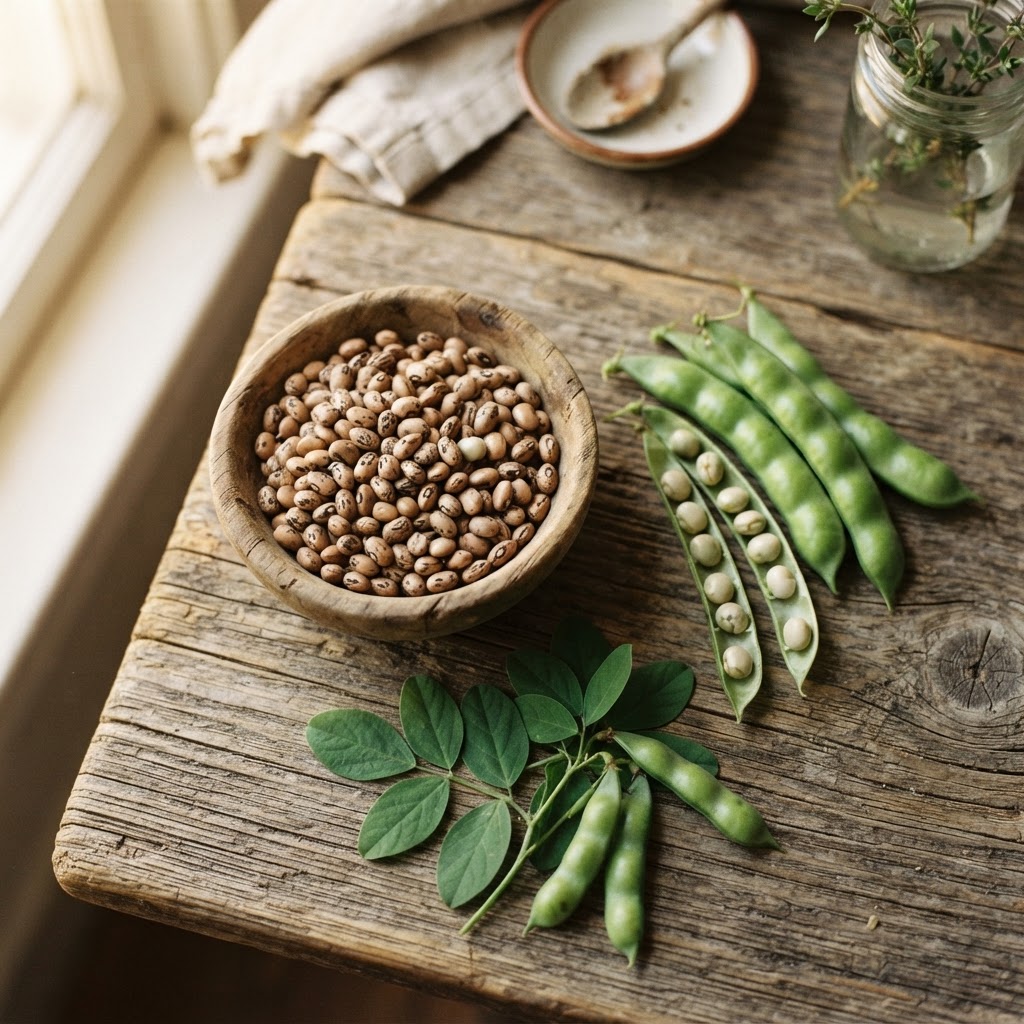
Pigeon peas are a hardy tropical legume and one of the world's most important pulses — a daily staple of India, the Caribbean, East Africa, and parts of Latin America. The round, speckled seeds are eaten fresh and green or dried and split, and the plant is drought-tolerant and remarkably resilient, thriving where many crops fail.
In India, split pigeon peas are "toor dal" — the everyday lentil of the subcontinent, cooked into the comforting yellow dal eaten across the country. In the Caribbean, the green or dried seeds are "gandules," the base of Puerto Rican arroz con gandules and the Bahamian national dish of pigeon peas and rice. In East Africa they are "ndengu," a beloved stewed pulse. Cheap, protein-rich, and able to fix nitrogen and survive on poor soils, pigeon peas nourish hundreds of millions — a true people's legume.
Toor Dal (Split, Skinned)
Dried pigeon peas split and hulled into yellow split dal — the most common form in India, cooked into everyday dal and the base of sambar.
Whole Dried Pigeon Peas
Dried peas left whole with their speckled brown seed coat — used in stews and rice dishes, especially in the Caribbean and East Africa.
Fresh Green Pigeon Peas
Young, tender pigeon peas in the pod — sweet and fresh, used in Caribbean rice dishes, Indian curries, and eaten boiled as a snack in season.
Gandules Verdes
The green Caribbean pigeon peas (gandules) of Puerto Rico and the Dominican Republic — the signature of arroz con gandules, often sold canned or frozen.
Ndengu (East African)
The pigeon pea of Kenya, Tanzania, and Malawi — stewed with coconut or tomatoes into a hearty pulse dish, a regional staple sold dry and fresh.
Congo Pea / Angola Pea
Older names for the same pigeon pea as it spread across the African continent and Atlantic — reflecting its movement from India to Africa and the Caribbean.
Buy dried pigeon peas (whole or split) from high-volume shops for freshness — look for clean, uniform peas with no dust, weevils, or musty smell. In Indian grocery stores, yellow split toor dal is sold in bulk; Caribbean and African markets stock whole dried pigeon peas and canned gandules.
Fresh green pigeon peas are seasonal — look for plump, bright green pods with no browning, or buy them shelled and frozen; canned green gandules are a convenient year-round option for Caribbean cooking.
Avoid split dal that looks dull, dusty, or has a rancid aroma — old dal takes longer to cook and tastes flat. The brightest, most evenly yellow split peas are the freshest.
Dried whole and split pigeon peas keep for a year or more in an airtight jar in a cool, dry, dark cupboard — their low moisture makes them one of the longest-storing pantry staples. Fresh green pigeon peas keep a few days in the pod in the fridge; shelled, they freeze well for several months. Cooked dal and pigeon-pea stews keep 3–4 days refrigerated and freeze well.
Shelling: Snap the end of a fresh green pod and pull the string down to unzip it, then run a thumb along the seam to pop it open and tip out the 4–6 round peas inside.
Splitting & hulling (for dal): Dried pigeon peas are milled to remove the outer seed coat, then split in half — the result is the familiar yellow split toor dal of Indian cooking, which cooks faster and softer than whole peas.
Soaking: Whole dried pigeon peas benefit from a 4–8 hour soak before cooking; split toor dal needs no soaking and cooks in 20–30 minutes once simmered.
Toor Dal (Indian Dal)
Simmer yellow split pigeon peas with turmeric until soft, then temper with ghee, cumin, and chili — the everyday yellow dal of India and the base of sambar.
Arroz con Gandules
Puerto Rico's national rice dish — green pigeon peas cooked with rice, sofrito, pork, and olives; the centerpiece of holidays and family meals.
Pigeon Peas & Rice
The Bahamian national dish — dried or green pigeon peas simmered with rice, salt pork, thyme, and sweet pepper into a fragrant, comforting one-pot meal.
Ndengu Stew (East Africa)
Whole pigeon peas stewed with coconut milk, tomatoes, and spices in Kenya and Tanzania — a hearty, protein-rich dish served with ugali or rice.
Sambar
South Indian tamarind-and-vegetable stew thickened with toor dal — eaten daily with dosa, idli, and rice, a cornerstone of South Indian cooking.
Stewed Green Gandules
Fresh green pigeon peas simmered with onion, garlic, and coconut in the Caribbean — a side dish of the autumn harvest, eaten straight or over rice.
Drying: Leave pods on the plant until they brown and the peas rattle dry, then shell and spread in the sun or a dehydrator to fully cure — the dried peas store for over a year as the pulse of the pantry.
Canning & freezing: Green pigeon peas are canned and frozen across the Caribbean to preserve the fresh taste year-round; the familiar cans of gandules make Caribbean cooking quick and reliable.
Splitting: Hulling and splitting dried peas into toor dal is itself a form of preservation — the split dal cooks faster and keeps as long as the whole peas, a long-shelf-life protein for every kitchen.
Pigeon peas are a high-protein pulse — about 22 g of protein and 15 g of fiber per 100 g dried — making them one of the most protein-rich of the common legumes and a vital plant-protein source in the tropics.
They provide good amounts of folate, iron, magnesium, potassium, and B vitamins, and are rich in complex carbohydrates that release energy slowly — a filling, low-glycemic staple.
As a legume, pigeon peas fix atmospheric nitrogen, enriching depleted tropical soils and making them a cornerstone of sustainable smallholder farming across India, Africa, and the Caribbean.
Pigeon peas are over 3,500 years old as a crop — domesticated in India, they spread to East Africa by 2000 BCE and then across the Indian Ocean trade to the Caribbean and the Americas, becoming a true global staple.
The plant is a perennial in the tropics — it can live and bear for 3–5 years, often grown as a hedge or windbreak around fields while producing food, a rare multi-year pulse crop.
Pigeon peas are remarkably drought-tolerant — their deep taproot finds water far below the surface, letting them produce a crop where maize and beans fail, which is why they're a lifeline in dry India and East Africa.
The name "pigeon pea" comes from their use as pigeon feed in colonial Barbados, while "gandules" (Caribbean) and "toor" (India) are the everyday names — the same humble pulse feeds hundreds of millions daily.
Pigeon peas anchor everyday cooking and celebration across the tropics:
Bahamian Pigeon Pea & Rice Season
Bahamas, Caribbean
🗓 Year-round staple
Pigeon peas and rice is the national dish of the Bahamas, flavored with salt pork, thyme, and sweet pepper — eaten daily, but especially at family gatherings, holidays, and the islands' Junkanoo celebrations.
Tu B'Av & Indian Harvest Fairs
Maharashtra & Gujarat, India
🗓 October–November 2026 (Rabi/Kharif harvest)
Across central India, 'toor' (pigeon pea) harvest fairs mark the gathering of the dal crop that feeds the subcontinent — markets fill with fresh green pigeon peas and the dried split toor dal that stocks every kitchen.
Pigeon Pea Harvest Celebrations
East Africa & the Caribbean
🗓 November–December 2026
From Kenya and Malawi to Jamaica and Trinidad, pigeon peas (gandules, ndengu, togwala) are celebrated at autumn harvests with stews, rice dishes, and community meals marking the end of the growing season.
Nitrogen-fixing & soil-building: Pigeon peas fix large amounts of nitrogen and their leaf litter enriches soil, making them an excellent rotation, intercrop, and green-manure crop for smallholder tropical farms.
Drought-tolerant & low-input: Their deep taproot and heat tolerance let pigeon peas yield on poor, dry soils with little fertilizer or water — a resilient crop in a warming climate and a lifeline for subsistence farmers.
Global range: India grows the majority of the world's pigeon peas (as toor dal), followed by East Africa (Malawi, Tanzania, Kenya) and the Caribbean; the crop spans the tropics from Asia to Africa to the Americas, wherever it is hot and dry-seasoned.
In-Season Recipes with Pigeon Peas
Seasonal recipes featuring Pigeon Peas right now
Coming Soon
All Other Recipes with Pigeon Peas
Coming Soon