Legumes, Beans & Nuts · Fall
Pecans
Carya illinoinensis · Also: Pecan Nuts, Pecan Meats
Pecans are the buttery, richly flavored nuts of a North American hickory tree — the only major tree nut truly native to the United States. Indigenous peoples of the Mississippi and Gulf coasts gathered wild pecans for thousands of years, and the name itself comes from the Algonquian word "pacane," meaning a nut cracked with a stone.
The pecan ripens in autumn, its smooth green husk splitting open to reveal the ridged, golden-brown shell inside. High in oil and naturally sweet, pecans are prized raw, toasted, candied, and baked — the soul of the American pecan pie and Southern pralines. From Texas pecan coffee to Mexican candies and holiday stuffing, the pecan is a cornerstone of Southern and Southwestern cooking and one of the most commercially valuable nuts in the United States.
Stuart
The classic commercial pecan — large, plump, and reliable, with a good shell-to-kernel ratio; the most widely planted variety in the Southeastern U.S.
Desirable
A large, thin-shelled pecan prized for its rich, buttery flavor and easy cracking — a favorite of growers and home bakers, especially in Georgia.
Pawnee
An early-ripening variety with small-to-medium nuts and an exceptionally rich, sweet flavor — often the first fresh pecans of the autumn harvest.
Western Schley
A popular Western U.S. variety — medium-sized, thin-shelled, and high-yielding; the backbone of New Mexico and Arizona pecan orchards.
Native / Seedling Pecans
Wild or seed-grown pecans from Texas and the South — smaller and harder-shelled than named cultivars, but often more intensely flavored and historically the original American pecan.
Maramec
A Northern-origin pecan variety adapted to colder climates — one of several cultivars that extended pecan growing beyond the Deep South into the Midwest.
Pecans fall from late September through November. Forage freshly dropped nuts before wildlife (squirrels especially) get them, and discard any with holes or a dark, shrivelled kernel — a sign of weevil damage or rancidity.
Buy shelled pecans that look plump and uniformly golden, with no dusty or dark spots and a fresh, sweet smell; avoid any with a bitter or painty aroma, the first sign of rancidity in their high-oil kernels.
For cracking at home, choose in-shell pecans that feel heavy for their size and rattle only slightly — loose rattling means a dried-out kernel. Thin-shelled varieties (Desirable, Western Schley) crack far more easily than thick-shelled natives.
Pecans are high in oil and turn rancid faster than most nuts — keep shelled pecans in an airtight container in the fridge for up to 6 months, or in the freezer for up to 2 years. In-shell pecans keep for several months in a cool, dry place. Toasted pecans should be used within a few weeks once opened, and candied pecans stored airtight at room temperature.
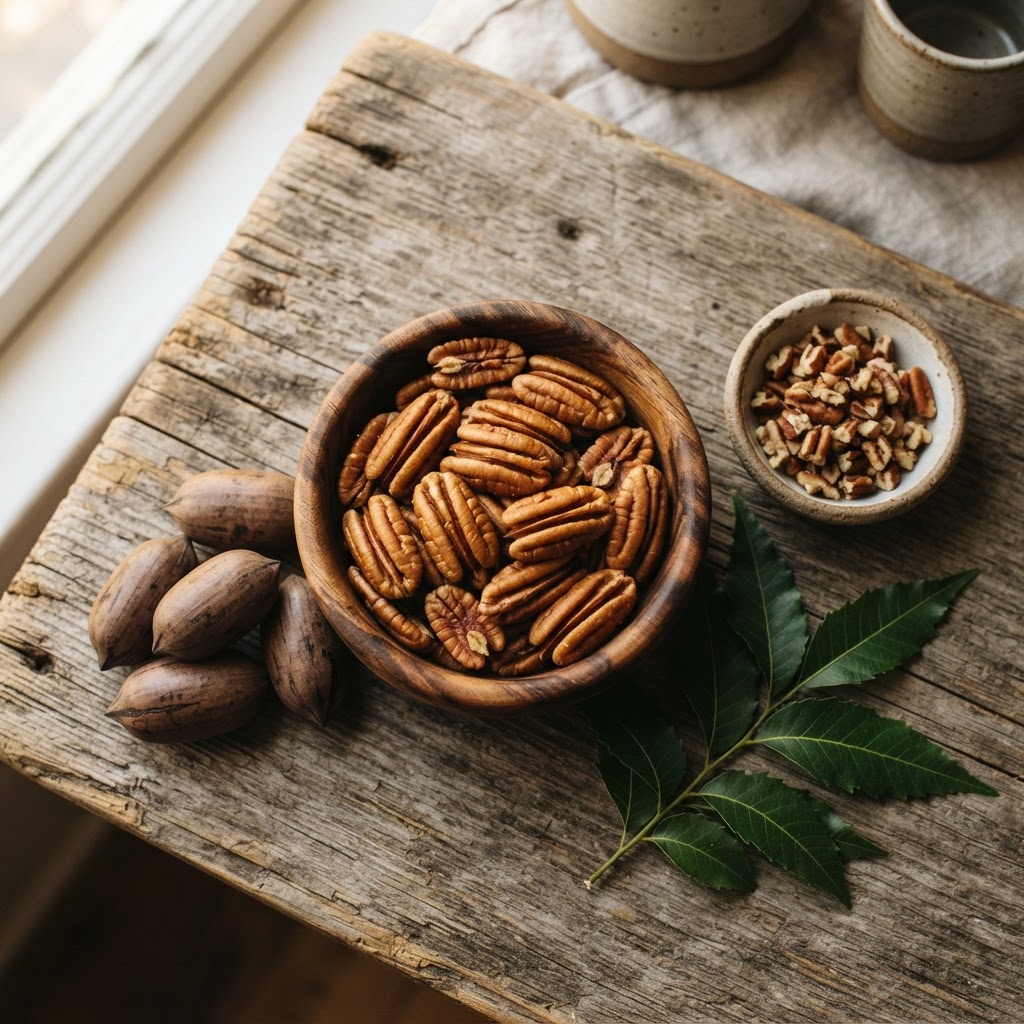
Hulling: Fresh-fallen pecans are wrapped in a green outer husk that splits and dries as they ripen. Peel or cut away the husk and rinse off any clinging residue before cracking.
Cracking: Use a dedicated pecan cracker or a nutcracker on the shell's seam; thin-shelled varieties yield whole halves, while thick-shelled natives may need picking out for pieces.
Toasting: Roast shelled pecans at 175°C (350°F) for 8–10 minutes, stirring once, until fragrant and deepened in colour — toasting intensifies their buttery sweetness and is worth doing for almost any recipe.
Pecan Pie
The iconic Southern dessert — a gooey filling of corn syrup, sugar, eggs, and toasted pecans baked in a flaky crust; the Thanksgiving table centerpiece across the American South.
Pralines
New Orleans' classic candy of toasted pecans set in a creamy, sugary patty — French pralines (made with almonds) crossed the Atlantic and became pecan pralines in Louisiana.
Toasted & Salted
Roast pecans with butter and salt for the simplest, most satisfying snack — eaten by the handful or scattered over salads, roasted vegetables, and oatmeal.
Pecan-Crusted Fish
A Louisiana and Southern classic — fish or chicken fillets coated in crushed toasted pecans and pan-fried for a crisp, nutty crust with a rich crunch.
Pecan Pesto
A Southern twist on Italian pesto — blend toasted pecans with basil, oil, and cheese for a deeply nutty sauce for pasta or grilled chicken.
Candied & Spiced
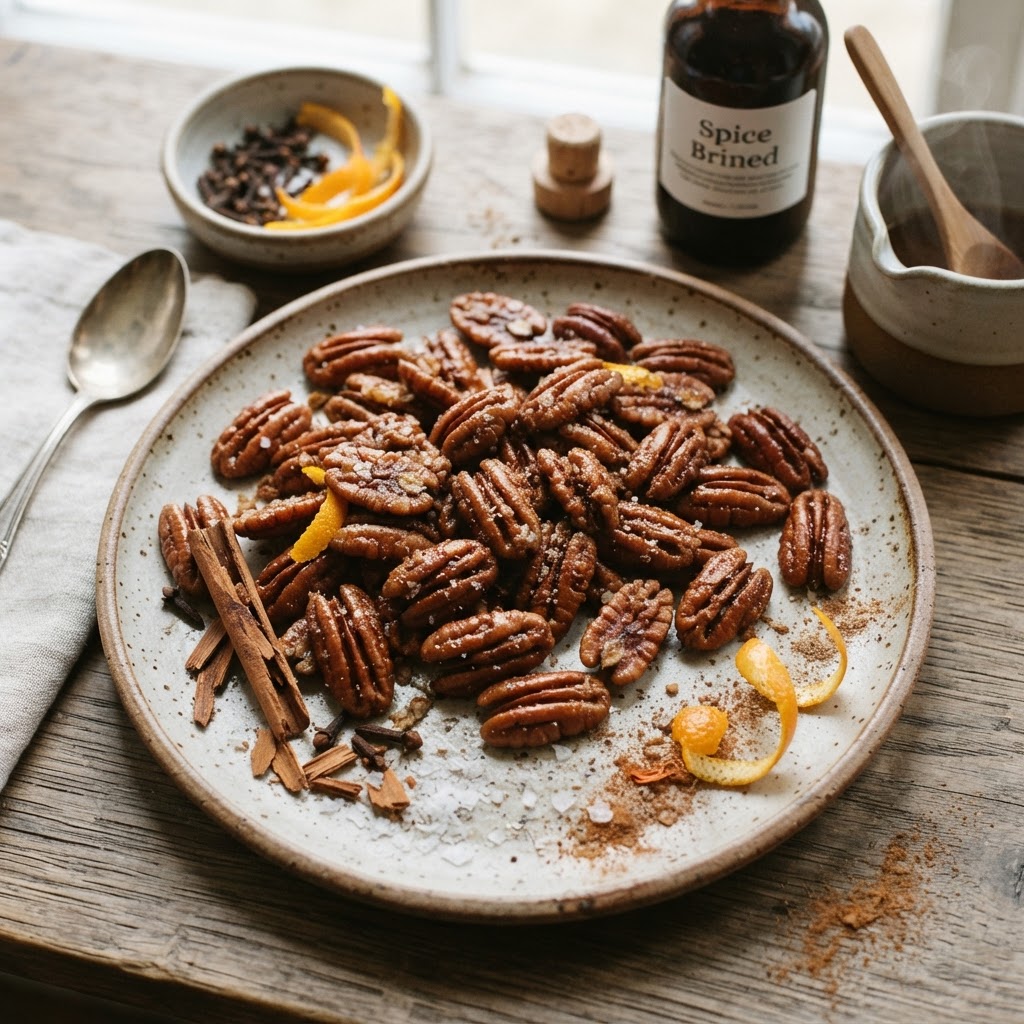
Coat pecans in egg white, sugar, and spices (cinnamon, cayenne) and roast — a holiday-party staple and a beloved gift from the South.
Curing: Freshly harvested pecans should be dried (cured) for 2–4 weeks in a thin layer in a warm, dry spot until the kernels snap rather than bend — this stabilizes their oils and concentrates their flavour.
Freezing: Fully cured pecans — shelled or in-shell — freeze for up to two years with no loss of flavour; freezing is the best long-term storage for their high-oil kernels.
Candying: Pecan pralines and candied pecans are the traditional Southern way to preserve the autumn harvest as shelf-stable sweets for the holidays and gifts.
Pecans are among the most oil-rich nuts — about 72 g of fat per 100 g, mostly heart-healthy monounsaturated fats, the same type found in olive oil. They provide about 9 g of protein and a good amount of fiber.
They are an excellent source of manganese and copper, and a good source of thiamine, zinc, and magnesium. Pecans also pack more antioxidants than almost any other nut, largely from vitamin E and ellagic acid.
Regular nut consumption, including pecans, is linked to lower cholesterol and reduced heart-disease risk — a handful a day is a traditional and research-backed way to support heart health.
Pecans are the only major tree nut truly native to North America — all the others (almonds, walnuts, pistachios, cashews) arrived from elsewhere, while pecans grew wild along the Mississippi and its tributaries for millennia.
The word "pecan" comes from the Algonquian "pacane," meaning a nut too hard to crack by hand — Indigenous peoples used stones to open them long before European contact.
A single mature pecan tree can yield 200–500 pounds of nuts in a good year, and pecan trees live and bear for over a hundred years — many Southern homesteads still harvest from trees planted generations ago.
The pecan pie as Americans know it was popularised in the 1930s by the Karo syrup company, which printed the recipe on its corn-syrup cans — a marketing move that became a Thanksgiving institution.
Pecan country celebrates the autumn harvest across the American South and Southwest:
National Pecan Festival
Albany, Georgia, USA
🗓 November 2026 (annual)
Albany, in the heart of Georgia's pecan country, hosts the National Pecan Festival each fall — a parade, pecan-cooking contests, a pecan queen, and orchard tours celebrating America's only major native tree nut.
Pecan Street Festival
Austin, Texas, USA
🗓 May & September 2026 (biannual)
Named for Austin's historic Pecan Street (Sixth Street), this long-running arts and food festival honors the pecan tree's place in Texas heritage with live music, local pecan foods, and crafts.
San Saba Pecan Harvest
San Saba, Texas, USA
🗓 October–November 2026
San Saba calls itself the Pecan Capital of the World — its autumn harvest is a community event, with orchards opening for pick-your-own pecans and local bakers turning out pecan pies and pralines.
Native & low-input: Pecans evolved in North American river-bottom forests, so they need fewer pesticides, water, and amendments than imported nut crops — a native tree well-suited to its soils and climate.
Long-lived & carbon-storing: A pecan orchard is a multi-generation investment — trees live a century or more, storing carbon in their wood and producing food for decades, a far more permanent landscape than annual crops.
Global range: The U.S. grows roughly two-thirds of the world's pecans, led by Georgia, New Mexico, and Texas; Mexico is the other major producer, and pecans are also grown in South Africa, Australia, and parts of South America.
Available Near You
Enter your ZIP code to find farms with pecans near you.