Pears
Pears (Pyrus communis) are one of the oldest cultivated fruits — grown for at least 3,000 years in Europe and Asia. Uniquely among fruits, pears ripen from the inside out and are best ripened off the tree, with a delicate floral sweetness and dozens of distinct varieties prized from poached desserts to cheese boards.
Check ripeness at the neck (stem end) — press very gently with your thumb; if it yields, the pear is ripe throughout. Most other fruits you press at the equator; pears ripen from the inside out starting at the stem end.
Pears are harvested mature but not ripe — they must be ripened off the tree. This is intentional; pears left to ripen on the tree develop a gritty, mealy texture from the inside out. Always buy firm pears and ripen at room temperature.
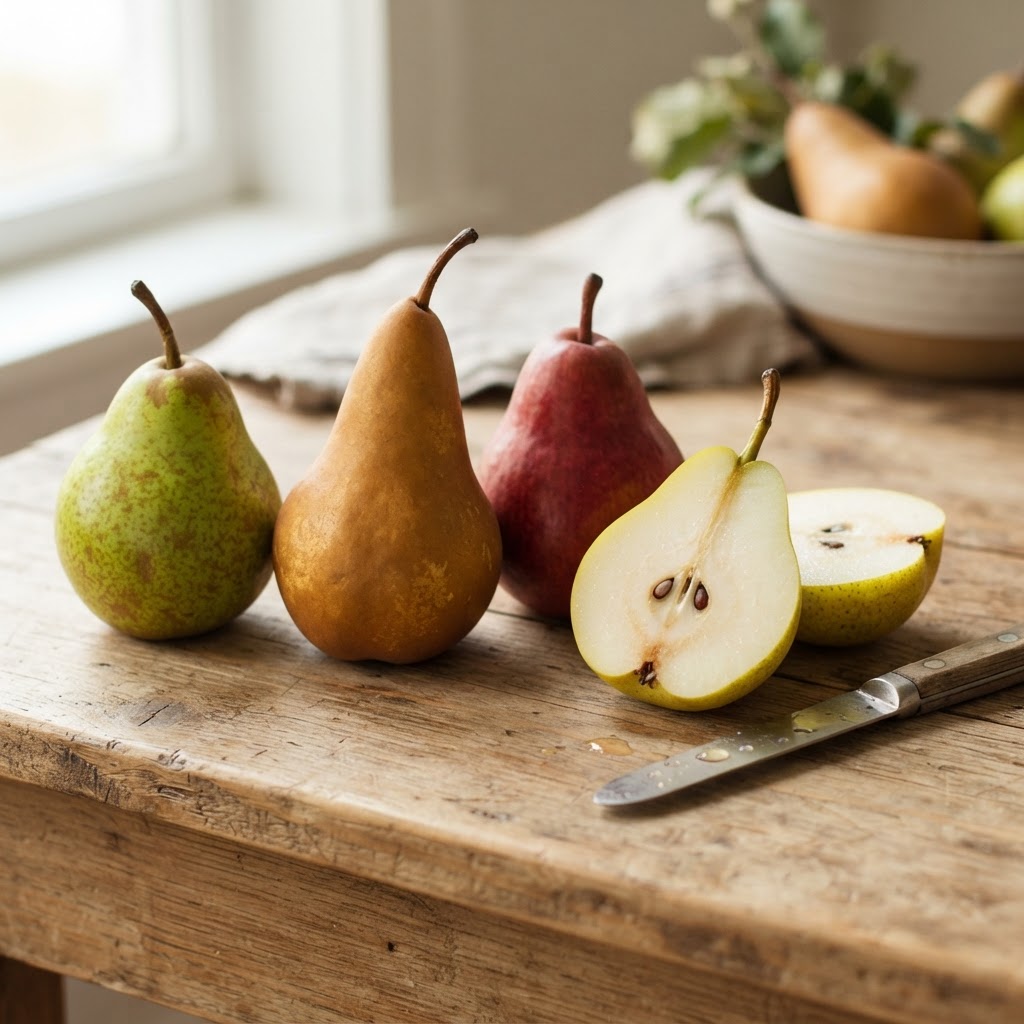
Bartlett (Williams)
The classic sweet, soft, juicy pear. Best fresh and for canning — turns from green to yellow when ripe.
Bosc
Brown, elongated, firm, and complex with spicy, nutty notes. Best for cooking and poaching — holds shape.
Anjou
Green or red, mild, sweet, and juicy with a slightly firm texture. Good fresh and for baking.
Comice
The sweetest, juiciest variety. Very fragrant and buttery — the classic cheese board pear.
Asian Pear →
Crisp, round, and apple-like in texture — stays firm when ripe. Juicy and delicately sweet, used in Korean BBQ marinades, salads, and cheese boards.
Ripen firm pears at room temperature — check daily at the neck for yield. Once ripe, refrigerate to slow further softening — use within 3–5 days.
Pears brown quickly when cut — toss immediately with lemon juice to preserve color. Bosc pears hold their shape the longest; Bartlett softens quickly once ripe. For long-term storage, keep firm pears refrigerated and they will keep 1–3 months depending on variety.
Poaching: Whole peeled pears simmered in spiced red wine, white wine, or vanilla syrup — a classic French dessert of extraordinary elegance. Bosc pears are ideal for poaching due to their firm flesh and elegant shape.
Tarte Tatin Style: Caramelized upside-down pear tart — Bosc pears work best for long-cooked preparations as they hold their structure.
Cheese Board: Ripe Comice or Anjou pear with blue cheese, aged cheddar, Brie, or Gruyère — the sweetness and acidity of pear is the ideal counterpoint to salty, pungent cheese.
Salads: Thinly sliced ripe pear with arugula, walnuts, blue cheese, and a sharp vinaigrette — a timeless combination.
Sautéing: Sliced pears in butter and sugar until caramelized — a classic accompaniment to pork, duck, and game.
Canning: Pears in light syrup are a classic home preserve. Halve, core, pack in sterilized jars with syrup, and process in a water bath canner.
Pear Butter: Similar to apple butter — cook pears down with sugar and spices for hours until thick and deeply flavored. Excellent on toast and cheese.
Jam & Preserves: Pear jam with ginger and vanilla is one of the most refined fruit preserves. Pears are naturally low in pectin — combine with high-pectin fruit or add commercial pectin.
Perry: Fermented pear juice — the pear equivalent of hard cider. Some pear varieties are grown specifically for perry production. A traditional drink in Herefordshire and Normandy.
A medium pear provides approximately 101 calories, 5.5g of fiber (22% of daily value), and 12% of the daily value for vitamin C. The fiber is split between soluble and insoluble — the soluble pectin fiber lowers LDL cholesterol and feeds beneficial gut bacteria.
Pears are also a good source of copper (16% DV), which plays roles in immune function, metabolism, and antioxidant defense. The skin contains much of the fiber and antioxidants — always eat pears unpeeled when possible.
The stone cells (sclereids) that give pears their characteristic slightly gritty texture are insoluble fiber particles. Asian pear varieties have more stone cells, contributing to their crunchier texture compared to European pears.
Pears ripen from the inside out — this is why a perfectly ripe pear looks the same on the outside as an unripe one. The only reliable way to test ripeness is the neck check (press at the stem end). Many people have never eaten a perfectly ripe pear because they judge by the outside.
There are over 3,000 known pear varieties worldwide, but very few are grown commercially. In the US, Bartlett (Williams), D'Anjou, Bosc, and Comice account for about 95% of commercial production.
Pears have been cultivated for at least 3,000 years. Ancient Romans made over 50 varieties of pear wine. In France, perry (pear cider) has centuries of history in Normandy alongside apple cider. Chinese pears (Pyrus pyrifolia — the crunchy, round Asian pear) are a distinct species from European pears.
The US pear industry is concentrated in Washington, Oregon, and California — the Pacific Northwest produces about 90% of US pears. Pear orchards are long-lived (20–50+ years) and relatively sustainable compared to annual crops, building soil health and providing habitat.
Pears require very specific climate conditions, particularly cold winter chilling hours, which limits where they grow well. Climate change is increasingly disrupting winter chill patterns in traditional pear-growing regions.
Organic pear production is available and worth seeking out — pears are treated with fewer pesticides than apples but still appear on pesticide monitoring lists.