
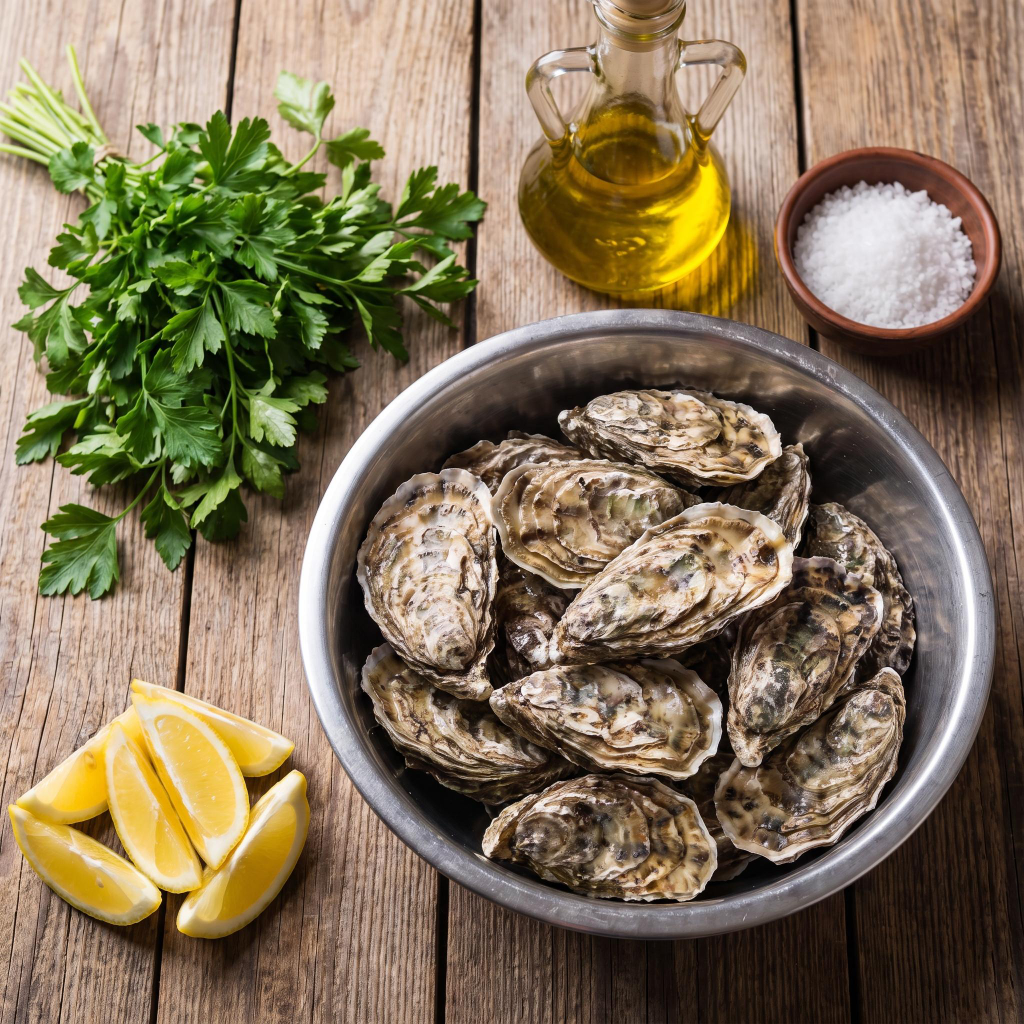
Oysters
Delicate shellfish enjoyed raw or cooked, briny and flavorful
Buy oysters live and tightly closed. They should smell clean and briny, like the sea. Tap any open oysters — they should close; discard any that stay open or have cracked shells.
Oysters are sold by name reflecting their harvest bay or creek — the same species tastes different from different waters, a phenomenon called 'merroir.' Ask your fishmonger for recommendations and try several.
For raw bars, choose smaller, sweeter oysters (Kumamoto, Beausoleil). For cooking, larger oysters work well. Plan on 6 oysters per person for a starter, a dozen for a main.
Each oyster reflects the waters it came from — a liquid snapshot of a particular bay or creek:
Eastern / Atlantic
The classic American oyster — briny and mineral, with regional varieties like Wellfleet, Blue Point, and Malpeque.
Pacific / Kumamoto
Smaller, sweeter, and less briny than Eastern oysters — with notes of cucumber, melon, and butter; a West Coast favorite.
Belon / European Flat
Flat, round, and intensely metallic — a strong, acquired taste prized by oyster connoisseurs; originally from France.
Olympia
Tiny, sweet, and coppery — the native West Coast oyster, slow-growing and rare; a historic delicacy.
Beausoleil / Malpeque
Small, clean, and balanced Canadian oysters — a great introduction to raw oysters for beginners.
Hama Hama / Totten
Pacific Northwest oysters known for their cucumber-melon finish and firm, briny meat — a terroir-driven treat.
Store live oysters cup-side down (deep shell down) in the refrigerator, covered with a damp cloth. Never submerge them in fresh water or seal them in plastic — they need to breathe.
Keep at 35–40°F and use within 1–2 days. Oysters keep longer than clams and mussels but are best as fresh as possible.
Shuck just before serving for raw bars. For cooking, shuck or steam open; save the liquor (the liquid inside) for sauces and stews.
Oysters are sublime raw and excellent cooked.
Raw on the Half Shell: The purest expression — served on ice with lemon, mignonette (shallot-vinegar), or cocktail sauce. Eat the first one plain to taste the oyster itself.
Grilling & Broiling: Place oysters on a hot grill or under the broiler until they pop open, then top with garlic butter, hot sauce, or cheese — Oysters Rockefeller, Oysters Bienville, and oysters casino.
Frying: Breaded and deep-fried oysters are crisp and rich — a po'boy staple and a Southern classic.
Stewing: Oysters simmered in their liquor with butter, cream, and herbs make a rich, briny stew — a New England tradition.
Smoking: Smoked oysters, packed in oil, are a pantry staple for antipasti.
Smoking: Smoked oysters, canned in oil, keep for years and are a classic antipasto.
Canning: Pressure-canned oysters keep for months — acceptable for stews and dressings.
Pickling: Pickled oysters in vinegar and spices are a traditional preserved preparation with bright, tangy flavor.
Freezing Cooked: Shucked oysters freeze well for up to 3 months for use in cooked dishes; raw oysters lose texture when frozen.
Drying: Dried oysters add intense umami to Asian soups and stir-fries.
Oysters are one of the most nutrient-dense foods in the sea — exceptionally high in zinc, vitamin B12, and protein, with very few calories. A 3-ounce serving provides over 600% of the daily value for zinc and a remarkable dose of B12.
They are rich in selenium, copper, iron, and omega-3 fatty acids, supporting immune, heart, and brain health. Oysters are among the best dietary sources of zinc, important for immune function and wound healing.
Oysters are low in mercury and a lean protein, making them an excellent regular part of a healthy diet.
Oysters can change sex during their lives, often starting as male and becoming female — a trait called sequential hermaphroditism that helps maintain population balance.
An oyster filters up to 50 gallons of water a day, straining plankton and cleaning the water. A healthy oyster reef can dramatically improve water quality in an estuary.
The 'R-month' rule — only eat oysters in months with an R — is a relic of pre-refrigeration days; modern oysters are safe and good year-round, though flavor varies by season.
Pearls come from oysters, but the oysters we eat are a different family from the pearl oysters — edible oysters rarely produce pearls, and when they do, they are small and not valuable.
Oysters are among the most sustainable seafood you can eat. Farmed oysters require no feed, no freshwater, and no chemicals — they filter their food from the seawater and improve water quality.
Oyster reefs also provide vital habitat for other marine life and protect shorelines from erosion. Restoration of oyster reefs is a major conservation priority in the Chesapeake and elsewhere.
Because oysters are filter feeders, always buy from trusted sources and check for biotoxin advisories in your region — oysters can accumulate toxins from algal blooms, which is why harvest areas are closely monitored.
Available Near You
Enter your ZIP code to find farms with oysters near you.
Recipes with Oysters
Coming Soon