
Grains & Seeds · Summer & Fall
Oats
Avena sativa · Also: Oat Groats, Rolled Oats, Steel-Cut Oats, Oatmeal, Pinhead Oats, Porridge Oats
Oats are the great grain of cool, wet northern climates — a hardy cereal that thrives in the short, damp summers of Scotland, Scandinavia, and Northern Europe, where wheat struggles and oats become the daily bread and porridge. From the oatcakes of the Scottish Highlands and the brose of the crofters to the skyr and hafragrautur of Iceland and the muesli of Switzerland, oats are the warming grain of the North, sustaining its people through long, cold winters.
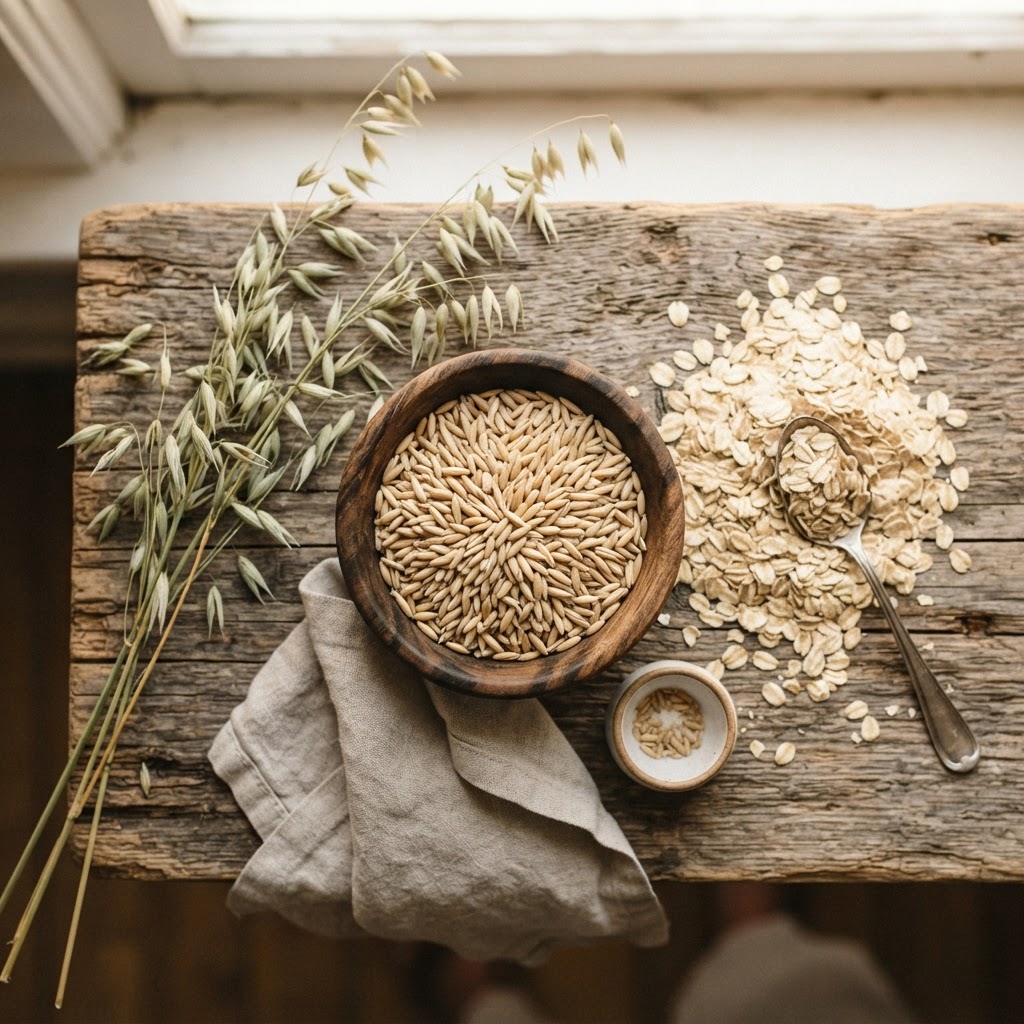
The grain is plump, pale, and naturally soft, with a mild, sweet, cream-like flavor and a distinctive sticky, comforting texture when cooked. Oats are sold as whole groats, steel-cut (pinhead) oats, rolled (flaked) oats, and quick oats — each cut and rolled for a different cooking time and texture, from the chewy nuttiness of steel-cut to the soft cream of rolled oatmeal. Naturally rich in soluble fiber — especially the beta-glucan that lowers cholesterol — oats are among the most heart-healthy of grains; a comforting bowl of porridge, the base of granola and muesli, the binder of meatballs and flapjacks, and the soul of the oatcake.
Oat Groats (Whole Oats)
The whole, unbroken oat grain with only the inedible outer hull removed; the most nutritious form — high in fiber and minerals; takes the longest to cook (45–60 minutes) and has the deepest, nuttiest flavor; often soaked overnight.
Steel-Cut Oats (Pinhead Oats)
Whole oat groats chopped into 2–3 pieces with steel blades; also called Irish oats or pinhead oats; cook in 20–30 minutes into a chewy, nutty porridge with distinct grain texture — the traditional porridge of Ireland and Scotland.
Rolled Oats (Old-Fashioned Oats)
Oat groats steamed to soften, then rolled flat into flakes; the familiar American oatmeal and the base of granola, muesli, and oatmeal cookies; cook in about 5 minutes on the stovetop into a soft, creamy porridge.
Quick Oats
Rolled oats cut smaller and rolled thinner for the fastest cooking (about 1 minute); softer and creamier than old-fashioned oats, but with less chew and texture; useful for quick breakfasts and baking.
Oat Flour
Finely milled oats — a soft, slightly sweet, gluten-free flour used in pancakes, muffins, oatcakes, and as a thickener; makes tender, moist baked goods and is a good gluten-free baking flour when combined with a binder.
Scottish Oats & Oatmeal
Stone-ground oat groats — a medium-fine meal between steel-cut and rolled, the traditional oatmeal of Scotland; cook into a smooth, creamy porridge that is neither chewy like steel-cut nor flat like rolled — the original Scottish 'porridge.'
For porridge, choose based on the texture you prefer — steel-cut for chewy, nutty porridge; rolled for soft, creamy oatmeal; Scottish stone-ground for the traditional smooth Scottish porridge. For baking, old-fashioned rolled oats give the best texture in cookies, crisps, and granola; quick oats dissolve too much, and steel-cut don't soften enough.
For the most nutrition, buy whole oat groats or steel-cut oats — they retain the entire grain and all the fiber; rolled oats are still whole grain (the germ and bran remain), and instant oatmeal packets are the most processed and often sweetened. Look for certified gluten-free oats if you are sensitive — oats are naturally gluten-free but are often contaminated with wheat in milling.
Season: oats are a cool-season cereal planted in spring and harvested in late summer to early fall; the dried grains and flours are available year-round, with fresh-milled oat flour best from autumn mills.
Keep oat groats, steel-cut, and rolled oats in an airtight container in a cool, dry, dark place for up to a year — the grains store well, though oats' natural oils can go slightly rancid over many months, so the fridge or freezer extends freshness. Oat flour, with the oils exposed, is more perishable; refrigerate or freeze and use within a few months. Cooked oatmeal keeps 4–5 days refrigerated and reheats well with a splash of milk.
Harvesting: Oats are a cool-season cereal planted in early spring and harvested in late summer to early fall when the grains turn from green to pale gold and the nodding seed heads dry; they thrive in the cool, damp climates where wheat struggles, which is why they became the grain of the North.
Hulling: Oat grains are enclosed in a tough, inedible hull that must be removed before eating; the hulled grain is the oat groat — the whole oat. Unlike barley and emmer, the hull loosens and is removed relatively easily, but it cannot be eaten.
Cutting, rolling & milling: Oat groats are left whole, chopped (steel-cut), stone-ground (Scottish oatmeal), or steamed and rolled flat (rolled oats) for different cooking times and textures; oats are also milled into oat flour for baking. Steaming before rolling stabilizes the oils and gives rolled oats their characteristic soft, flake-like form.
Porridge & Oatmeal
The classic — oats simmered with water or milk into a warming bowl of porridge, from chewy Irish steel-cut to creamy Scottish stone-ground to soft American rolled; sweetened with honey, brown sugar, or fruit, or made savory with salt and butter in the Scottish way.
Granola & Muesli
Rolled oats baked with honey, oil, and nuts into crunchy granola, or soaked with fruit, nuts, and milk into Swiss bircher muesli; the cold and room-temperature oat breakfasts invented for modern healthy eating, both built on rolled oats.
Oatcakes & Bannocks
The traditional bread of Scotland and the North — oatmeal and water (or buttermilk) kneaded into a dough and baked on a griddle into cracker-like oatcakes; savory, nutty, and the daily bread of the Highlands for centuries, eaten with cheese or butter.
Oatmeal Cookies, Flapjacks & Crisps
Rolled oats in oatmeal-raisin cookies, in British flapjacks (oat bars bound with butter and golden syrup), and in the crisp topping of fruit crisps; the chewy, nutty texture of oats defines these classic treats.
Pancakes, Muffins & Oat Flour Baking
Oat flour in pancakes, muffins, and quick breads for a tender, moist, slightly sweet crumb; a favorite gluten-free flour when combined with a binder, and a wholesome alternative to refined wheat in everyday baking.
Savory Binder & Stuffing
Oats used as a binder in meatballs, meatloaf, veggie burgers, and stuffings, replacing breadcrumbs; also in haggis (the Scottish national dish uses oatmeal), skirlie (Scottish oat and onion), and black pudding — a traditional savory use across Northern Europe.
Drying: Oat groats, steel-cut, and rolled oats keep for up to a year in a sealed, cool, dry place — the grain of the North stored through long winters; the hardy oat was a lifeline crop for crofters and villagers in Scotland, Scandinavia, and Russia.
Steaming & rolling: Rolled oats are steamed before flaking, which stabilizes the natural oils and extends shelf life — a preserving innovation that made oats transportable and long-storing, and a foundation of modern breakfast foods.
Milling: Stone-ground Scottish oatmeal and fresh oat flour are best milled in small batches and kept cold; the oils in the oat germ spoil faster than in wheat, so small mills and home milling preserve the most flavor.
Oats are among the most nutritious of grains — high in soluble fiber, especially beta-glucan, which is clinically proven to lower cholesterol and support heart health; they also provide protein, B vitamins, and minerals like manganese, phosphorus, and magnesium.
Oats have a lower glycemic index than most grains, giving slow, sustained energy — which is why a bowl of porridge keeps you full for hours; the beta-glucan forms a gel in the gut that slows digestion and steadies blood sugar.
Oats are naturally gluten-free, but they are often cross-contaminated with wheat in milling and transport, so people with celiac disease should seek certified gluten-free oats; they contain a protein called avenin that a small number of gluten-sensitive people also react to, but most tolerate oats well.
Oats were the daily grain of the Scottish Highlands for centuries — wheat would not ripen in the cool, wet climate, so oats and barley became the staple; the Highland diet of porridge, oatcakes, and brose gave the crofters a reputation for extraordinary health and stamina.
Samuel Johnson defined oats in his 1755 dictionary as 'a grain, which in England is generally given to horses, but in Scotland supports the people' — to which a Scotsman famously replied, 'And where else will you see such horses, and such men?'
Porridge is so deeply Scottish that the World Porridge-Making Championship is held each October in the Highland village of Carrbridge, where competitors from around the world compete for the Golden Spurtle — the traditional oat porridge stick used to stir the pot.
Muesli was invented around 1900 by Swiss doctor Maximilian Bircher-Brenner for his patients; granola was invented in the US in the late 1800s and revived in the 1960s; both built a modern healthy-eating culture on the ancient northern grain, turning the porridge of the crofters into the breakfast of the wellness era.
From Highland harvest fairs to the Golden Spurtle, oats are the celebrated grain of the North:
Highland Oatcake & Harvest Fairs
Scotland & the Scottish Highlands
🗓 August–September 2026 (harvest)
The Scottish Highland harvest is marked by village fairs and agricultural shows celebrating the oat crop — the grain of the Highlands for centuries; oatcakes, porridge, brose, and skirley are served, and the Lairig ghrù harvest home (the 'Muckle Supper') honors the bringing-in of the oats with feasting and fiddle music.
Lammas & Lughnasadh (Harvest Home)
Scotland, Ireland, Wales & Northern England
🗓 August 1, 2026 (first harvest)
Lammas — the 'loaf-mass' of the first harvest — was traditionally celebrated with bread baked from the new oats and wheat; in the Scottish and Irish countryside, oatcakes or bannocks were made from the first grains of the harvest and shared at the Lughnasadh feast of first fruits.
World Porridge Day & Golden Spurtle
Carrbridge, Scotland (global celebration)
🗓 October 10, 2026 (World Porridge Day); October 2026 (Golden Spurtle)
The village of Carrbridge in the Scottish Highlands hosts the World Porridge-Making Championship (the Golden Spurtle) each October, where competitors from around the world compete to make the perfect bowl of oat porridge; World Porridge Day celebrates the simple bowl of oats that nourishes millions.
Harvest Festival & St. Swithun's
England & across Britain
🗓 September–October 2026 (harvest)
The traditional British Harvest Festival, held in autumn, celebrates the bringing-in of the grain harvest with church services, school assemblies, and feasts; oatcakes, harvest loaves, and oatmeal desserts are shared, and the grain harvest — oats in the North, wheat in the South — is thanked with the harvest-home supper.
Cool-climate & low-input: Oats thrive in cool, damp, low-fertility soils where wheat and maize struggle; they need less fertilizer and water than many cereals and are a useful low-input rotation crop that suppresses weeds and breaks disease cycles — a resilient grain for marginal northern land.
Rotation & cover crop: Oats are often planted as a cover crop to protect soil over winter, add organic matter, and suppress weeds; they are a useful break crop in cereal rotations, which makes them a regenerative agriculture tool as well as a food crop.
Whole-grain nutrition: Because even rolled and quick oats retain the whole grain (bran and germ), eating oats is a low-waste, high-nutrition use of the crop — unlike refined wheat, where the bran and germ are removed; supporting whole oat products keeps the full grain's value in the food supply.
Global range: Oats originated in the Fertile Crescent as a weed in wheat and barley fields, then spread into the cool, damp climates of Northern Europe where they thrived; today they are grown across Russia, Canada, the Nordic countries, Scotland, and the northern United States — the great grain of the cool north.
Available Near You
Enter your ZIP code to find farms with oats near you.
Recipes with Oats
Coming Soon