
Grains & Seeds · Summer & Fall
Millet
Panicum miliaceum · Also: Proso Millet, Foxtail Millet, Finger Millet, Pearl Millet, Bajra, Ragi, Jowar
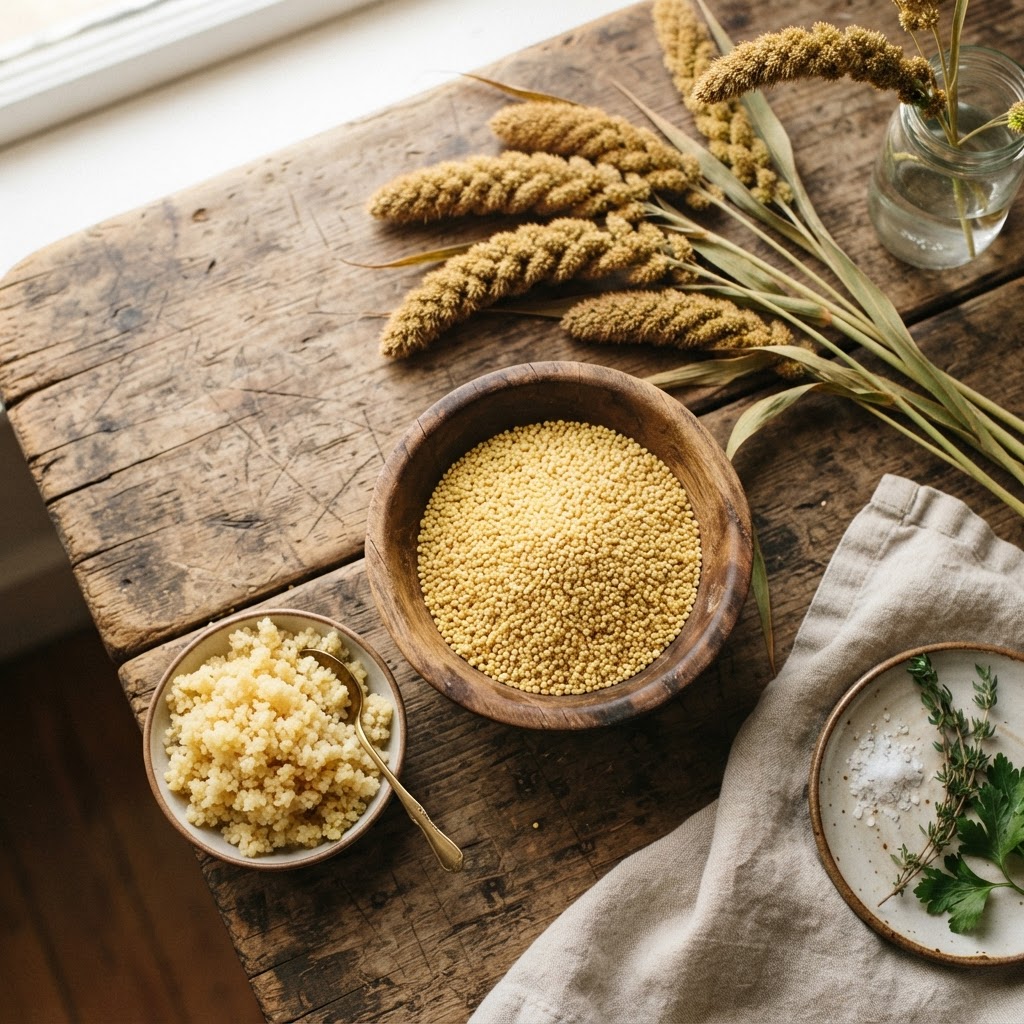
Millet is not one grain but a family of small-seeded grasses that fed half the ancient world — from the millet porridge of Neolithic China and the sorghum-millet bread of the African Sahel to the ragi dosa of South India and the proso millet of Eastern Europe. Among the oldest cultivated grains, millets were grown across Asia and Africa for thousands of years before the great grains of the lowlands — rice, wheat, and maize — spread into their territory.
The grains are tiny, round, and golden, with a mild, slightly sweet, corn-like flavor and a fluffy texture when cooked. Drought-tolerant and fast-growing, millets thrive in poor soils and harsh climates where other grains fail — which is why they remain a staple across the African Sahel, the Indian Deccan, and the dry plateaus of Asia. Naturally gluten-free and rich in minerals, millet is a nourishing porridge grain, a fluffy pilaf base, a flatbread flour (ragi roti, bajra roti, injera), and a fermented beer grain; now rediscovered as a climate-smart grain for a hotter, drier world.
Proso Millet (Common Millet)
The pale, round, golden millet most often sold in Western stores — Panicum miliaceum, an ancient grain of Central Asia and Eastern Europe; quick-cooking, mild, fluffy, and the main millet grown in the US, mostly for birdseed and livestock but increasingly for food.
Foxtail Millet (Italian Millet)
Setaria italica — one of the oldest cultivated grains, a staple of Neolithic China and traditional India; small yellow grains on a bushy, fox-tail-like head; nutty and quick-cooking, used in South Indian upma, pongal, and pilafs.
Finger Millet (Ragi)
Eleusine coracana — a reddish-brown millet of South India and East Africa, a daily staple for millions; ground into flour for ragi dosa, ragi mudde (a dense dough-ball), and porridge, and prized for its exceptional calcium content.
Pearl Millet (Bajra)
Pennisetum glaucum — the large-seeded, drought-hardy millet of the African Sahel and the Indian desert; ground into flour for bajra roti flatbread and cooked into thick porridges; the staple grain of the world's driest farming regions.
Sorghum (Jowar, Great Millet)
Sorghum bicolor — a large-grained grass often grouped with millets; a staple of the African Sahel, South Asia, and the American South (where it's called milo); ground into flour for jowar roti, popped, cooked like couscous, or brewed into beer.
Little Millet & Kodo Millet
Traditional minor millets of South Asia — small, nutritious grains eaten in rural India as rice substitutes in upma, pongal, and biryani; with barnyard millet and browntop millet, part of the 'Shree Anna' ancient-grain revival of India.
For everyday cooking, buy hulled proso or foxtail millet — small, round, pale-yellow grains sold whole or cracked; they cook quickly into a fluffy pilaf or porridge. For flatbreads and batters, buy whole-grain millet flour — ragi (finger millet) flour is reddish-brown and high in calcium; bajra (pearl millet) flour is greyish and the classic flour of Rajasthani roti.
Look for Indian or African sources for the traditional millets — ragi and bajra from India, pearl millet and fonio from West Africa; many Indian and international groceries carry the full range of minor millets. Hulled millet should be clean, bright golden, and free of bitterness; whole-grain flours should smell fresh and nutty.
Season: millets are warm-season crops harvested in late summer to early fall; the dried grains and flours are available year-round, with fresh-milled flour best from autumn mills.
Keep hulled millet grains in an airtight container in a cool, dry, dark place for up to a year; the small grains store well but can go rancid faster than large grains if kept warm, so the fridge extends their shelf life. Whole-grain millet flours are more perishable — the natural oils in the germ spoil — so refrigerate or freeze and use within a few months. Cooked millet keeps 4–5 days refrigerated and freezes well.
Harvesting: Millets are warm-season grasses planted after the spring rains and harvested in late summer to early fall when the seed heads turn from green to golden; they mature quickly — many varieties in just 60–90 days — which is why they are a lifeline grain in short-season and drought-prone regions.
Dehulling: The tiny grains are enclosed in a hard, inedible hull that must be removed before cooking; traditional communities pound and winnow the grains, while modern processing mechanically dehulls them. Hulled millet sold in stores is ready to cook; unhulled grain is used only for seed or animal feed.
Milling: Dehulled millet is ground into flour for flatbreads, batters, and porridges; stone-ground flour keeps more of the bran and germ. Millet can also be cracked, puffed, flaked, or fermented into beer and batter — the range of traditional processing across Africa and Asia is enormous.
Millet Pilaf & Grain Bowl
Toasted then simmered in broth, hulled millet cooks into a fluffy, light pilaf — like couscous but gluten-free; toss with herbs, vegetables, and olive oil, or use as a base for grain bowls; toasting before cooking deepens the nutty flavor.
Millet Porridge (Congee & Upma)
Simmered with extra water or milk into a soft breakfast porridge — from Indian millet upma and pongal to Chinese millet congee; creamy and comforting, often sweetened with honey and fruit or made savory with broth and vegetables.
Ragi & Bajra Flatbreads
Finger millet (ragi) and pearl millet (bajra) flours are kneaded into dough and rolled into roti, bhakri, and dosa across India; dense, earthy, and gluten-free, these flatbreads are the daily bread of South India and Rajasthan and a traditional nourishing food.
Millet Salad & Tabbouleh
Cooked and cooled millet tossed with parsley, tomato, cucumber, lemon, and olive oil as a gluten-free tabbouleh; the small grains hold their shape and absorb dressings well, making millet a good salad base.
Millet Beer & Fermentation
Across Africa and Asia, millet is malted and fermented into traditional beers — sorghum and pearl millet beers of the Sahel, finger millet beers of East Africa; the grain is sprouted, dried, ground, and brewed into thick, sour, nourishing beers shared at ceremonies.
Puffed Millet & Sweets
Millet is puffed into light crisps (the original 'puffed grain'), pressed into energy bars and sweets, and mixed with honey or jaggery into Indian laddoos and African snacks; puffed millet is a light, gluten-free breakfast cereal and snack base.
Drying & dehulling: Hulled millet grains keep for a year or more in a sealed, cool, dry place — one of the great stored grains of the ancient world, which carried villages through the dry season and the long winter; the hard hull protected the grain in storage before modern dehulling.
Milling: Whole-grain millet flour is best milled fresh and kept cold; the small grains' oils can spoil, so small batches, refrigeration, and stone-milling preserve the most flavor and nutrition.
Malting & fermentation: Across Africa and Asia, millet is sprouted and malted for beer, or fermented into batters for dosa and injera-style flatbreads; these processes preserve the grain while unlocking nutrients and creating traditional foods for ceremonies and daily meals.
Millets are naturally gluten-free and rich in minerals — especially magnesium, phosphorus, and iron — with a good balance of fiber and protein; finger millet (ragi) is notably high in calcium, and the minor millets are rich in antioxidants and B vitamins.
Millets are low-glycemic compared to refined grains, giving slow, sustained energy; their fiber and mineral content made them a healthier staple than the refined rice and wheat that replaced them in many traditional diets, and their return is now recommended for diabetes and gluten-free eating.
Each millet variety has a distinct nutritional profile — pearl millet is high in iron, finger millet in calcium, sorghum in antioxidants — so eating a mix of millets gives a broad range of nutrients; traditional diets mixed millets for exactly this reason.
Millets were among the first grains ever farmed — foxtail millet and broomcorn millet were domesticated in China nearly 8,000 years ago, and pearl millet in Africa around the same time, long before rice spread into China or wheat into Africa.
Before the Green Revolution, millets were a major staple of India and Africa; rice and wheat displaced them in the 20th century, but India's 2023 International Year of Millets and a global ancient-grain revival are bringing millets back as 'Shree Anna' — the mother of grains.
Millets are climate superheroes — they need far less water than rice, wheat, or maize, grow in poor soils, and tolerate heat and drought; pearl millet can grow where annual rainfall is below 250 mm, making it a key grain for a warming, drying world.
Millet was a staple of Neolithic Europe too — before wheat and rye spread north, communities across Central and Eastern Europe ate proso millet porridge; the word 'millet' comes from Latin milium, and the grain fed armies and peasants from Roman times through the Middle Ages.
From Indian harvest festivals to Sahelian village feasts, millet is the festival grain of the drylands:
Makar Sankranti & Pongal
Across India
🗓 January 14, 2026 (winter harvest solstice)
Makar Sankranti and Pongal celebrate the winter harvest across India with sweets made of the new grains — in many regions, millet and sesame sweets like til-gud and millet pongal are prepared as the harvest comes in; the festival marks the sun's northward journey and the ripening of the winter crops.
Bihu (Bohag & Magh)
Assam, Northeast India
🗓 April & January 2026
The Bihu festivals of Assam celebrate the planting (Bohag) and harvesting (Magh) of the rice and millet crop; traditional sweets and snacks made of foxtail millet and sticky rice are shared, and the festivals honor the subsistence grains that have fed Assamese villages for millennia.
Millet Festival of India & International Year of Millets
India (national & global)
🗓 2023–2026 (ongoing)
India led the UN International Year of Millets (2023), celebrating the ancient 'Shree Anna' grains — finger millet, foxtail millet, pearl millet, and sorghum — with millet festivals across the country; these continue to promote millet as a climate-smart, nutritious grain for the future.
Nomadic & African Millet Harvests
Sahel & West Africa
🗓 September–November 2026 (post-rainy harvest)
Across the Sahel — from Niger to Mali to Burkina Faso — pearl millet harvest is the year's great event, marked by feasting, thanksgiving, and the brewing of millet beer; the grain feeds villages through the long dry season and is the cultural heart of West African farming.
Drought-tolerant & low-water: Millets need only a fraction of the water that rice, wheat, and maize require; they thrive on rain-fed drylands, making them a climate-resilient grain for the Sahel, the Indian Deccan, and a warming world — a reason the UN and India promote millets as a future grain.
Low-input & smallholder friendly: Millets grow in poor soils with little fertilizer and resist many pests, making them ideal for smallholder and subsistence farmers; they are often intercropped with legumes, which fix nitrogen and enrich the soil.
Crop diversity & seed sovereignty: The many millet landraces — preserved by farming communities across Africa and Asia — are a living genetic library of drought and heat tolerance; supporting traditional millets helps keep this diversity alive and in farmers' hands rather than corporate seed supply.
Global range: Millets originated independently in Africa (pearl millet, sorghum, finger millet) and Asia (foxtail, proso, barnyard); today they grow across the African Sahel, India, China, Eastern Europe, and increasingly in North America and Europe as a gluten-free, sustainable grain.
In-Season Recipes with Millet
Seasonal recipes featuring Millet right now
Coming Soon
All Other Recipes with Millet
Coming Soon