
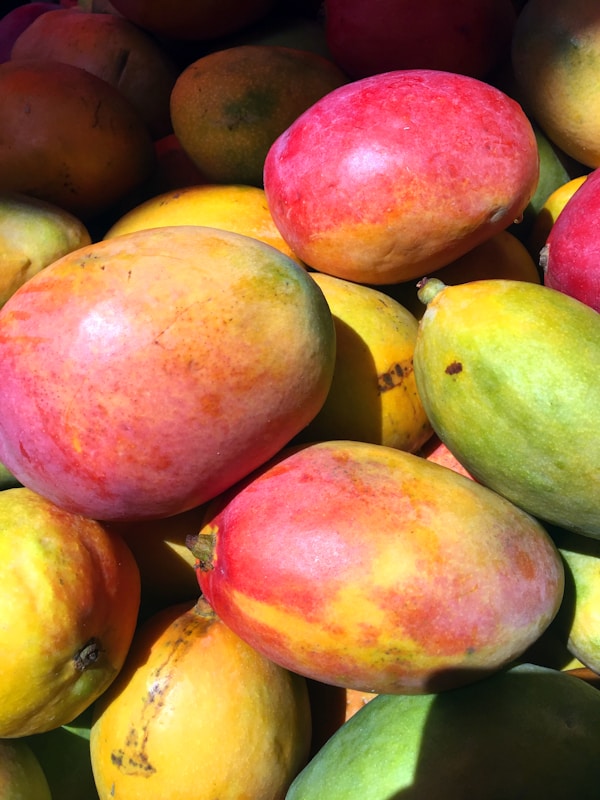
Mango
The king of tropical fruits — fibrously sweet with complex floral notes and hundreds of varieties.
Don't judge mango ripeness by color — color varies enormously by variety and is not a reliable indicator. Instead, squeeze gently near the stem; a ripe mango yields slightly. It should smell sweet and fruity at the stem end.
Ataulfo (honey) mangoes are the best choice for pure sweetness and minimal fiber. Tommy Atkins are the most common supermarket variety — reliable but mild. Kent and Keitt varieties are excellent when available. Avoid rock-hard, wrinkled, or overly soft mangoes.
Ataulfo / Honey Mango
Small, golden yellow, very sweet with minimal fiber and a small seed. Considered by many to have the best flavor.
Tommy Atkins
The most common supermarket mango — red and green skin, firm flesh, good shelf life, but mild flavor with some fiber.
Kent
Large, sweet, juicy, minimal fiber. Excellent for eating fresh and making juice.
Alphonso (Hapus)
The most prized Indian variety — intensely sweet, aromatic, and creamy. Available May–June.
Store unripe mangoes at room temperature — refrigeration halts ripening. Once ripe (yields to gentle pressure, fragrant at stem end), refrigerate and use within 3–5 days.
Frozen mango chunks are an excellent year-round substitute — no added sugar, perfect for smoothies, sauces, and cooking. Freeze peeled, cubed mango on a sheet pan before bagging to prevent clumping.
Fresh Salsa: Diced ripe mango with lime juice, red onion, cilantro, and jalapeño — extraordinary with fish tacos, grilled shrimp, and chicken. The sweetness balances heat and acid perfectly.
Mango Lassi: The iconic Indian drink — blend ripe mango with yogurt, a pinch of cardamom, and a little sugar. One of the world's great beverages.
Amchur (Dried Green Mango): Unripe green mangoes dried and ground into powder — a sour, tangy spice essential in Indian cooking, particularly in chutneys, marinades, and street food.
Mango Chutney: Cooked with sugar, vinegar, ginger, and spices — the complex sweet-sour condiment that transforms simple dishes. The Major Grey style is the most famous Western version.
Grilled Mango: Brush ripe mango slices with oil, grill until caramelized — concentrates sweetness and adds smokiness. Serve with ice cream, pork, or duck.
Freezing: The best method — peel, cube, freeze on a sheet pan, then bag. Retains flavor and nutrition well. Use within 6–12 months.
Drying: Mango slices can be dehydrated into chewy, sweet dried mango — a concentrated snack. Commercial dried mango often has added sugar; homemade is far superior.
Mango Jam & Preserves: Cooked with sugar and lime juice into jam. The natural pectin in mango is moderate — combine with high-pectin fruit or add commercial pectin.
Amchur Powder: Green (unripe) mangoes peeled, sliced thin, sun-dried, then ground — the essential souring agent in Indian cooking.
Mangoes are a nutritional powerhouse, delivering exceptional amounts of vitamins A and C in a single serving. One cup of mango provides 67% of the daily value for vitamin C and 18% for vitamin A as beta-carotene.
The orange flesh signals high carotenoid content — these antioxidants are associated with reduced risk of certain cancers and protection of eye health. Mangoes also contain significant folate, B6, and potassium.
Mangoes contain a unique mix of antioxidant polyphenols including mangiferin, which has demonstrated anti-inflammatory and anti-diabetic properties in research. The fiber content (3g per cup) supports digestive health and healthy blood sugar regulation.
Mangoes have been cultivated in South Asia for over 4,000 years and hold enormous cultural significance. They are the national fruit of India, Pakistan, and the Philippines — and India produces about 40% of the world's mangoes, yet exports less than 1% due to domestic consumption.
Over 500 varieties of mango exist worldwide. The Alphonso (Hapus) variety from Maharashtra, India is considered by many experts the finest-flavored mango in the world — intensely sweet, aromatic, and creamy. It's available in the West primarily as canned pulp due to import restrictions.
Mangoes belong to the same family as cashews and pistachios (Anacardiaceae). The sap and skin of mango contain urushiol — the same compound in poison ivy — which can cause contact dermatitis in sensitive individuals.
India, China, Thailand, Indonesia, and Mexico are the dominant mango-producing nations. Shipping by sea has a much lower carbon footprint than air freight — buying mangoes in season reduces this impact.
Mango trees are long-lived perennials that can produce fruit for 100+ years, making them relatively sustainable crops compared to annual vegetables. They provide significant ecosystem services — shade, erosion control, carbon sequestration.
Fair trade certification in mango-exporting countries helps ensure that farmers receive fair prices and workers receive fair wages.
Available Near You
Enter your ZIP code to find farms with mango near you.
Recipes with Mango
Coming Soon