
Fruit · Late Spring – Fall
Lychees, Rambutans & Longans
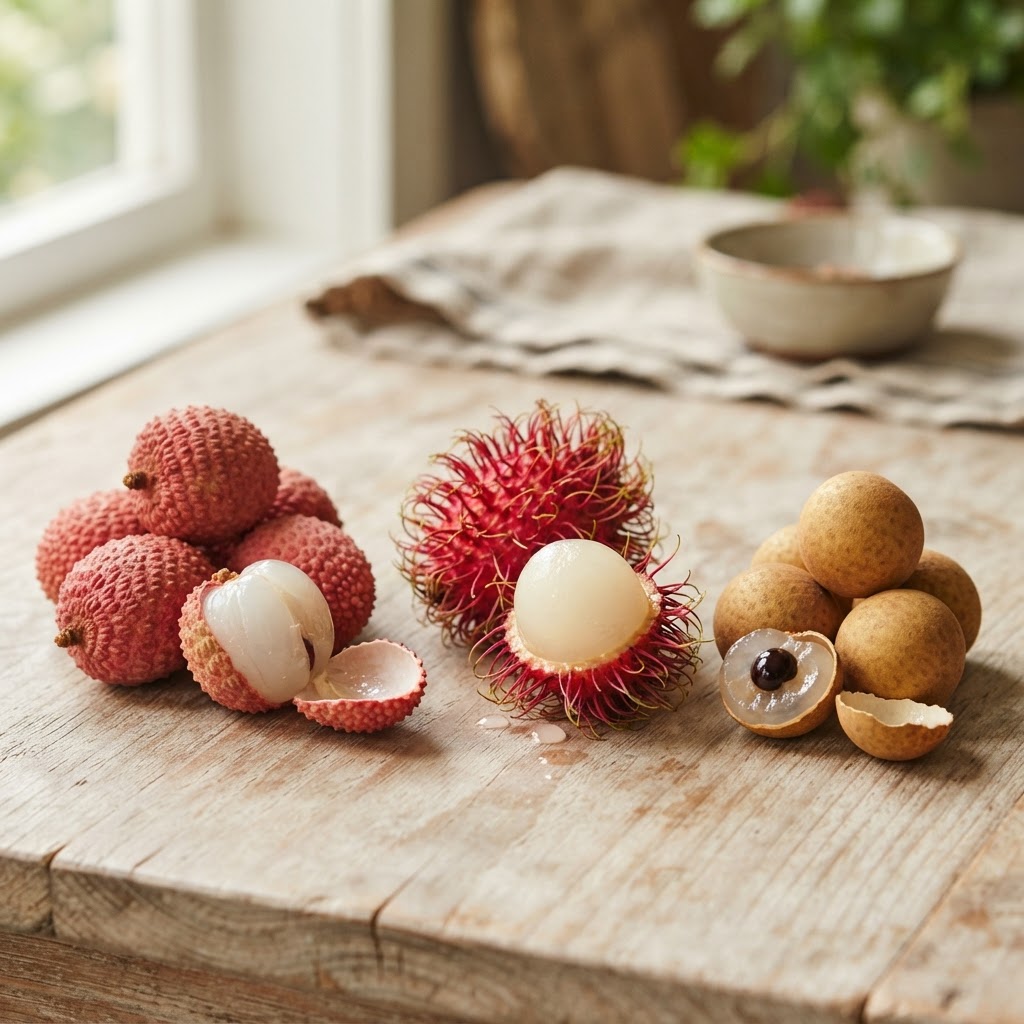
Three cousins from the soapberry family (Sapindaceae): lychees have bumpy pink skin, rambutans wear a vivid red shell of soft spines, and longans are the smallest — smooth and brown. Once peeled, all three reveal fragrant white flesh around a large seed, with a sweet, floral flavor often compared to roses.
Lychees are the sweetest and most fragrant. Longans have a more tart, musky flavor. Rambutans fall somewhere in between. All three are beloved across Southeast Asia, and increasingly popular worldwide in drinks, desserts, and bubble tea.
Lychee
Bumpy pink-red shell. The sweetest and most fragrant of the three. Native to Southeast China and Northern Vietnam — cultivated for 3,000+ years. Season: late spring through summer.
Rambutan
Deep red shell with long, soft spines. Originally from Malaysia; spread by Arab and Dutch traders. Less well-known than lychee. More available fall through winter. Needs consistent tropical weather.
Longan
Smooth tan-brown skin. The most tart and musky of the three. From the same region of China as lychee but grows at higher altitudes. Hardest to find fresh outside Asia. Season: late spring through early fall.
All three are members of the soapberry family (Sapindaceae), which also includes mamoncillo — and even maple trees.
Bees living near lychee orchards produce lychee honey, which shares the delicate floral flavor of the fruit with a subtle rose-like taste.
Ancient Chinese texts say a lychee loses its color one day after picking, its fragrance on the second day, and its sweetness on the third. This ancient advice still holds up perfectly today.
Lychees & Rambutans: Look for pink to red skin and fruit that feels firm but not hard. Tan or squishy fruit may be past its prime.
Rambutans specifically: The spines should be flexible and soft — dry or brittle spines signal old fruit.
Longans: Often sold in bunches on the branch. Will be slightly firmer than lychees but tan-colored when ripe.
All three: Avoid any with broken skin or obvious blemishes. The fruits do not ripen further after picking, so what you buy is what you get.
Canned, frozen, dried: All three are widely available at Asian grocery stores. Fresh longans outside Asia are rare — canned is often the best option.
These fruits have a short shelf life — eat as soon as possible after purchasing, as they do not ripen further off the tree.
Store in the refrigerator for up to seven days. They will begin to go mushy and sour if kept past their peak.
Freeze them (peeled and seeded) for use in sorbets, ice creams, and smoothies.
Fresh Eating: All three are delicious eaten raw with no accompaniment. Peel like a small citrus — the large seed in the center can be removed beforehand or spit out after eating the flesh.
Fruit Salads & Desserts: Excellent in fruit salads, drizzled with syrup and served over ice cream, or blended into smoothies and sorbets.
Baked Goods: Fresh, canned, and dried versions work in cakes, cupcakes, and tea cakes.
Vietnamese Chè: Sweet soups made with both dried longan and fresh lychee — a refreshing traditional dessert.
Indian Dairy Desserts: Lychee is used in kheer and rabdi, where the floral flavors complement the sweetness of condensed milk.
Bubble Tea & Cocktails: Lychee jelly is a classic bubble tea topping. Lychee juice has become a bar staple — the lychee martini ("lycheetini") has earned cult status.
Savory Uses: In Chinese cuisine, lychees are sometimes cooked with chicken or pork, where their sweetness balances savory sauces.
Canning: All three are widely available canned in syrup — a practical pantry option for off-season use.
Drying: Dried lychees and longans are a traditional Chinese pantry staple, used in teas, soups, and desserts.
Freezing: Freeze peeled, seeded fruit for use in sorbets, ice creams, and cocktails.
Juice / Nectar: Lychee juice is commercially produced and widely available.
All three fruits are good sources of Vitamin C, potassium, and dietary fiber.
Lychees in particular are rich in antioxidants and have been studied for anti-inflammatory properties.
The fruits are relatively low in calories and high in water content, making them refreshing and hydrating.
Lychee Origin: Native to Southeast China and Northern Vietnam — cultivated for more than 3,000 years. Spread to India, the Caribbean, and Europe in the 1700s.
Rambutan Origin: From present-day Malaysia, spread through East Africa, Indonesia, and South America by Arab and Dutch traders.
Longan Origin: Same region as lychee, but grows at higher altitudes — fruits best in places with cool, non-freezing winters.
Top Producers: China, India, Vietnam, and Thailand. Most imported lychees in U.S. markets come from China and Vietnam.
U.S. Growing: Lychees and longans grow in South Florida, Hawaiʻi, and parts of California. Rambutans are mostly limited to Hawaiʻi. All three can be found at farmers' markets in these areas.
Season: Lychees and longans peak late spring through early fall. Rambutans are more available fall through winter.
Pesticide Concerns: These fruits can suffer from insect pests and fungal diseases, leading to pesticide use. Australian researchers found pesticide residues above permissible levels in imported lychees, including a suspected carcinogenic fungicide. Buy organic when possible.
Herbicides: Glyphosate and paraquat are sometimes used in commercial orchards, which can damage surrounding wildlife.
Labor Concerns: Harvesting these fruits is labor-intensive. In Vietnam and Thailand, agricultural workers can face poor conditions, long hours, and high chemical exposure risk.
What to Do: Seek certified organic versions — both fresh and processed products are increasingly available. If possible, buy from local vendors in Hawaiʻi, South Florida, or California who can speak to their growing practices.
In-Season Recipes with Lychee
Seasonal recipes featuring Lychee right now
Coming Soon
All Other Recipes with Lychee
Coming Soon