
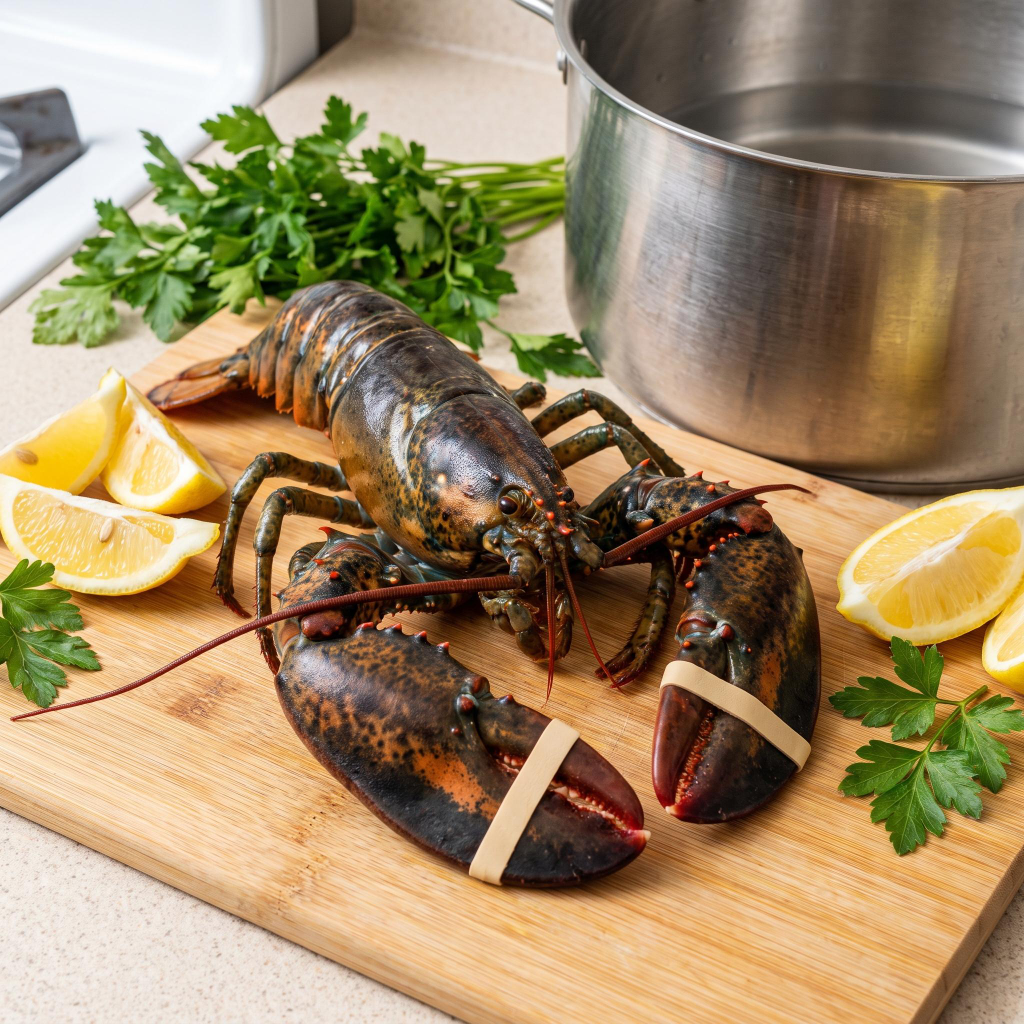
Lobster
Premium crustacean with rich, succulent meat
Buy lobsters live for the best quality — they should be active, with tails that curl under when picked up. A limp lobster may be dying and should be cooked immediately.
Hard-shell lobsters have more meat per pound; soft-shell (newly molted) lobsters have less meat but sweeter, more tender flesh and are often cheaper by the pound.
For tails and claws sold separately, look for cold-water lobster (Maine or Canadian) for the sweetest flavor. Avoid 'water-added' frozen products, which are pumped with moisture.
Plan on 1–1½ pounds of whole lobster per person for a main course.
From the iconic Maine lobster to delicate langoustine, each variety is a luxury in its own right:
Maine / American
The classic lobster with large claws and sweet, firm meat — the icon of New England seafood boils and rolls.
Spiny / Rock
Clawless warm-water lobster with a tail full of sweet meat — the lobster of Florida, the Caribbean, and California.
European / Norway
Similar to Maine lobster but from European waters — prized in France and the Mediterranean; increasingly rare.
Slipper / Flathead
Flattened, odd-looking lobsters with sweet, scallop-like meat — a bycatch delicacy in some cuisines.
Langoustine
Small, delicate 'Norway lobster' with intensely sweet meat — a European luxury, often called scampi.
Crawfish
Freshwater mini-lobsters — the soul of Louisiana boils and Scandinavian kräftskriva; sweet and briny.
Live lobsters should be cooked the day you buy them. Store in the refrigerator covered with a damp cloth or newspaper — never in fresh water, on ice, or sealed in plastic, all of which will kill them.
Keep them cold (35–40°F) and cook within 24 hours. A dead lobster must be cooked immediately; do not eat a lobster that died more than a few hours before cooking.
Cooked lobster meat keeps refrigerated for 1–2 days. Whole cooked lobsters and picked meat freeze well for up to 3 months.
Lobster is a luxury — cook it simply to let the sweet meat shine.
Boiling: The classic method — boil in heavily salted water for 8–10 minutes for a 1½-pound lobster, adding 2 minutes per additional pound.
Steaming: Gentler than boiling and yields slightly sweeter meat — steam over salted water for 10–12 minutes for a 1½-pound lobster.
Grilling & Broiling: Split the tail, brush with butter, and grill or broil for a smoky, rich preparation.
Butter-Poaching: Gently poach picked tail and claw meat in warm butter for the tender, luxurious texture of fine dining.
Lobster Rolls: Chunks of cooked lobster, barely dressed with melted butter or a light touch of mayo, in a toasted split-top bun — the New England icon.
Freezing: Whole cooked lobsters and picked meat freeze well for up to 3 months. Freeze tails raw for the best texture.
Lobster Stock: Shells make an extraordinary stock for bisque, sauces, and seafood stews — freeze the stock for months.
Canning: Lobster is occasionally canned in butter (a New England tradition) for rich, ready-to-use meat.
Bisque & Pâté: Lobster bisque and lobster pâté extend a small amount of meat into an elegant dish.
Lobster is a lean, high-protein seafood — about 20 grams of protein and only 90 calories per 3-ounce serving, with less fat and fewer calories than most meats.
It is rich in vitamin B12, selenium, zinc, and copper, and a good source of omega-3 fatty acids. Lobster is relatively high in sodium and cholesterol compared to some seafood, but low enough in saturated fat that it remains a healthy choice.
The 'luxury' reputation of lobster is mostly about price and tradition — nutritionally it is an excellent lean protein.
Lobsters were once so abundant in New England that they were considered poverty food — servants in colonial Massachusetts reportedly negotiated contracts limiting how often they could be fed lobster.
Lobsters can live 50–100 years and grow throughout their lives, molting their shells to grow. The largest recorded lobster weighed over 44 pounds.
Lobsters taste with their legs and chew with their stomach — they have sensory hairs on their legs and a 'gastric mill' in their stomach that grinds food.
Lobsters are typically cooked alive because they spoil very quickly after death, producing toxins. Modern practices include chilling or stunning to minimize suffering.
American (Maine) lobster is a well-managed fishery with size limits, trap limits, and protections for breeding females — a generally sustainable choice.
However, entanglement of North Atlantic right whales in lobster trap ropes has become a serious concern; some regions are transitioning to ropeless gear to protect the critically endangered whales.
Spiny lobster from the U.S. (Florida, California) is well-managed. Imported spiny lobster varies — check a current seafood guide. Farmed lobster is emerging but still rare.
Available Near You
Enter your ZIP code to find farms with lobster near you.
Recipes with Lobster
Coming Soon