
Legumes, Beans & Nuts · All Seasons
Lentils
Lens culinaris · Also: Daal, Masoor, Lens
Lentils are the small, lens-shaped seeds of a bushy annual legume — so characteristic in shape that "lens" itself takes its name from them. Earthy, nourishing, and quick to cook, lentils are among the oldest cultivated crops in the world.
Evidence of lentil farming in the Near East dates back more than 10,000 years, making them a founding staple of human agriculture. From India's many dals to the rich lentil stews of the Mediterranean, the tiny Umbrian Castelluccio lentil, and the French green Puy, lentils are a global pantry cornerstone — humble, cheap, shelf-stable for years, and packed with protein and fiber. Italians eat them with cotechino on New Year's Eve for luck, and the lentil's coin-like shape makes it a universal symbol of prosperity.
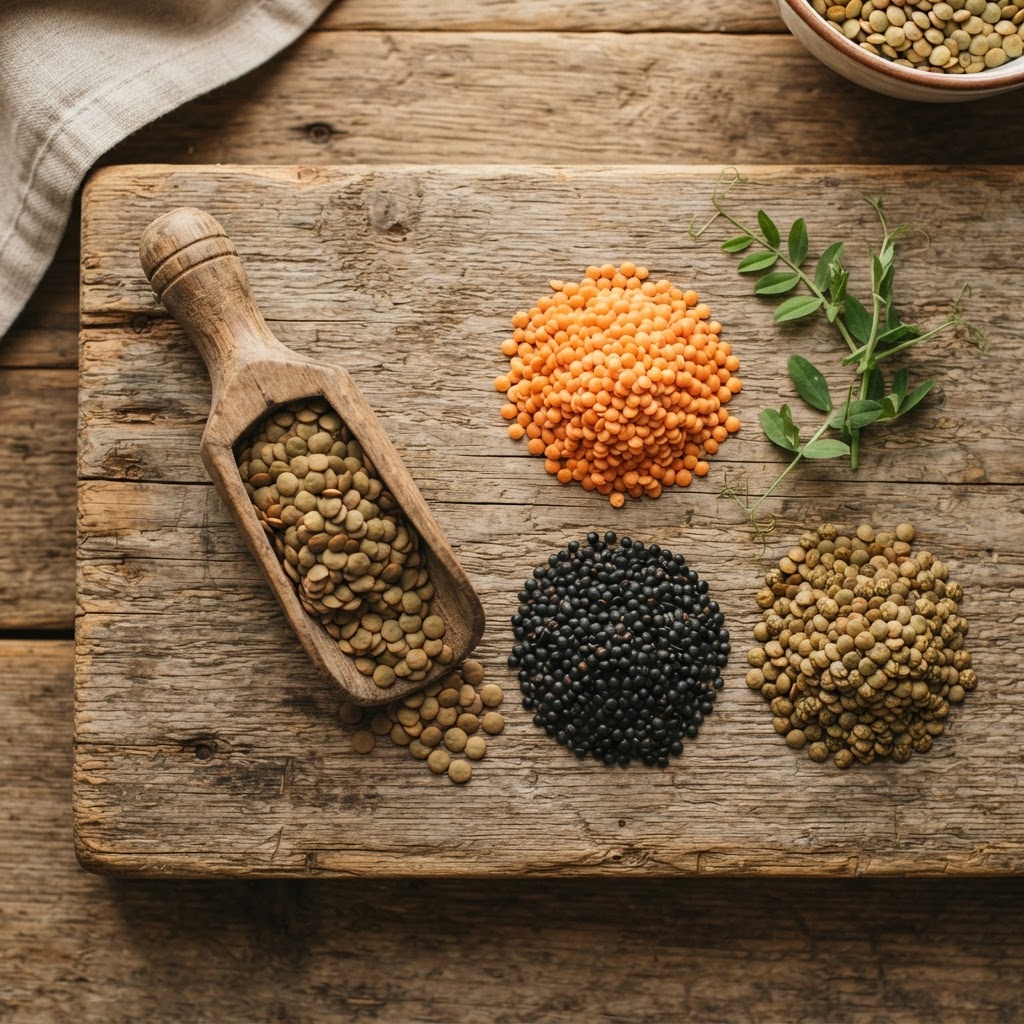
Brown & Green Lentils
The everyday Western lentil — earthy and versatile, holds its shape well in soups and stews; brown lentils are the standard grocery-store type.
French Green (Lentilles du Puy)
Tiny, dark-green, and peppery lentils from the Auvergne with an AOC designation — prized for holding their shape and a firm, mineral flavor in salads.
Castelluccio Lentil
A tiny, delicate Umbrian heirloom grown in the high Sibillini plateau — tender, thin-skinned, and famously flavourful, celebrated across Italy.
Red & Yellow Lentils (Masoor)
Split, skinless lentils that cook quickly to a soft golden puree — the base of Indian dals and Middle Eastern soups; color deepens to yellow when cooked.
Black Beluga Lentils
Small, shiny jet-black lentils that resemble caviar and hold their shape — rich and earthy, prized for salads and plating.
Black Gram (Urad Dal)
A small, dark-skinned Indian lentil — whole black gram or split and hulled white; the staple of South Indian idli and dosa batters and rich North-Indian dals.
Buy dried lentils sealed and uniform in color — avoid bags with dust, broken bits, or evidence of insects. Older lentils take longer to cook and may never fully soften, so choose fresh, brightly-coloured stock.
Whole lentils (green, brown, Puy, beluga, Castelluccio) keep their shape; split, skinless red and yellow lentils break down into purees — choose the type that suits your dish.
Canned cooked lentils are a convenient shortcut — check for added salt and rinse well before use.
Dried lentils keep for years in a sealed jar in a cool, dry, dark cupboard, though they're best cooked within a year — very old lentils stay hard no matter how long you simmer them. Cooked lentils keep about 4–5 days refrigerated, and they freeze beautifully for quick weeknight meals.
Sorting & rinsing: Spread dried lentils on a tray and pick out any stones or shrivelled seeds, then rinse in a sieve under cold water.
Soaking (optional): Most lentils need no soaking, unlike larger beans. A short 1–2 hour soak speeds cooking for whole types; split red and yellow lentils never need it.
Cooking times: Split red/yellow cook in 15–20 minutes; brown and green in 20–30; Puy, beluga, and Castelluccio hold shape in 25–35; black gram (whole) takes 40–60 minutes.
Lentil Soup & Stew
The global classic — lentils simmered with aromatics, vegetables, and stock into hearty, warming soups and stews, from Mediterranean to Middle Eastern kitchens.
Indian Dal
Split red or yellow lentils cooked with turmeric, cumin, and garlic into a silky dal — finished with a sizzling tempering of spiced oil and served with rice or flatbread.
Lentilles du Puy Salad
Cook French green lentils until just tender, drain, and toss warm with vinaigrette, shallot, and herbs — a classic French bistro salad that holds its shape.
Cotechino e Lenticchie
Italy's New Year's Eve luck dish — slow-cooked pork sausage over a bed of lentils, the coin-shaped legumes promising prosperity.
Lentil Curry & Mujadara
Spiced lentil curries of India, or the Middle-Eastern mujadara of lentils and rice crowned with crisp onions — humble, deeply satisfying staples.
Lentil Burgers & Loaves
Mash cooked lentils with grains, herbs, and binders into vegetarian patties and loaves — a hearty plant-protein main course.
Drying: Lentils are naturally dried for storage — a shelf-stable staple that keeps for years and underpins food security across South Asia and the Middle East.
Canning: Cooked, canned lentils are a convenient, long-lasting pantry shortcut — rinse before use to remove added salt.
Freezing cooked: Cooked lentils freeze well for 3–6 months in airtight containers, ready to fold into soups, salads, and curries.
Lentils are a nutritional powerhouse — roughly 18 g of protein and 15 g of fiber per cooked cup, with folate, iron, phosphorus, and potassium in abundance, and almost no fat.
They're especially valued for plant-based diets as an affordable, complete-when-paired-with-grains protein, and their low glycemic index helps steady blood sugar.
Rich in polyphenols and prebiotic fiber, lentils support gut and heart health and are a staple of the Mediterranean and DASH diets.
Lentils are among the oldest crops in human agriculture — charred lentil seeds from the Near East date back roughly 11,000 years, making them one of humanity's first domesticated foods.
The word "lens" (the optical glass) comes from the lentil — the seed's distinctive biconvex shape gave its name to the familiar curved lens.
Italy's New Year's tradition of eating lentils with cotechino sausage on 31 December is meant to bring prosperity: the coin-shaped lentils symbolise money for the year ahead.
Lentils are so cheap, nutritious, and shelf-stable that they're a foundation of food security in much of South Asia, the Middle East, and the Horn of Africa — a global "poor man's meat" that far outpunches its cost.
From U.S. lentil festivals to Italian New Year's luck, lentils carry rich cultural meaning:
Lentil Festival
Pullman, Washington, USA
🗓 August 2026 (annual National Lentil Festival)
The National Lentil Festival in the heart of U.S. lentil country celebrates the Palouse harvest with lentil chili, a giant lentil pancake, and lentil-themed games in the rolling hills of eastern Washington.
Festa della Lenticchia
Castelluccio, Umbria, Italy
🗓 Late May 2026 (bloom) & September 2026 (harvest)
The tiny, prized Castelluccio lentil of the Umbrian highlands is celebrated each year — the plateau's famous lentil-field bloom in late May draws visitors, and the September harvest brings rustic lentil stews to village tables.
Lucky Lentils on New Year's (Cotechino e Lenticchie)
Italy, nationwide
🗓 December 31, 2026 (New Year's Eve)
Italians eat lentils with cotechino pork sausage on New Year's Eve — the coin-shaped lentils are said to bring prosperity in the coming year, a beloved national tradition.
Nitrogen-fixing: Like all legumes, lentils fix their own nitrogen, enriching the soil and reducing fertilizer needs — an excellent rotation crop in dryland farming.
Low-water & cool-season: Lentils thrive in cool, dry climates with minimal water and inputs, making them one of the most sustainable sources of plant protein — far gentler on land and water than animal protein.
Global range: Canada and India are the world's largest producers, followed by Turkey, Australia, and the U.S. (the Palouse region of Washington and Idaho) — lentils span temperate drylands on every continent except Antarctica.
Available Near You
Enter your ZIP code to find farms with lentils near you.
Recipes with Lentils
Coming Soon