
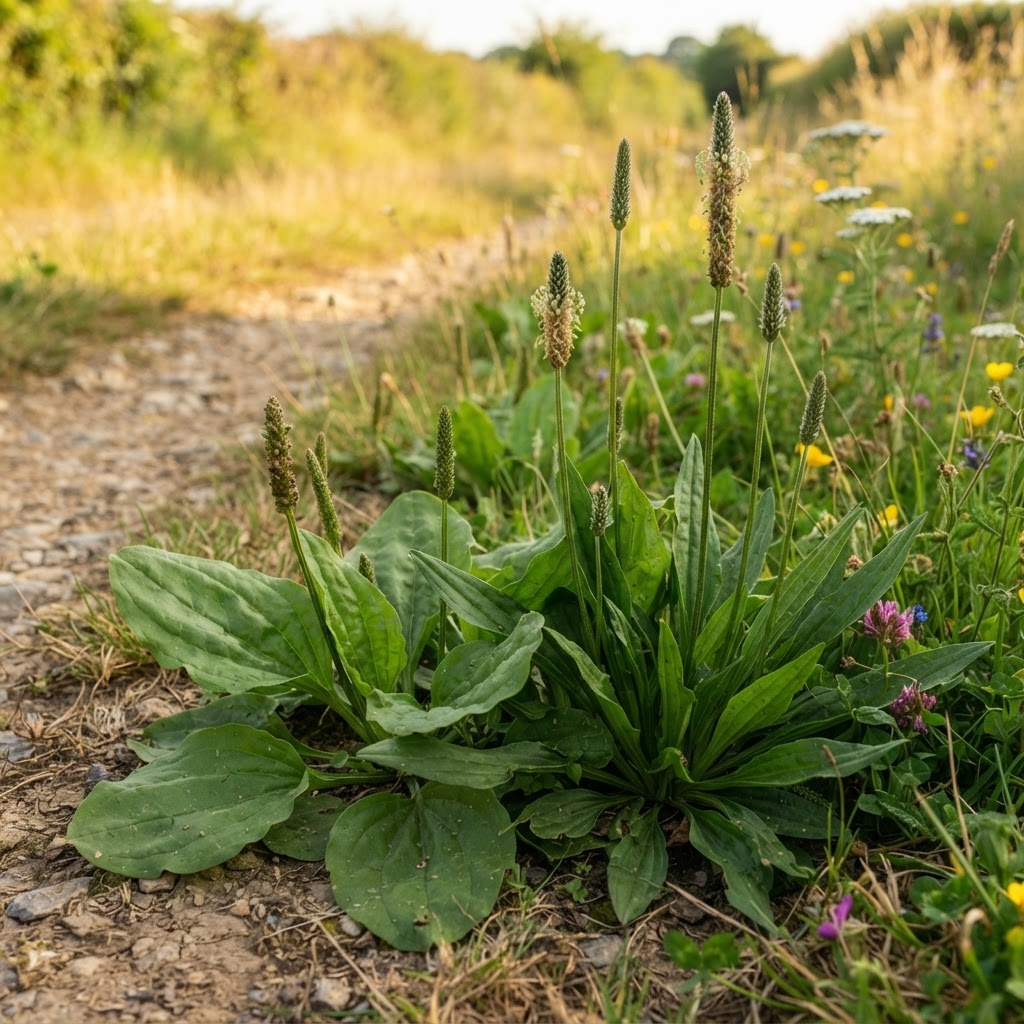
Plantain
Also known as: Greater Plantain, Ribwort, Waybread, Broadleaf Plantain, Narrowleaf Plantain, Common Plantain, Wegerich, Piantaggine, Llantén, Weybread
Plantain (Plantago major and Plantago lanceolata) is a hardy, low-growing perennial of the Plantaginaceae family, long familiar as the humble wayside herb of paths, lawns, and meadows across temperate Europe, Asia, and North America. It forms a basal rosette of broad, ribbed, oval leaves or narrow, lance-shaped, ribbed leaves, and sends up slender, leafless spikes of tiny, inconspicuous greenish-white flowers from spring to early autumn. Native to Eurasia and widely naturalized, plantain has been gathered for millennia as a wild edible, a gentle healing herb, and a household remedy, prized for its tender young leaves, edible seeds, and centuries of folkloric association with healing, resilience, and the open wayside.
spring, summer
Mild, green, and pleasantly herbaceous with an earthy, slightly grassy, and fain...
Plantago major / Plantago lanceolata
herb
Pairs Well With
Plantain is best gathered young and tender, and used as a mild wild green or gentle herb rather than as a bold seasoning.
The young leaves are eaten raw in spring salads, where their fresh, green, and slightly earthy flavor blends well with milder lettuces, herbs, and a tangy vinaigrette, and used as a garnish for cold soups and summer plates.
They are lightly cooked in soups, stews, and stir-fries, added toward the end of cooking to preserve their delicate flavor, and used as a pot herb or wild spinach in country cooking, often combined with nettles, dandelion, or sorrel.
Plantain leaves are infused into gentle herbal teas and tisanes, often blended with chamomile, mint, or honey, and used in cooling summer infusions to soothe the digestion and the skin.
The seeds may be gathered and used as a mild, nutty accent or ground into a simple flour substitute in folk cooking, and the tender leaves may be lightly battered and fried as a crisp wild vegetable.
Always gather the youngest leaves, as older leaves quickly become tough and bitter.
Plantain has been treasured for millennia in European, Asian, and Native American herbal and folk tradition as a gentle, cooling, and healing herb of the wayside.
The leaves were traditionally infused as a gentle herbal tea to soothe the digestion, calm coughs, and ease minor fevers, and valued as a gentle, nutritive tonic supportive of the whole system.
A warm infusion or poultice of plantain was used in folk practice to soothe minor wounds, burns, insect bites, and skin irritations, to ease tired and aching eyes, and as a gentle facial rinse to refresh and brighten the complexion.
Plantain was a classic household remedy, carried as a charm against illness, used to draw out infections and soothe the sting of nettles and insects, and treasured as a humble but powerful healing herb available to all.
In tradition it was a plant of the open wayside, gathered from paths and meadows and kept as a household remedy for the skin, the digestion, and the ills of the cold months.
Gather the young, tender leaves in spring and early summer, before the plant flowers, when the flavor is most mild and the texture most delicate, and use fresh or dried; for drying, spread the leaves on a screen in a warm, airy, shaded place and store sealed away from light and heat.
Rinse the leaves well, then use raw in salads, as a garnish, or lightly cooked in soups, stews, and stir-fries, added toward the end of cooking to preserve their delicate flavor.
Infuse the leaves into gentle herbal teas and tisanes, blended with chamomile, mint, or honey, or use as a cooling poultice for the skin.
The seeds may be gathered when ripe and used as a mild, nutty accent or ground into a simple flour substitute.
Always gather the youngest leaves, as older leaves quickly become tough, fibrous, and bitter, and harvest only from clean, unpolluted ground away from roads and sprays.
Plantain is generally considered safe for most adults when consumed in moderate, culinary amounts as a wild green or gentle herb.
The herb is mild and the young leaves are prized for their fresh, green flavor, and should be gathered young and tender to avoid toughness and bitterness.
As a member of the plantain family, it is rarely allergenic, though those with known sensitivities should use caution.
Plantain has been used in folk medicine to soothe the skin and digestion; pregnant and breastfeeding women should use plantain only in small, culinary amounts, and medicinal or prolonged use should be undertaken only with professional guidance.
Always use only culinary-grade plantain from a reliable source and correctly identify any wild plants, as the leaves can be confused with less benign look-alikes, and harvest only from clean, unpolluted ground away from roads and sprays.
Plantain has a long tradition in natural beauty and herbal skincare, treasured for its gentle, cooling, soothing, and healing properties.
A warm infusion of the leaves is a classic herbal skin wash and poultice, traditionally used to soothe minor wounds, burns, rashes, insect bites, and skin irritations, and to calm and refresh the complexion.
Plantain is infused into gentle facial toners, skin rinses, and herbal baths to soothe and renew the skin, and into soothing creams and oils to ease minor skin irritations and bring a soft, rested glow.
The leaves are used in herbal compresses for tired and irritated eyes, in soothing bath herbs and foot soaks, and in herbal pillows and dream sachets for relaxation.
With its humble, resilient character and gentle, healing virtue, plantain remains a beloved herb of natural beauty rituals and herbal skincare across the temperate world.
Plantain thrives in the disturbed, compacted soils of paths, lawns, meadows, roadsides, and rough ground across temperate Europe, Asia, and North America, forming spreading rosettes of leaves and slender flower spikes from spring to early autumn.
The plant is remarkably hardy and resilient, able to withstand trampling and mowing, and its small flowers support bees and other pollinators, while its seeds feed small birds.
In tradition, plantain was a plant of the open wayside, gathered from paths and meadows as a humble but powerful healing herb, and treasured across Europe, Asia, and North America for its gentle, soothing virtues.
It was carried as a charm against illness, used to draw out infections and soothe the sting of nettles and insects, and remains a living thread of folk medicine, household remedy, and the ecology of the open ground.
Available Near You
Enter your ZIP code to find farms with plantain near you.
Recipes with Plantain
Coming Soon