
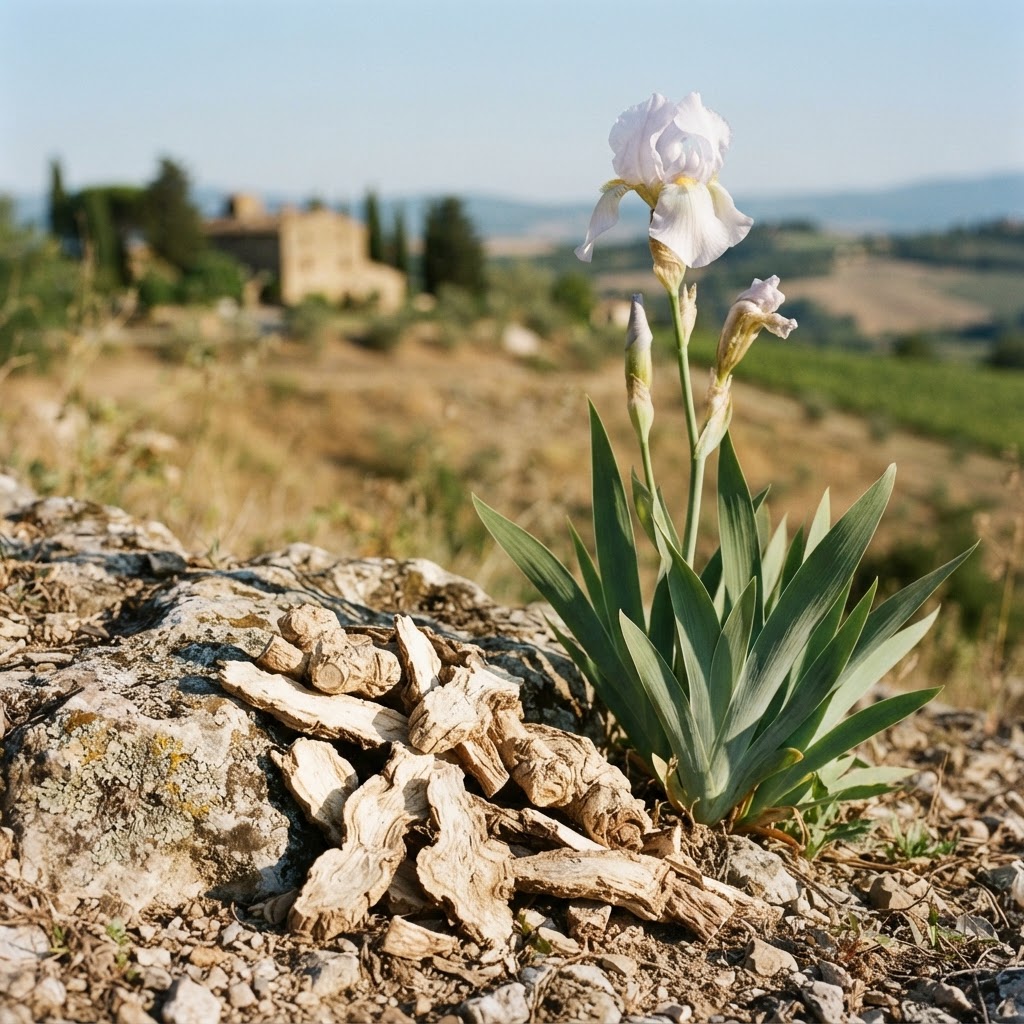
Orris Root
Also known as: Florentine Iris, Orris, Iris Root, Violet Root, Queen Elizabeth Root, Bearded Iris Root
Orris Root is the dried, aged rhizome of the Florentine Iris (Iris germanica var. florentina and closely related Iris pallida), a stately perennial of the Iridaceae family long cultivated in the hills around Florence and across southern Europe. The plant bears broad, sword-like, grey-green leaves and tall stems of pale, luminous lavender-white flowers marked with a soft yellow beard. Unlike most roots, orris must be dug, peeled, and dried slowly over two to three years before its characteristic violet-like perfume develops, as the irone compounds mature within the starchy rhizome. For centuries orris root has been one of perfumery's most precious fixatives and a cherished, if subtle, culinary aromatic, lending its powdery, violet sweetness to fine confections, liqueurs, and herbal apothecary blends.
summer, fall
Softly floral, powdery, and violet-like with a sweet, woody, and faintly earthy ...
Iris germanica var. florentina (also Iris pallida)
herb
Pairs Well With
Orris root is used only sparingly and with care, prized as a fixative and aromatic base rather than a primary flavor.
A small piece of aged orris root may be infused into creams, custards, and syrups to lend a delicate, powdery violet note, balanced with sugar and cream.
It is a traditional aromatic in certain European liqueurs, bitters, and cordials, where it rounds and extends floral and herbal notes and helps fix the blend.
Finely powdered orris is sometimes used in tiny amounts to scent sugars, pastilles, and Turkish-style confections, and to anchor violet and rose perfumes in confectionery.
Orris is best paired with other florals—violet, rose, lavender, and citrus—or with warm spices, and should be used in minute quantities, as too much turns bitter and soapy.
In modern kitchens it is rare; most orris today goes to perfumery, and culinary use requires food-grade, properly aged and powdered root.
Orris root has been treasured for centuries in European perfumery, herbalism, and apothecary tradition as a fixative, a gentle aromatic, and a soothing herb.
The aged root was traditionally infused into oils, powders, and sachets to scent linens, the body, and the home, and to fix and extend other fragrances in fine perfumery.
It was valued as a gentle, drying, and soothing herb in old herbal practice, used in gargles and dentifrices for the mouth and throat, and as a mild astringent.
Orris was a classic ingredient in violet- and rose-scented cosmetics, hair powders, and tooth powders, and was carried in pomanders and nosegays against ill air.
In folk tradition, pieces of orris root were kept in linen closets and wardrobes to perfume and protect fabrics, a use that continues in European country custom.
Dig the rhizomes in late summer or early autumn from mature, established plants (three or more years old), choosing plump, firm roots.
Wash thoroughly, peel away the outer bark and the small rootlets, and cut the cleaned rhizome into thin slices or chunks.
Dry the pieces slowly in a warm, airy, shaded place, then age them in airtight containers for at least two, and ideally three or more, years to allow the violet-like irone compounds to develop fully—the scent strengthens and softens with age.
For culinary or perfumery use, grind the aged root to a fine powder only as needed, as the fragrance fades once ground.
Use in tiny pinches: infuse a small piece and strain well, and always pair with sugar, cream, citrus, or other florals to carry and balance the delicate, powdery note.
Properly aged orris root is generally considered safe in very small culinary and aromatic amounts for most adults.
The fresh or insufficiently aged root can be irritating to the skin and mucous membranes and may cause allergic reactions in sensitive individuals; handle with care and avoid the fresh root.
Orris root powder is a fine dust and may irritate the eyes and respiratory tract; avoid inhaling and use in a well-ventilated space.
Orris is potent and should be used only in minute quantities; excessive amounts may cause nausea or digestive upset.
Pregnant and breastfeeding women should avoid medicinal amounts; culinary use should be occasional and very light.
Always use food-grade, properly aged orris root from a reliable source; ornamental and perfumery grades may be treated and are not intended for consumption.
Orris root is one of the most cherished aromatics in natural beauty and perfumery, treasured for its powdery, violet-like scent and its ability to fix and extend other fragrances.
Aged orris powder is a classic base for dry shampoos, hair powders, and body powders, lending a soft, refined, and long-lasting floral fragrance.
It is infused into oils, balms, and sachets to perfume the skin, linens, and wardrobes, and to anchor rose, violet, and lavender notes in homemade perfumes.
Orris is traditionally used in dentifrices and mouthwashes for its gentle, drying, and soothing effect on the gums and mouth.
Its fixative quality makes it a staple of natural perfumery, where it deepens and prolongs floral and herbal blends and adds a soft, suede-like, powdery warmth.
The Florentine Iris thrives on the sun-warmed, stony hillsides and limestone soils of southern Europe, especially around Florence, where orris cultivation has been a refined art since the Middle Ages.
The plant is hardy and long-lived, forming broad, sword-leaved clumps that stabilize dry slopes and grace old cottage and monastery gardens; its flowers support bees and other pollinators in early summer.
In tradition, the iris was a symbol of royalty, wisdom, and divine message—the fleur-de-lis of French heraldry is widely held to be an iris—and orris root was an aromatic of wealth, refinement, and the apothecary.
For centuries the hills around Florence produced the finest orris in Europe, and the slow, patient aging of the root remains a craft passed down through generations, a living thread of Mediterranean herbal and perfumery heritage.
Available Near You
Enter your ZIP code to find farms with orris root near you.
Recipes with Orris Root
Coming Soon