
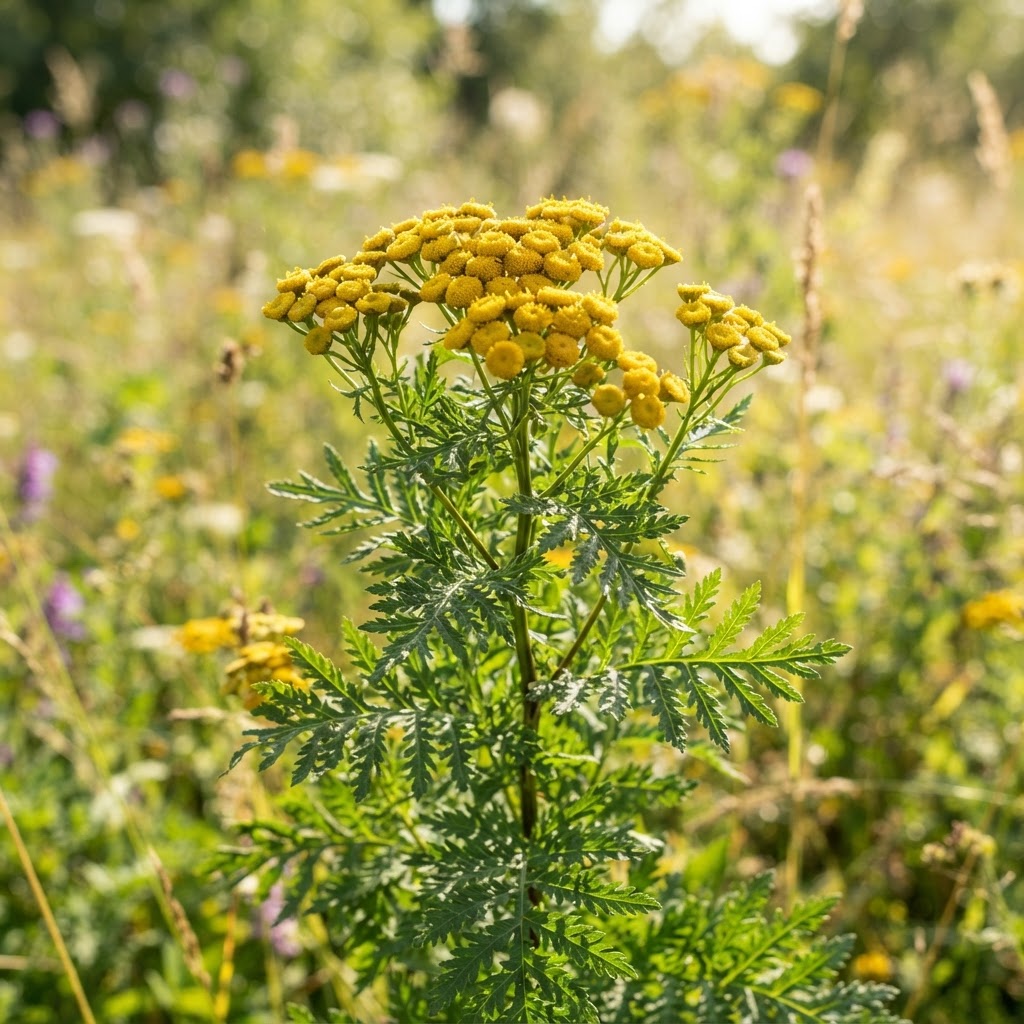
Tansy
Also known as: Common Tansy, Bitter Buttons, Cow Bitter, Golden Buttons, Garden Tansy, Tanaisie, Rainfarn, Hierba de San Isidro
Tansy (Tanacetum vulgare) is a hardy perennial of the Asteraceae family, native to Europe and western Asia and long naturalized across temperate regions. It grows as an upright, bushy plant with deeply divided, dark green, fern-like leaves and flat clusters of small, button-like golden yellow flowers. All parts of the plant carry a strong, distinctive, camphor-like aroma, and tansy has a long but cautionary history as a culinary, medicinal, and insect-repelling herb. Once used to flavor puddings, cakes, and eggs in medieval and early modern Europe, tansy is now regarded as a herb to use with great care, if at all, in modern cooking.
summer
Strongly bitter, camphoraceous, and warmly aromatic with a sharp, pungent, and r...
Tanacetum vulgare
herb
Pairs Well With
Historically, small amounts of chopped tansy leaves were used to flavor custards, puddings, tarts, and eggs, especially during Lent and Easter, as a bitter tonic herb.
Tansy was once added to small cakes and biscuits, known as tansy cakes or tansies, flavored with the herb's bitter aroma.
The young leaves were occasionally used as a bitter salad or pot herb in very small quantities.
Tansy flowers were used as a garnish and to color and flavor herbal vinegars and liqueurs.
Modern culinary use is rare and discouraged due to safety concerns; tansy is best treated as a historical curiosity rather than a kitchen staple.
Tansy has been used since ancient Greek and medieval European times as a bitter, warming, and carminative herb for digestion, worms, fevers, and menstrual complaints.
The herb was traditionally eaten in tansy puddings and cakes around Easter, both as a bitter Lenten tonic and as a symbolic cleansing herb.
Tansy was widely used in folk medicine as a vermifuge, or worm-dispelling herb, and as a remedy for gout, colds, and digestive upset.
In European folklore, tansy was strewn on floors and packed in bedding to repel fleas, flies, and insects, and was planted near doors and windows for the same purpose.
Modern interest is largely historical and cautionary; tansy is considered unsafe for self-medication due to its toxic compounds.
If tansy is used at all, only very small amounts of the fresh or dried leaves are added as a bitter flavoring to eggs, custards, or vinegar.
Wear gloves when handling, as the plant can cause skin irritation in sensitive people.
For historical puddings, a few young leaves were blanched and chopped into custard or egg mixtures.
Tansy vinegar is made by steeping a small handful of flowers in wine or cider vinegar for several weeks.
Given the herb's potential toxicity, modern cooks should prefer safer bitter or aromatic herbs, such as thyme or pennyroyal-free alternatives, and reserve tansy for decorative and insect-repelling uses.
Tansy contains thujone and other toxic compounds and is considered unsafe for medicinal or regular culinary use; ingestion, especially of the concentrated essential oil, can cause seizures, liver and kidney damage, and other serious effects.
Pregnant and breastfeeding women should avoid tansy entirely, as it has been traditionally associated with miscarriage and serious toxicity.
Children should not be given tansy in any form.
Skin contact with the plant can cause dermatitis in sensitive individuals.
Use tansy strictly as an ornamental or insect-repelling plant; any internal use should be avoided without professional guidance.
Never use tansy essential oil internally, as it is highly toxic even in small amounts.
Tansy thrives in well-drained, sunny, often disturbed soils across temperate Europe and western Asia and has naturalized widely in North America, where it can be invasive in pastures and roadsides.
The name tansy comes from the Greek athanatos, meaning immortal, reflecting the plant's long-lasting flowers and its use in embalming and preservation.
In European folklore, tansy was a herb of immortality, purification, and protection, used in burial rites, strewn in houses to repel insects, and eaten at Easter as a cleansing bitter herb.
In cottage gardens, tansy was planted near doors and windows as an insect repellent and was used to preserve meat and keep flies away.
Its bright golden buttons attract bees and beneficial insects.
Available Near You
Enter your ZIP code to find farms with tansy near you.
Recipes with Tansy
Coming Soon