
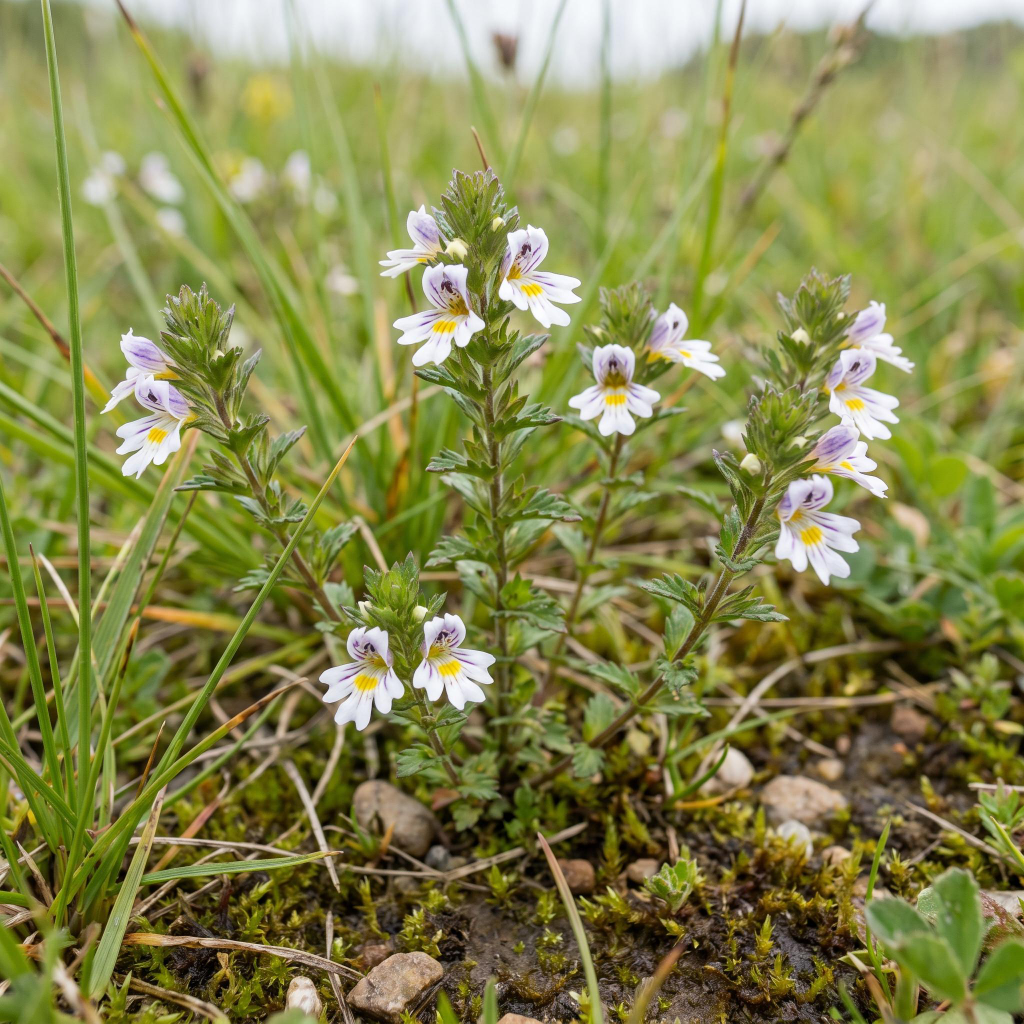
Eyebright
Also known as: Euphrasia, Meadow Eyebright, Common Eyebright, Augentrost, Eufrasia, Casse-lunettes
Eyebright (Euphrasia officinalis) is a small, delicate annual of the broomrape family, a semiparasitic wildflower of grassy meadows, heaths, and pastures across Europe and parts of Asia and North America. It grows just a few inches tall, with tiny toothed leaves and white or lilac-veined flowers whose central lobe carries a yellow blotch, giving each bloom the look of a miniature, freckled eye. The whole flowering plant has been used for centuries in European herbalism, most famously for eye preparations, and today it is best known as a gentle, traditional herb for eyestrain and minor eye irritation.
summer, fall
Slightly bitter and astringent, mildly saline with a faintly green, herbaceous e...
Euphrasia officinalis
herb
Pairs Well With
Eyebright is not a culinary herb in any meaningful sense, and it is not used to flavor everyday dishes.
In herbal practice it is taken as a tea, infusion, tincture, or compress rather than as food.
Eyebright infusions are sometimes used as a bitter, saline flavoring in small, medicinal amounts in old-style tonic drinks and herbal bitters.
It is far more useful as a remedy than as an ingredient and should be treated accordingly.
Eyebright has been used in European herbalism since at least the Middle Ages, most often for eye discomforts such as redness, tired eyes, and mild inflammation, a use suggested by the flower's eye-like markings under the Doctrine of Signatures.
It was traditionally taken as an eyewash, compress, and as a tea for catarrh, hay fever, and minor eye strain.
Herbalists have also used it for sinus congestion and minor respiratory irritation.
Modern interest focuses on its traditional role as a gentle, cooling eyewash and in combination products for eye and sinus comfort.
Eyebright has not been widely studied in humans, and it is best regarded as a traditional remedy rather than a proven medicine.
For an infusion, pour just-boiled water over 1 to 2 teaspoons of dried herb per cup, cover, and steep for 10 to 15 minutes; strain carefully through a fine cloth or paper filter to remove all plant particles before use.
Cool the strained infusion before using as an eyewash or compress; apply with a clean cotton pad, or use a sterile eyecup if experienced.
For internal use, the same tea is sipped in small amounts, typically up to two or three cups a day for short periods.
Tinctures follow manufacturer directions and are diluted in water.
Use only clean, well-identified, dried material and keep all eye preparations scrupulously clean and freshly made; discard any unused infusion after a day.
Eyebright preparations used directly in the eye carry risk of contamination and irritation, so many herbalists now recommend them only as a cooled compress rather than an eyewash, and advise against home-prepared eye drops.
Do not use eyebright in the eyes of contact lens wearers or in cases of eye injury, infection, or impaired vision without professional diagnosis.
Avoid internal use in pregnancy and breastfeeding, and in young children, except under qualified advice.
Stop use and seek help if eye symptoms worsen or persist, if pain, redness, or vision changes occur, or if any allergic reaction appears.
Foraging should be done with expert guidance, as several small meadow flowers resemble eyebright and the semiparasitic plant is best left growing wild.
Eyebright is a semiparasitic plant, drawing some water and nutrients from the roots of neighboring grasses and clovers, which is why it thrives in short, species-rich meadows and pastures and helps keep vigorous grasses in check.
It is pollinated by small insects and is part of the traditional hay-meadow flora of Europe, declining where meadows are fertilized or reseeded.
Its name comes from the Greek and Latin for gladness or good cheer (Euphrasia), and its folk reputation as an eye herb is very old.
In country practice it was gathered while in flower and dried for winter use, and it was one of the herbs associated with clear sight and clear weather.
In wildlife and traditional meadow conservation, eyebright is valued as a sign of old, unfertilized grassland and as a useful, if modest, member of a diverse sward.
Available Near You
Enter your ZIP code to find farms with eyebright near you.
Recipes with Eyebright
Coming Soon