
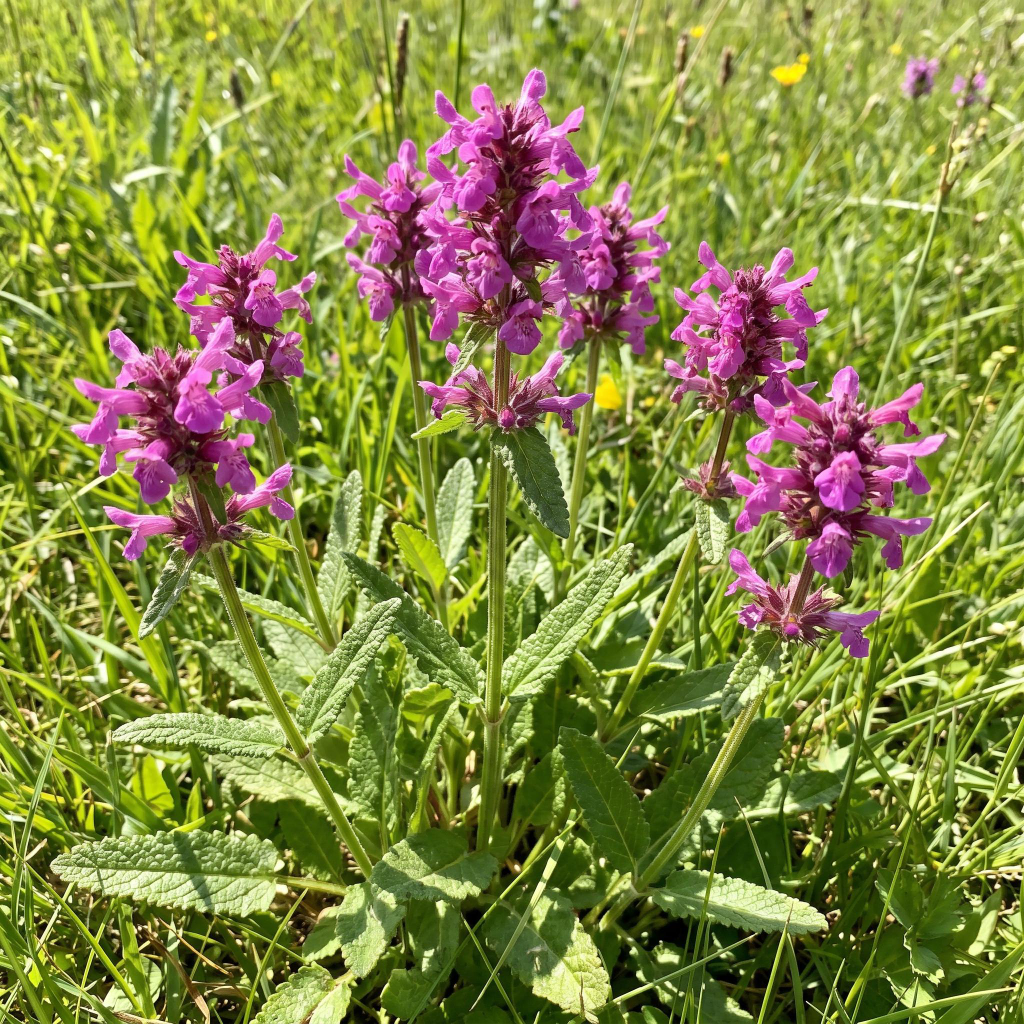
Betony
Also known as: Wood Betony, Bishopwort, Lousewort, Common Betony, Woundwort, Wild Hop
Betony is a hardy perennial of the mint family, native to meadows and open woodlands of Europe and western Asia. It forms tidy clumps of scalloped, hairy leaves and sends up slender spikes of pink-purple flowers through summer. Revered in medieval and Celtic herbalism as a near-magical cure-all, betony was planted near cottages and churchyards for protection. Today it is valued as a gentle nervine and digestive tonic and grown as an undemanding cottage-garden herb.
spring, summer, fall
Mildly bitter, gently astringent, and faintly aromatic with an earthy, green-tea...
Stachys officinalis
herb
Pairs Well With
Betony is chiefly a medicinal-aromatic herb, used in small amounts rather than as a kitchen staple.
The dried leaves brew into a gentle, earthy infusion drunk as a 'nervine' tea to calm the nerves and aid digestion.
Young spring leaves can be added sparingly to soups, stews, or savory broths as a warming, mildly bitter green.
Historically, betony leaf was folded into herbal vinegar, vermouth-style bitters, and digestive cordials.
It pairs well with honey, lemon balm, or oatstraw in blended herbal teas; use moderately, as the flavor is subtle and slightly bitter.
Betony was among the most esteemed herbs of medieval Europe; the axiom 'Sell your coat and buy betony' captures its reputation as a near-universal remedy.
Anglo-Saxon, Welsh, and Irish herbal texts prized it for headaches, anxiety, indigestion, wounds, and 'weariness of the mind,' often taken as a tea or infused ale.
Monastic physic gardens grew betony beside rue, sage, and mint, and it was carried as a protective charm against ill spirits and mischief.
Celtic folk practice used betony in midsummer rituals and as a wound poultice; the genus name 'Stachys' refers to its spike of flowers.
Modern Western herbalists continue it as a gentle nervine and digestive bitter, often combined with skullcap, oats, or chamomile.
Harvest leafy flowering tops in midsummer just as the buds open; snip sprigs on a dry morning and dry quickly in a warm, airy, shaded place to preserve the delicate aroma.
For tea, steep 1 to 2 teaspoons of dried leaf in freshly boiled water for 8 to 10 minutes; cover while steeping to keep the volatile oils.
For a tincture, loosely fill a jar with dried herb and cover with vodka or brandy; steep 4 to 6 weeks, shaking now and then, then strain.
To blend, combine betony with lemon balm, chamomile, or skullcap for a calming evening tea, or with peppermint and honey to soften the bitterness.
Store dried leaf airtight, away from light and heat, for up to a year.
Betony is generally considered safe in moderate, culinary-to-medicinal amounts for adults, with a long history of gentle use.
Large or prolonged doses may cause mild stomach upset; keep to short courses and ordinary tea-strength servings.
Pregnant and breastfeeding women, young children, and people on sedative or blood-pressure medication should consult a qualified herbalist or healthcare provider before regular use.
Betony may mildly lower blood pressure; those on antihypertensive drugs should monitor levels.
As with any herb, people with allergies to plants in the mint family should introduce it cautiously.
Betony thrives in meadows, hedgerows, and open woodland edges, attracting bees and butterflies to its pink-purple summer spikes.
In medieval Britain it was planted at cottage doors and in churchyards as a protective charm, believed to ward off evil spirits, nightmares, and even mad dogs.
The old saying 'Sell your coat and buy betony' reflects its folk status as a remedy for nearly every ailment.
Celtic midsummer lore held that betony gathered at dawn brought courage and clarity, and garlands were woven into festival crowns.
In ecology-minded gardens, betony serves as a low-maintenance pollinator plant and a pleasant, untidy groundcover in cottage and wildlife borders.
Available Near You
Enter your ZIP code to find farms with betony near you.
Recipes with Betony
Coming Soon