
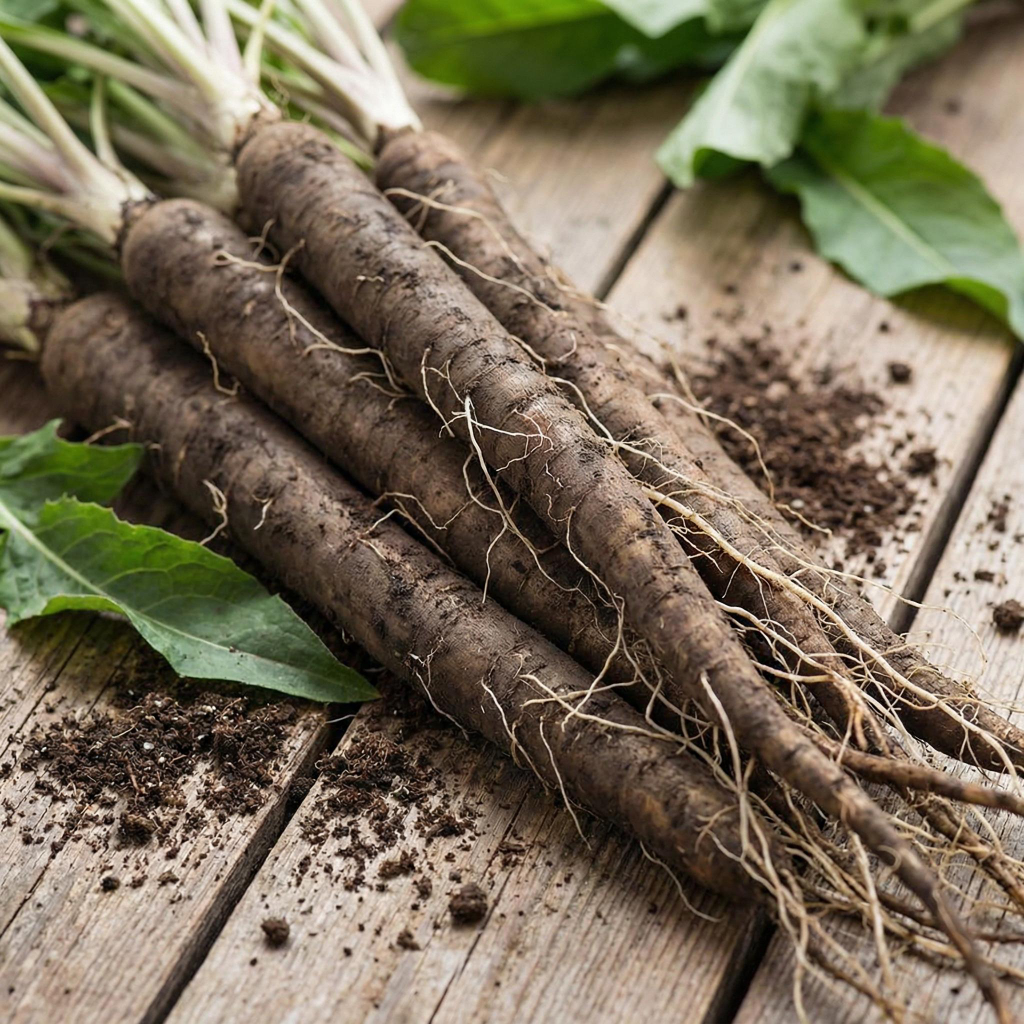
Salsify
Also known as: White salsify: oyster plant, goat's beard, vegetable oyster. Black salsify: scorzonera, Spanish salsify
Some vegetables so homely can sort of understand why aren't more popular with masses. Celery root, rutabagas and salsify come to mind as misunderstood, less-than-attractive root vegetables that, when cooked properly, truly delicious. Don't let salsify's uninviting appearance turn you off. If can get hands on this delicious—but sometimes elusive—veggie, will not be disappointed! Two different plants with different origins commonly referred to as 'salsify.' White salsify (Tragopogon porrifolius) native to Eastern Mediterranean. First cultivated 16th century in Italy and France, then later central and northern Europe. Root first brought to North America 18th century where became fairly popular, nicknamed 'oyster plant'—root's flavor somewhat resembling bivalve. Black salsify (scorzonera, Spanish salsify, Scorzonera hispanica) native to wider area of Europe and Asia (far east as Siberia). Cultivation began little later than white salsify, around 17th century, first grown in Spain.
fall, winter
White salsify supposed to resemble oysters in flavor—became 'monument to people'...
Tragopogon porrifolius (white salsify), Scorzonera hispanica (black salsify/scorzonera)
vegetable
Pairs Well With
White salsify roots range from slender to slightly thicker and parsnip-like, with ivory to light brown skin. Black salsify roots tend to be much slimmer, with dark black skin. Both have creamy white flesh. White supposed to resemble oysters in flavor, while black said to be tastier of two roots. Goes bad very quickly if broken or pierced—look for intact roots with little to no blemishes or mushy spots. Roots should be firm and not springy. Usually harvested starting late fall through mid-winter. Unlikely to see at conventional grocery store—search at local farmers' market or specialty store. Rare veggie, sometimes elusive but worth seeking out.
If can store at around 32°F in high humidity, roots will keep for as long as month or two. In crisper drawer in fridge, will keep for 1-3 weeks. Goes bad very quickly if broken or pierced—look for intact roots with little to no blemishes or mushy spots when buying. Roots should be firm and not springy. Store carefully to maintain quality.
Raw: Young roots can be eaten raw if sliced thinly or grated. Boiled: Common preparation, add flour and lemon juice to prevent graying. Steamed: Another cooking method. Fried: Can be fried. Baked: Can be baked. Pureed into soups: Cream of salsify soup classic. Salsify Provencal: Paired with tons of garlic and parsley. Gratin: Nice caramelization with gratin technique. Fritters: Oyster-style fritters. Tempura: Japanese preparation. Salsify Oyster Stew: Classic recipe. Scorzonera Wrapped in Crisp Prosciutto: Elegant preparation. Scorzonera Fettuccine in Mushroom Cream Sauce: Pasta dish. Must use acidulated water immediately after cutting to prevent oxidation.
Lacto-fermented: Like in mixed-veggie ferment including salsify. Pickled: Roots can be pickled. Stores 1-3 weeks in fridge crisper, or month or two at 32°F high humidity. Goes bad very quickly if broken or pierced so handle carefully for preservation.
Not exactly nutritional powerhouse, but root veggie has decent amounts of fiber, Vitamin C, Vitamin B-6, folate, potassium, and manganese. Even has little bit of protein, calcium, and iron. Modest nutritional profile but good source of several vitamins and minerals.
May see growing wild—spread to most US states. Cousin yellow salsify (Tragopogon dubius) considered invasive in some areas. According to 'Edible: an Illustrated Guide to World's Food Plants,' until 1500s, black salsify thought to be effective against 'toxins' and plague. White salsify's genus name Tragopogon means 'goat's beard'—probably refers to seed heads of plant resembling giant dandelion clocks (and goats' beards). White salsify first cultivated 16th century Italy and France. Black salsify cultivation began around 17th century Spain. Root brought to North America 18th century, became fairly popular, nicknamed 'oyster plant.' Became 'monument to people's insatiable desire for oysters.' Two different plants (white and black) commonly called salsify. Diane Morgan's book 'Roots' treasure trove of ideas. Very rare veggie in US. Roots said to be better tasting after hard frost. Young shoots and flowers can be eaten.
Salsify still very rare veggie in US, making environmental impact negligible. If have questions about how raised, ask local farmer about growing practices. Usually harvested starting late fall (roots said to be better tasting after hard frost) through mid-winter. Unlikely to see at conventional grocery store—search at local farmers' market or specialty store. White salsify spread to most US states growing wild. Yellow salsify cousin considered invasive in some areas. Minimal environmental impact due to rarity.
Available Near You
Enter your ZIP code to find farms with salsify near you.
Recipes with Salsify
Coming Soon