
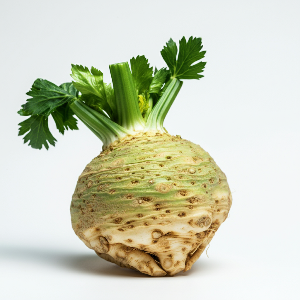
Celery Root
Also known as celeriac, a knobby root with intense celery flavor.
fall, winter
Intense celery flavor with nutty undertones...
vegetable
Look for a firm celery root with no soft spots and a tangible heft. Smoother exteriors will be easier to peel. Avoid celeriac that is nearing the size of a cantaloupe - the flesh may be too woody. Instead look for something more like an apple or grapefruit.
Remove stalks and leaves before storing if still attached (save them for making stock). Store in a root cellar if available, or in the crisper drawer ideally wrapped in a kitchen towel or in a paper bag. Whole, unpeeled celery root will keep for a few weeks.
Celery root can be used raw in salads, roasted, braised, or in soups. One classic French preparation is celeri remoulade - a slaw dressed with remoulade sauce. Can be grated with mayonnaise, Dijon mustard, capers, tarragon, and parsley dressing. Makes excellent soup when combined with fennel, figs, and feta. For mashed celery root, use one part celery root to two parts potatoes with garlic, butter, salt, pepper, and fresh parsley.
Celery root stems can be used to make stock with quartered onion, garlic, and black peppercorns, then frozen into ice cubes for later use.
One cup raw contains around 65 calories, 2-3 grams of both fiber and protein, and mild amounts of calcium and potassium. While not a superfood, it offers reasonable nutritional value.
Despite popular belief, celery root is not the root of the celery we see in grocery stores, but rather of a close relative. Both are descendants of wild celery, native to the Mediterranean. Other names include 'celery knob' and 'turnip celery.' Celery root became available in the U.S. in the 19th century but never became mainstream - historically much better known in Europe, Western Asia, and North Africa.
There is not much industrial celeriac production in the U.S. You're more likely to find celery root at farmers' markets, which provides an opportunity to ask growers about their production methods. Not included on the EWG's Shopper's Guide to Pesticides in Produce due to limited large-scale production. Best way to avoid pesticides is buying organic. Peak season is fall, winter, and early spring.
Available Near You
Enter your ZIP code to find farms with celery root near you.
Recipes with Celery Root
Coming Soon