Legumes, Beans & Nuts · Fall
Hazelnuts
Corylus avellana · Also: Filbert, Cobnut
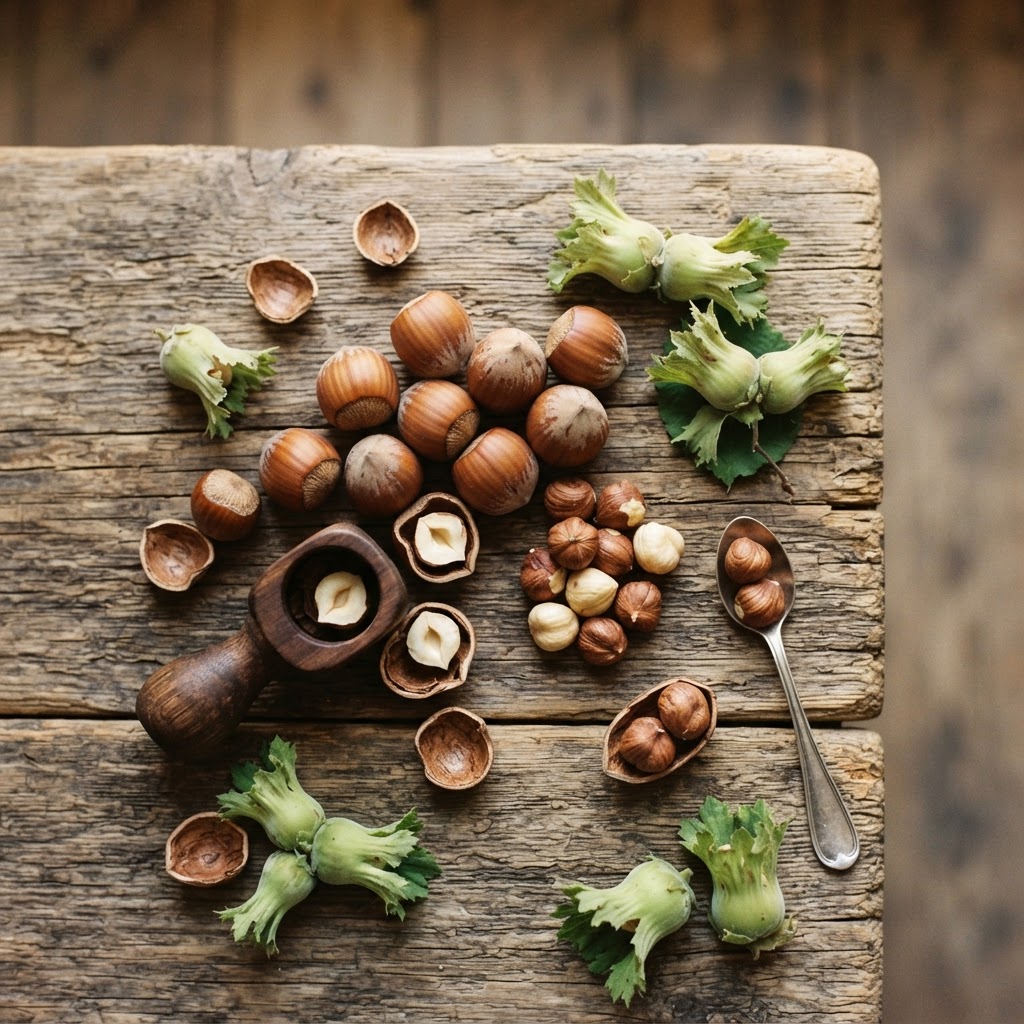
Hazelnuts are the rounded, coppery-skinned nuts of the hazel shrub, encased in leafy green husks that curl back like petals as they ripen. Sweet, buttery, and faintly earthy, they are one of the oldest nuts gathered and cultivated in Europe.
Turkey grows roughly seventy percent of the world's hazelnuts; Italy's Piedmont is home to the prized Tonda Gentile, the hazelnut behind gianduja and Nutella. The native American hazel (Corylus americana) still grows wild across the eastern U.S. From pralines and tortes to pestos and savoury crusts, the hazelnut's rich, aromatic flavor — deepened by roasting — makes it a darling of bakers and chefs from autumn through winter.
Tonda Gentile delle Langhe
The prized round, sweet hazelnut of Italy's Piedmont — IGP-protected, with a thin skin that slips easily on roasting; the gold standard for gianduja and fine pastry.
Barcelona (Corylus avellana)
The classic European hazel widely grown worldwide — large, round, and rich, a mainstay of Turkish, Spanish, and Oregon orchards.
Ennis (Oregon)
A large, elongated Oregon cultivar prized for in-shell roasting and holiday nut bowls; the leading variety of the U.S. Willamette Valley.
American Hazelnut (C. americana)
A smaller native shrub whose wild nuts are sweeter than the European hazel and still foraged across the eastern U.S. woodlands.
Cobnut
The traditional English name for cultivated hazels — Kent cobnuts are sold green and milky-sweet in early autumn, a seasonal delicacy.
Jefferson & Dorris
Modern disease-resistant American hybrid cultivars bred for commercial yields, blending the native hazel's hardiness with the European's large, flavorful nuts.
Buy in-shell hazelnuts that feel heavy for their size with tight, uncracked shells and no rattling — rattling means the kernel has dried and shrunk inside.
For shelled nuts, choose plump, pale kernels with smooth, intact skins; avoid shrivelled, dusty, or sour-smelling nuts, which are rancid. Vacuum-sealed bags stay fresher than bulk bins.
Green (fresh) cobnuts are a late-summer treat in England — sold still in their husks, milky and soft, worth seeking at specialty markets.
Thanks to their high oil content, hazelnuts turn rancid quickly at room temperature. Keep in-shell nuts in a cool, dry place for a few months; store shelled nuts in an airtight container in the refrigerator for up to a year, or the freezer for longer. Roasted nuts keep a few weeks sealed at room temperature.
Cracking: Shell in-shell nuts with a nutcracker, taking care not to crush the round kernel inside.
Roasting: Roast shelled nuts at 175°C (350°F) for 10–15 minutes until fragrant and golden — toasting both deepens their flavor and loosens the bitter skin.
Skinning: Wrap warm roasted nuts in a tea towel and rub — most of the papery brown skin slips off, leaving clean, pale kernels ready for pastes and baking.
Roasted & Salted
The simplest pleasure — roasted hazelnuts with a pinch of salt, eaten out of hand as a snack or alongside cheese.
Hazelnut Praline & Gianduja
Caramelised hazelnuts ground into a paste, blended with chocolate for gianduja and Nutella — the Piedmontese invention that conquered the world.
Hazelnut Cake & Tortes
Ground hazelnuts folded into cakes, tortes, and dacquoise — the nut's buttery richness gives the classic Austrian and Italian nut cakes their character.
Pesto di Nocciole
A Ligurian hazelnut pesto blending basil, garlic, oil, and ground hazelnuts — a rustic twist on classic Genovese pesto.
Crusted Meats & Fish
Crush roasted hazelnuts and press onto pork, chicken, or salmon before pan-searing or baking for a crisp, nutty crust.
Roasted Vegetable Garnish
Scatter toasted, chopped hazelnuts over roasted Brussels sprouts, squash, or bitter greens — the crunch and richness cut earthy flavors beautifully.
Drying: Fresh hazelnuts must be dried for several weeks before long storage — spread in-shell in a warm, airy spot until the kernel turns from milky to firm and crisp.
Freezing: Both in-shell and shelled hazelnuts freeze well for a year or more in airtight containers, preserving their oils.
Hazelnut paste & butter: Ground roasted hazelnuts can be blended into a smooth paste or butter that keeps refrigerated for months, ready for baking and chocolate work.
Hazelnuts are rich in heart-healthy monounsaturated fats, vitamin E, folate, and minerals — particularly manganese, copper, and magnesium.
A handful (about 28 g) provides roughly 4 g of protein and 3 g of fiber, plus antioxidants including proanthocyanidins that support vascular health.
Their high vitamin E content makes them especially valued for skin and eye health, and their fats help absorb fat-soluble vitamins from other foods.
Hazelnuts are one of humanity's oldest foods — evidence of hazelnut gathering in Britain dates back roughly 9,000 years to the Mesolithic period.
The name "filbert" is said to come from St. Philibert, whose feast day falls on 22 August — right at the start of the hazelnut harvest in England and France.
Piedmont's Tonda Gentile is so prized it earned IGP protection, and gianduja — the hazelnut-chocolate paste invented to stretch scarce cocoa in 19th-century Turin — later inspired the world's most famous hazelnut spread, Nutella.
The American hazel (Corylus americana) was a staple food of many Native American peoples and still grows wild across the eastern U.S., though commercial orchards favor the larger European hazel.
From Italian hazelnut fairs to Turkish harvest festivals, the hazel marks late summer and autumn:
Fiera delle Nocciole (Hazelnut Fair)
Cortemilia, Piedmont, Italy
🗓 August 2026 (annual)
Piedmont's celebrated hazelnut fair honors the IGP-protected Tonda Gentile, with tastings of hazelnut cakes, gianduja chocolates, pastas, and liqueurs across the Langhe hills.
Hazelnut Festival
Mugla & Black Sea coast, Turkey
🗓 August–September 2026 (harvest season)
Turkey grows roughly 70% of the world's hazelnuts, and coastal harvest festivals celebrate the August–September pick with traditional sweets, music, and communal roasting.
Mount Pisgah Arboretum Hazelnut Celebration
Oregon, USA
🗓 September–October 2026 (harvest)
Oregon's Willamette Valley produces nearly all U.S. hazelnuts, and autumn harvest events showcase roasted nuts, hazelnut baked goods, and the native American hazel.
Perennial & low-input: Hazels are perennial shrubs that stabilize soil, support pollinators with early-spring catkins, and need fewer inputs than annual nut crops — an agroforestry favorite.
Global range: Turkey dominates global production; Italy's Piedmont, the U.S. Pacific Northwest (Oregon and Washington), Spain, and Azerbaijan are also major hazelnut regions, all with temperate, maritime climates.
Wild & hybrid future: Breeding American × European hybrids in the U.S. aims to combine the native hazel's disease resistance with the European's large nuts — expanding sustainable hazelnut farming into new regions and colder climates.
In-Season Recipes with Hazelnuts
Seasonal recipes featuring Hazelnuts right now
Coming Soon
All Other Recipes with Hazelnuts
Coming Soon