Legumes, Beans & Nuts · Spring
Fava Beans
Vicia faba · Also: Broad Bean, Faba Bean, Horse Bean
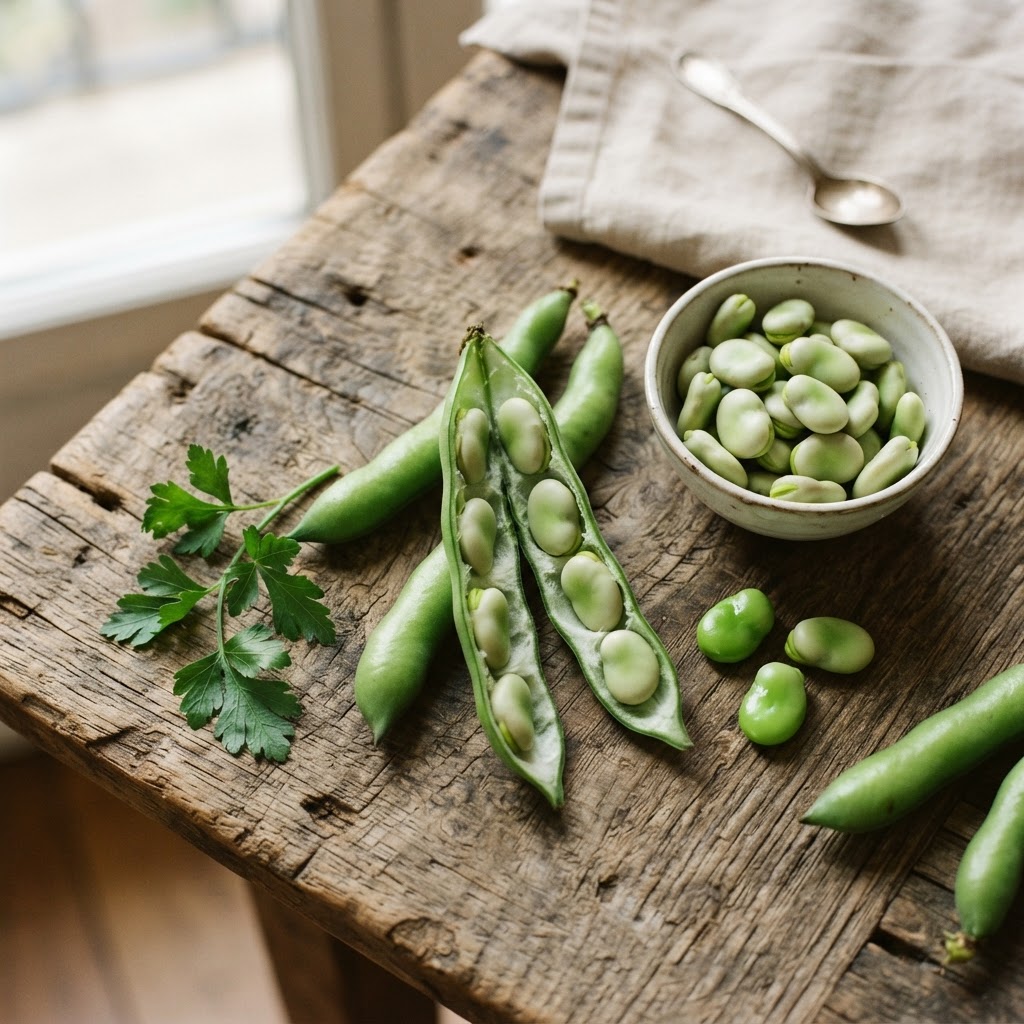
Fava beans are one of the oldest cultivated crops in human history, farmed across the Mediterranean and Middle East for at least 8,000 years. Their large, flattened green beans nestle inside thick, fuzzy pods and carry the unmistakable, buttery flavor of spring.
They are the beans of Egypt's ful medames, Italy's fava-and-pecorino spring feasts, and English broad-bean purees — a cool-season legume that thrives where winters are mild. Fresh favas reward the patient cook: each bean must be shelled, then peeled of its tough outer skin, but the brilliant-green, sweet bean revealed is the essence of the spring table.
Broad Windsor
The classic English/American garden fava — large-podded with 5–6 big beans, the standard fresh-market variety prized for its tender, buttery beans.
Aquadulce Claudia
A compact Spanish heirloom favored for early sowing and cold tolerance; long pods with 7–8 pale-green beans and a mild, creamy flavor.
Extra-Vege / Dalla Vedova
An Italian early cultivar prized for tender small pods picked young, when the beans can be eaten whole — a hallmark of spring produce markets.
Field Bean
Smaller, tougher-skinned fava grown for drying and animal fodder, also cooked into traditional stews in the UK and Middle East.
Ful (Egyptian)
Small, brown-skinned fava varieties bred for ful medames — cooked slowly overnight into the creamy stew that is Egypt's national dish.
Dried Fava (split)
Split, dried favas with the skin removed — golden and quick-cooking, the basis of fava-bean purees, falafel variants, and soups year-round.
Fresh fava pods should be plump, bright green, and heavy for their size, with the beans visibly bumping through the shell. Avoid yellowing, puffy, or black-spotted pods — they're old and starchy.
Choose pods that feel full and give only slightly when squeezed; young, smaller pods yield the most tender, sweetest beans. Very large pods can be starchy and need peeling.
Dried whole or split favas are an excellent pantry staple — buy them sealed and uniform in color, and store them as you would any dried bean.
Fresh favas are best eaten the day they're shelled — they lose sweetness quickly. Keep pods in a paper bag in the refrigerator for up to a week. Once shelled, beans keep a day or two refrigerated. Dried favas store indefinitely in a sealed jar in a cool, dry cupboard.
Shelling: Split the pod along its seam and push out the beans — each thick pod yields 4–8 large beans.
Blanching & peeling (double-peel): For the brightest, tenderest beans, boil shelled favas for 1 minute, then plunge in ice water. Pinch each bean to slip off the tough outer skin, revealing the vivid green inner bean.
Dried favas: Soak overnight, then simmer 45–90 minutes (skin-on) or 30–45 minutes (split and skinned) until tender — for stews, purees, and falafel.
Ful Medames
Egypt's national dish — slow-cooked dried favas with olive oil, lemon, cumin, and garlic, scooped up with bread for breakfast since Pharaonic times.
Fava & Pecorino
The Roman spring ritual — raw or barely cooked favas with sharp pecorino cheese and a drizzle of oil, eaten on May Day for luck.
Fava Puree
Mash peeled favas with olive oil into a silky dip or spread — the Italian maccu and English broad-bean puree.
Spring Pasta
Toss peeled favas with pancetta, lemon, and pecorino over fresh tagliatelle or orecchiette — the essence of the Italian spring table.
Fava Soup & Stew
Simmer dried or fresh favas with herbs and stock into hearty soups, or fold them into vegetable stews and braises.
Falafel (Egyptian)
Egyptian falafel (ta'ameya) uses split dried favas, not chickpeas — greener, fluffier, and a fava-bean twist on the Middle-Eastern classic.
Drying: Dried favas keep for years and are the traditional way to extend the harvest — split, skinned dried favas cook quickly into ful medames and purees.
Freezing: Blanch and peel fresh favas, then freeze in airtight bags to capture their bright spring flavor for months.
Canning & jarred: Jarred cooked favas and canned broad beans are a convenient shortcut, especially in Egyptian and Mediterranean cooking.
Fava beans are rich in plant protein (about 13 g per cooked cup), dietary fiber, folate, iron, and manganese — a nutrient-dense legume that earned its place as a staple of ancient diets.
They are a notable source of L-dopa, a precursor to dopamine, studied for potential benefits in Parkinson's disease — the only common food to contain it in meaningful amounts.
Note: people with G6PD deficiency (an inherited enzyme disorder) can develop "favism" — a serious hemolytic reaction to fava beans — and should avoid them entirely.
Fava beans are among the oldest cultivated crops — evidence of fava farming in the Mediterranean and Middle East dates back roughly 8,000 years, predating most other legumes.
The Greek philosopher Pythagoras and his followers famously refused to eat favas, believing the beans contained souls of the dead — an ancient taboo still faintly echoing through Mediterranean folklore.
Ful medames, Egypt's national dish of slow-cooked favas, is so old it appears in hieroglyphs and has been the Egyptian breakfast staple for more than 4,000 years.
Fava beans are the original broad bean of European cuisine; favas, not New-World kidney or pinto beans, were the beans of medieval Europe before Columbus brought American beans back.
Fava beans are woven through ancient and modern spring festivals across the Mediterranean:
Sham El-Nessim (Spring Fava Feast)
Egypt, nationwide
🗓 April 21, 2026 (Monday after Coptic Easter)
Egypt's ancient spring festival is celebrated nationwide with ful medames, the slow-cooked fava bean stew — families picnic along the Nile eating salted, fava-laden meals dating back to Pharaonic times.
Sagra della Fava (Fava Bean Festival)
Puglia & Sicily, Italy
🗓 April–May 2026 (spring harvest)
Southern Italian villages hold fava-bean sagre as the spring crop ripens, celebrating raw fava beans with pecorino, fava-and-pecorino purees, and fresh spring pastas.
Sicilian May Day Fava Traditions
Sicily, Italy
🗓 May 1, 2026
On May Day in Sicily, eating fresh fava beans with pecorino is said to bring luck and ward off the evil eye — a folk ritual marking the height of the spring harvest.
Nitrogen-fixing: Favas fix their own nitrogen, enriching the soil and reducing fertilizer needs — a hallmark sustainable rotation crop in cool-climate agriculture.
Cool-season & hardy: Favas tolerate frost and thrive in cool, damp soils where other beans won't grow — they're sown in late winter and harvested in spring, an early protein from cold climates.
Global range: Grown across the Mediterranean, Middle East, northern Europe, China, and parts of the Americas — Egypt, Italy, the UK, and China are major producers of fresh and dried favas.
In-Season Recipes with Fava Beans
Seasonal recipes featuring Fava Beans right now
Coming Soon
All Other Recipes with Fava Beans
Coming Soon