Grains & Seeds · Summer & Fall
Emmer (Farro)
Triticum dicoccum · Also: Farro, Farro Medio, Hulled Wheat, Emmer Wheat
Emmer is one of the very first grains ever farmed — a hulled wheat domesticated in the Fertile Crescent some 10,000 years ago and carried westward into the Mediterranean, where it became the daily bread of ancient Egypt, Greece, and Rome. In Italy, emmer is called farro — the grain of the legions, the porridge of the poor, and the honored ingredient of Tuscan mountain kitchens that have grown it for nearly three millennia without interruption.
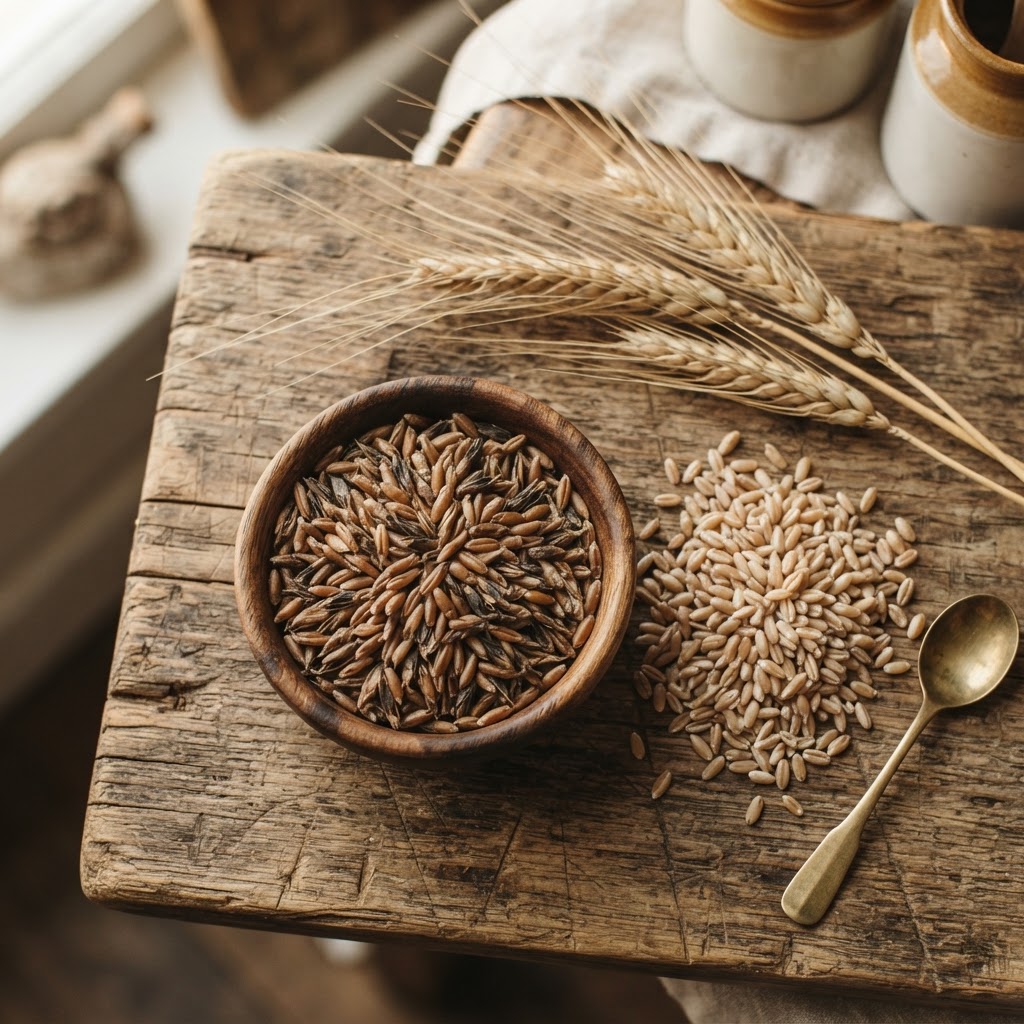
The grain is long, narrow, and encased in a tough husk that protects it in the field and must be milled off before cooking; this hulled grain keeps remarkably well and resists disease, which is why emmer has survived unchanged in the mountain valleys of Garfagnana, Sardinia, and Anatolia while modern wheats took over the lowlands. Cooked, emmer farro has a satisfying chew, a deep nutty flavor, and a warm, earthy sweetness; it holds its shape in soups and salads, and makes a broth-rich risotto-style farrotto. A lower-yielding, higher-protein, higher-fiber ancestor of modern wheat, emmer is the original farro — the ancient grain now returned to the modern table.
Whole (Hulled) Farro
The most intact form — emmer with only the inedible outer hull removed; the bran and germ remain, giving the fullest nutrition and deepest flavor; requires the longest soaking and cooking, and the most satisfying chew.
Semi-Pearled Farro
Part of the bran has been scoured away, shortening cooking time while keeping some nutrition and flavor; the most common form sold for everyday cooking, a good balance of flavor, nutrition, and convenience.
Pearled Farro
The bran fully removed for the fastest cooking; lighter in color and milder in flavor, and the least nutritious of the three forms, but still nuttier and chewier than modern wheat; cooks in about 15–20 minutes.
Farro Flour
Stone-ground emmer flour — a low-gluten, nutty, golden flour used in Italian country breads, pastas, and pancakes; it makes denser, darker, more fragrant baked goods than refined wheat flour.
Farro Piccolo (Einkorn)
Often confused with emmer, einkorn (Triticum monococcum) is a separate but related ancient wheat sometimes sold as 'farro piccolo'; it is the smallest and oldest of the farro family, with a delicate, sweet, low-gluten grain.
Emmer Landraces (Italy & Türkiye)
Traditional mountain landraces of emmer — the IGP-protected farro of Garfagnana, the Sardinian farro of Barbagia, and the Anatolian wheat landraces — each adapted to its own valley, saved seed to seed for thousands of years.
For the fullest flavor and nutrition, buy whole (hulled) emmer farro — it keeps the bran and germ intact and needs a long soak before cooking. Semi-pearled farro is the everyday compromise, faster to cook while still nutty; pearled farro is the quickest but least nutritious.
Look for Italian emmer, especially IGP-protected farro from Garfagnana or Sardinian farro di montagna, for the authentic heirloom grain; check labels carefully — much commercial 'farro' is spelt (farro grande) rather than true emmer (farro medio). Stone-ground farro flour is sold by artisan mills and bakers.
Season: emmer is a cool-season wheat harvested in late summer to early fall; whole and pearled farro are available year-round, while fresh-milled farro flour is best in autumn from small mills.
Keep whole and pearled emmer farro in an airtight container in a cool, dry, dark place for up to a year — the hulled grain keeps exceptionally well, protected by its husk in the field and its low moisture after harvest. Farro flour, with the germ's oils exposed, is more perishable; store it in the fridge or freezer and use within a few months for the best flavor. Cooked farro keeps 4–5 days refrigerated and freezes well for quick grain bowls.
Harvesting: Emmer is harvested in late summer when the long bearded heads turn golden and the grain hardens inside its hull; the tough husk clings to the kernel and protects it from birds, mold, and rain — a feature that made emmer ideal for mountain harvests before modern machinery.
Dehulling: Unlike modern free-threshing wheats, emmer's grain stays sealed in its hull and must be mechanically dehulled after threshing; this extra step is why emmer was largely replaced by easier-to-process wheats, and why it survives today mainly in mountain regions where its hardiness outweighs the effort.
Pearling & milling: Dehulled emmer may be left whole, semi-pearled (part of the bran scoured off), or fully pearled for faster cooking; the grain is also stone-ground into farro flour for bread and pasta, keeping the germ and bran in artisan milling.
Farro Soup (Zuppa di Farro)
The Tuscan classic — emmer farro simmered slowly with beans, vegetables, and sometimes a ham bone or tomato into a thick, hearty winter soup; the classic of Garfagnana and the dish that defines farro, rich with the grain's deep nutty chew.
Farro Salad
Cooked and cooled emmer tossed with olive oil, lemon, herbs, and vegetables — tomato, cucumber, feta, or roasted roots; the grain holds its shape and chew, making farro salad a staple of Italian summer tables and Mediterranean mezze.
Farrotto (Farro Risotto)
Emmer cooked risotto-style — toasted, then gradually bathed in broth and finished with butter and Parmigiano; the grain's chew and nutty depth give farrotto a richer, earthier character than rice risotto, with a satisfying bite.
Farro Bread & Pasta
Stone-ground farro flour makes dense, fragrant country breads (pane di farro) and rustic pastas — pici, orecchiette, and fresh tagliatelle; the lower gluten gives a softer, more digestible crumb, deeply golden and nutty.
Farro Porridge & Breakfast
Cooked emmer with milk, honey, and fruit into a warming breakfast porridge — like oatmeal but nuttier and chewier; a nourishing start that echoes the Roman puls, the emmer porridge eaten for millennia before modern oats.
Grain Bowls & Pilafs
Cooked emmer farro as the base for grain bowls, pilafs, and stuffed vegetables — tossed with roasted squash and sage in autumn, or with tomato and basil in summer; the grain's chew holds up to dressings and reheating.
Drying & dehulling: The hulled grain keeps for a year or more in a sealed, cool, dry place — one of the longest-storing staples of the ancient world, which is why emmer traveled with armies and sustained mountain villages through the winter.
Pearling for storage: Pearled and semi-pearled farro keep nearly as long as whole hulled grain and cook faster, which is why the lighter forms became common in modern kitchens; they trade some nutrition for shelf convenience.
Milling: Stone-ground farro flour is best milled fresh in small batches and kept cold; the germ oils in whole farro flour spoil faster than refined flour, so small mills and home milling preserve the most flavor and nutrition.
Emmer farro is higher in protein and fiber than modern wheat, and richer in minerals like magnesium, zinc, and iron; the whole hulled grain keeps all its bran and germ, giving a slow, sustained energy and a lower glycemic response than refined wheat.
Emmer is lower in gluten than modern bread wheat, and the gluten it has is more delicate and often better tolerated by people with mild wheat sensitivity (though it is not safe for those with celiac disease — it is a wheat and does contain gluten).
Emmer's tough hull protected the grain from disease and pests in the field, and the whole grain's high fiber, antioxidants, and complete mineral profile made it a healthier staple than the refined wheat that largely replaced it; modern interest in ancient grains has brought emmer back as a nutrient-dense alternative.
Emmer is one of the first grains ever cultivated by humans — domesticated in the Fertile Crescent around 10,000 years ago from a wild goatgrass, alongside einkorn and barley; it fed the first farmers of the Near East and spread with them across the Mediterranean.
Emmer was the daily bread of ancient Egypt (the grain found in the pyramids was emmer), the aulos and maza of ancient Greece, and the far of Rome — the porridge and bread that fed the legions and the people for a thousand years before modern bread wheat took over.
In Italy, 'farro' can mean three different grains — farro piccolo (einkorn), farro medio (emmer), and farro grande (spelt); true Tuscan farro is usually emmer (farro medio), and the IGP-protected farro della Garfagnana is emmer, grown in the same mountain valleys since Etruscan times.
Emmer's tough hulled grain resisted the mechanized milling that made modern wheat profitable, so it nearly disappeared in the 20th century — surviving only in a few mountain valleys of Italy, Türkiye, and Ethiopia; the recent revival of ancient grains has brought emmer back to chefs and home cooks worldwide.
From Tuscan mountain sagre to ancient Roman rites, emmer farro is one of the oldest celebrated grains on Earth:
Festa del Farro
Garfagnana, Tuscany (Italy)
🗓 October 2026 (autumn harvest)
The Garfagnana region of Tuscany holds its annual Festa del Farro each autumn to celebrate the IGP-protected emmer farro of the mountain valleys; villages serve farro soup, farro salad, and farro bread, honoring a grain that has been grown on these terraced hills since Etruscan and Roman times.
Ancient Grains & Harvest Festivals
Across Italy & the Mediterranean
🗓 September–October 2026
Across Italy's ancient-grain regions — from Sicily's perciasacchi to Sardinia's s'orgu — the autumn harvest is marked by sagre (village feasts) celebrating emmer farro, einkorn, and durum wheat; bread is baked in wood ovens, farro soup is ladled out, and the old landraces are honored as living heritage.
Ceres & the Roman Cerealia
Rome & the Mediterranean (historical)
🗓 April 2026 (spring sowing festival)
In ancient Rome the Cerealia, held in April, honored Ceres — the goddess of grain, whose name gives us the word 'cereal'; emmer (far) was the grain of the Roman people, their daily bread and porridge, and the festival celebrated the goddess whose return brought the grain to life each spring.
Sardinian & Anatolian Farro Traditions
Sardinia (Italy) & Anatolia (Türkiye)
🗓 Summer–Fall 2026
In the Barbagia mountains of Sardinia, emmer farro is still grown and cooked in a dish of fava beans and farro at village festivals; in Anatolia, the related wheat landraces are celebrated at local harvest days, keeping one of the oldest cultivated wheats in continuous, unbroken cultivation since the dawn of farming.
Low-input & hardy: Emmer thrives in poor, mountain soils with little fertilizer and far less water than modern wheat; its tough hull resists disease, pests, and bird damage, making it a reliable crop for marginal land and low-input farming systems.
Landrace preservation: The survival of emmer in a few mountain valleys — Garfagnana, Barbagia, Anatolia, the Ethiopian highlands — is a story of seed sovereignty; the IGP protection of Garfagnana farro and similar designations keep these landraces and their farmers economically viable.
Crop diversity: Growing ancient hulled wheats like emmer reintroduces genetic diversity into a wheat supply dominated by a few high-yield modern varieties; this diversity is insurance against disease and climate change, and supports small mills, artisan bakers, and mountain agriculture.
Global range: Emmer originated in the Fertile Crescent and spread across the Mediterranean and into Ethiopia and India; today it survives mainly in the mountain regions of Italy, Türkiye, Ethiopia, and in the fields of revived ancient-grain farmers in Europe and North America.
In-Season Recipes with Emmer
Seasonal recipes featuring Emmer right now
Coming Soon
All Other Recipes with Emmer
Coming Soon