
Legumes, Beans & Nuts · Summer
Edamame
Glycine max · Also: Green Soybean, Maodou (毛豆)
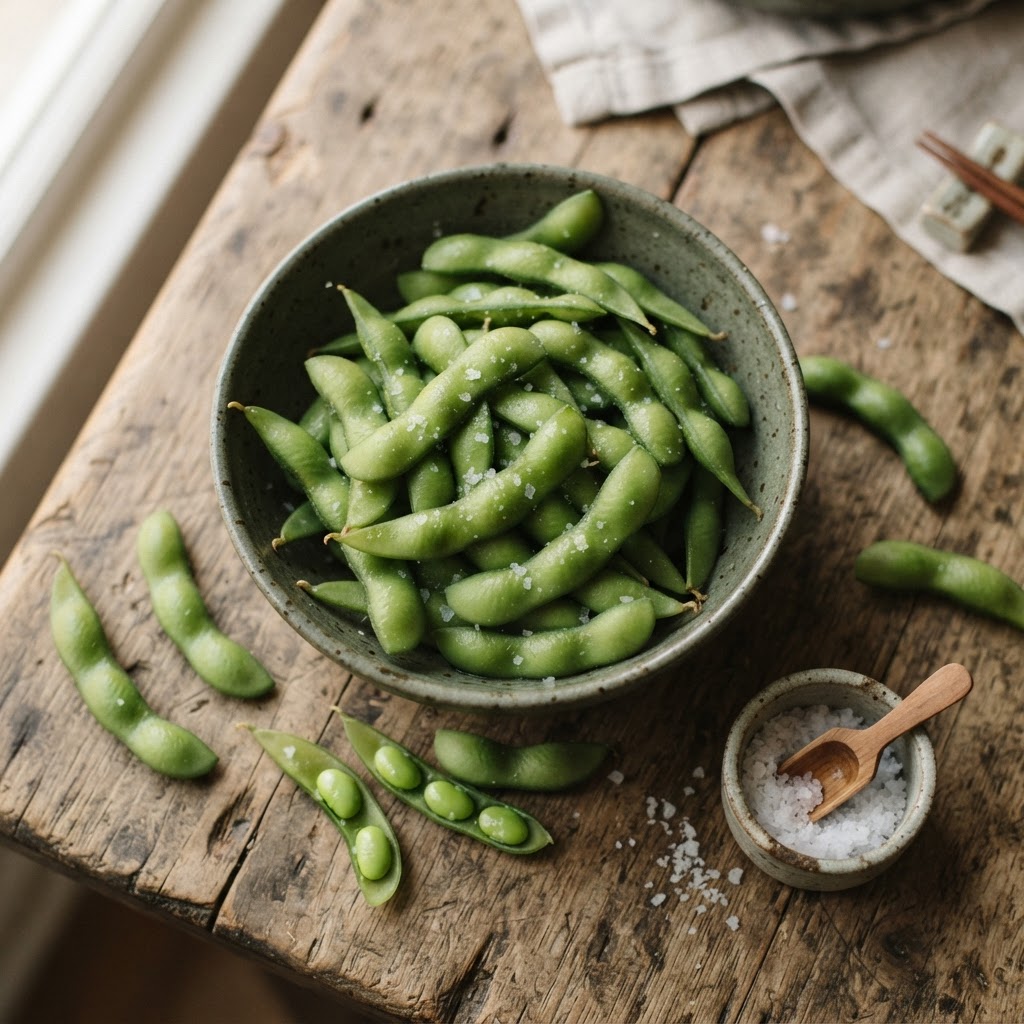
Edamame are immature soybeans harvested while still green and soft, traditionally boiled in the pod and salted as a Japanese bar snack and appetizer. The name, literally "stem beans," speaks to how they were once sold — still on their stems.
Though the same species (Glycine max) that yields dry soybeans, tofu, miso, and tempeh, edamame are picked young, when the beans are sweet, tender, and grassy — closer to a fresh pea than a dried legume. One of the few plant foods that is a complete protein, edamame has become a global favorite: simple, nutritious, and eaten straight from the pod with a sprinkle of salt.
Edamame (green soybean)
Immature soybeans picked while the pods are bright green and the beans are still soft — the form eaten as a snack or in salads and stir-fries.
Maodou
The Chinese name, meaning 'hairy bean' — the same immature soybean, beloved as a cheap, addictive bar snack across China, often boiled with star anise and salt.
Chiba Edamame (Kakegawa)
A prized cultivar from Shizuoka, grown along the warm coastal belt; sweet, large-podded, and the standard-bearer for Japanese edamame.
Shin Edamame (new crop)
The first, most-anticipated edamame of the season — freshly harvested summer beans prized for their sweetness and tender bite, like 'new potatoes' of the soy world.
Black / Brown Edamame
Rare heirloom cultivars with darker pods or beans, grown in Japan and the U.S., valued for their nuttier flavor and striking color.
Frozen Shelled Edamame
Widely sold frozen —IQF beans out of the pod — the convenient form for adding to salads, grain bowls, and stir-fries year-round.
Fresh edamame pods should be bright green, firm, and slightly fuzzy, with plump beans visible through the shell. Avoid yellowing, limp, or spotted pods — they're past peak.
Outside East Asia, fresh-in-pod edamame is mostly a summer farmers'-market find; high-quality frozen edamame (in-pod or shelled) is an excellent, equally nutritious year-round alternative and is how most are sold worldwide.
For the tenderest beans, choose smaller, younger pods; oversized pods can be starchy and less sweet.
Fresh edamame is perishable — use it within a few days, refrigerated in a perforated bag. For longer keeping, blanch fresh pods for a few minutes, drain, and freeze in airtight bags for months. Store-bought frozen edamame keeps for months in the freezer and needs no thawing before cooking.
Boiling: Drop pods into boiling salted water for 3–5 minutes until bright green and tender, then drain and sprinkle with flaky salt — the classic Japanese preparation.
Steaming: Steam pods 5–7 minutes to preserve more nutrients; finish with salt and serve warm as a snack.
Pan-blistering: Sear pods in a hot dry skillet until charred in spots, then salt — a smoky variation popular at izakayas.
Shelling: Pinch the pod to pop out the beans for salads, fried rice, and grain bowls; the pods themselves are fibrous and not eaten.
Salted Pods
The simplest, classic preparation — boil, salt, and pop beans from the pod with your teeth at an izakaya with a cold beer.
Edamame Salad
Toss shelled edamame with greens, sesame, and ginger dressing, or fold into a bright soba noodle salad.
Edamame Hummus
Blend shelled edamame with tahini, lemon, and garlic for a vivid green, high-protein twist on chickpea hummus.
Stir-Fried Maodou
Sear shelled edamame with garlic, chilies, and a splash of soy for a quick Chinese side dish.
Fried Rice & Grain Bowls
Scatter shelled edamame into fried rice, poke bowls, and Buddha bowls for color and a complete-protein lift.
Edamame Soup & Pesto
Puree blanched edamame into a silky soup or a bright edamame-basil pesto for pasta — unexpected and delicious.
Freezing: Blanch fresh edamame briefly before freezing to lock in the bright green color and tender texture — the standard method for preserving the summer harvest.
Frozen shelled: IQF (individually quick-frozen) shelled edamame is the most convenient form, ready to toss into any dish straight from the freezer.
Drying (mame): Mature soybeans are dried for long storage as daizu — the base for tofu, miso, and soy sauce — though this is the dry-soybean stage, not edamame.
Edamame is one of the few plant foods that provides a complete protein — containing all nine essential amino acids — making it especially valued in vegetarian and vegan diets.
A cup of shelled edamame delivers about 17 grams of protein, 8 grams of fiber, and generous folate, vitamin K, iron, and magnesium, all for roughly 190 calories.
Rich in isoflavones and heart-healthy fats, edamame is also lower in carbohydrates than many other legumes, with a gentle impact on blood sugar.
The name edamame (枝豆) literally means "stem beans" — historically they were sold still attached to their stems.
Edamame and the mature dry soybean are the exact same plant, just harvested at different stages: young and green for edamame, fully mature and dry for soy oil, tofu, miso, and tempeh.
In Japan, soybeans are the "fortune beans" thrown at Setsubun each February to drive out evil spirits — roasted dry soybeans, not edamame, but the same humble legume.
The soybean was domesticated in China roughly 3,000 years ago and is now one of the world's most important protein crops, though most of the harvest is pressed for oil or animal feed rather than eaten as edamame.
From summer edamame festivals to Setsubun's fortune beans, Japan honors the soybean across the year:
Edamame Matsuri (Edamame Festival)
Kakegawa & Kumamoto, Japan
🗓 June–August 2026 (summer harvest)
As the summer edamame harvest peaks, towns across Shizuoka and Kumamoto hold edamame festivals celebrating freshly boiled soybeans with beer, local salt, and folk dancing.
Soybean Harvest Festivals
Tohoku & Hokkaido, Japan
🗓 September–October 2026 (autumn harvest)
Japan's autumn daizu (dry soybean) harvest is celebrated with markets featuring the year's new-crop soybeans, natto, tofu, and edamame — honoring the soybean that underpins Japanese cuisine.
Mame-maki (Setsubun)
Across Japan
🗓 February 3, 2026
On Setsubun, roasted soybeans (fortune beans) are thrown to drive out evil and invite good luck — the bean most Japanese handle each year is the soybean behind edamame.
Nitrogen-fixing: Like all legumes, soybeans fix atmospheric nitrogen, enriching the soil and reducing fertilizer needs for the crops that follow them.
Efficient protein: Soybeans produce more protein per acre than almost any other crop, making edamame a relatively climate-efficient protein source compared to animal protein.
Global range: Soybeans are grown across the Americas, China, and India — but the young edamame market is dominated by Japan, China, Taiwan, and an expanding U.S. frozen sector. Most edamame eaten worldwide is now grown in China or the U.S. and shipped frozen.
In-Season Recipes with Edamame
Seasonal recipes featuring Edamame right now
Coming Soon
All Other Recipes with Edamame
Coming Soon