Legumes, Beans & Nuts · Spring–Summer
Chickpeas
Cicer arietinum · Also: Garbanzo Bean, Chana, Bengal Gram
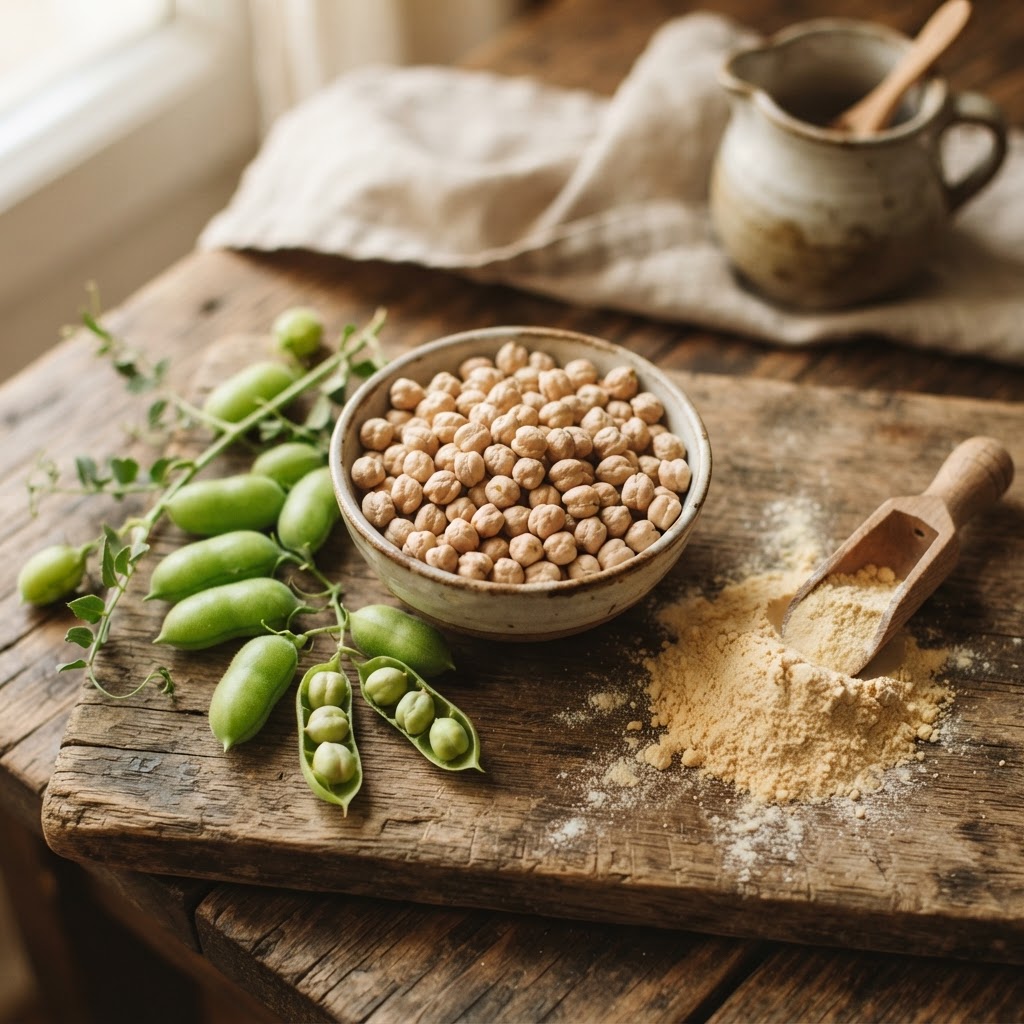
Chickpeas are among the oldest cultivated legumes, farmed in the Middle East for more than 7,000 years. Their nutty, buttery flavor and remarkable versatility anchor the cuisines of India, the Mediterranean, and the Levant — from hummus and falafel to chana masala and chickpea-flour flatbreads.
India grows the lion's share of the world's chickpeas, where the cool-season chana crop is the largest pulse harvest. Dried chickpeas keep indefinitely, their flour (besan) is naturally gluten-free, and a can of chickpeas is one of the most useful, affordable staples a kitchen can hold.
Kabuli
The large, pale beige chickpea familiar in the West and Mediterranean — round, smooth, and mild, the standard for hummus, salads, and roasted snacks.
Desi (Chana)
Smaller, darker, and more angular, with a thicker seed coat. Grown mainly in India and Ethiopia; nuttier and higher in fiber, used for chana dal and besan.
Chana Dal
Split, hulled desi chickpeas — golden split lentil-like pulses that cook quickly into a creamy dal and form the base of many Indian sweets.
Black / Brown Chickpea
Whole desi chickpeas with their dark coats intact — smaller and earthier than Kabuli, used in rustic Indian curries (kala chana).
Green Chickpea (Chholiya)
Fresh, immature green chickpeas eaten as a seasonal snack or made into chutneys and chaats in India; sweeter and more tender than dried.
Besan (Chickpea Flour)
Fine flour milled from split desi chickpeas — golden, gluten-free, and the binding flour of Indian pakoras, socca, farinata, and panelle.
Choose dried chickpeas that are whole, uniform in color, and free of dust or broken bits. Kabuli chickpeas should be plump and pale; desi and chana dal should be glossy and evenly split.
Canned chickpeas are a fine, convenient shortcut — rinse them well to remove the starchy canning liquid (aquafaba) unless you plan to whip it into meringue. For the creamiest hummus, seek out small, thin-skinned Middle Eastern chickpeas.
Besan should be bright golden and finely ground; buy it from a shop with quick turnover, as the flour's oils can go rancid over time.
Dried chickpeas keep for years in a sealed jar in a cool, dry cupboard. Canned chickpeas last for years on the shelf. Besan is more perishable — store it airtight in the cupboard for a few months or refrigerate/freeze it for up to a year to protect its oils.
Soaking (dried): Soak dried chickpeas overnight in plenty of water (or do a quick 1-hour boil-soak). They'll roughly double in size and cook far more evenly; always discard the soaking water.
Cooking: Simmer soaked chickpeas 45–90 minutes until tender, or pressure-cook in 15–20 minutes. For the silkiest hummus, cook until the chickpeas are falling apart and skins slip easily.
Skinning for hummus: Rub cooked chickpeas between your hands (or pinch each one) to slip off the skins for an ultra-smooth hummus — a labor of love that transforms the texture.
Aquafaba: The starchy liquid drained from a can of chickpeas whips like egg whites into meringues and mousses — a remarkable vegan egg substitute.
Hummus
Blend cooked chickpeas with tahini, lemon, garlic, and olive oil into the creamy Levantine dip — the most famous chickpea dish on earth.
Falafel
Grind soaked (not cooked) chickpeas with herbs and spices, form into balls, and deep-fry for the crisp Middle Eastern street-food classic.
Chana Masala
Simmer cooked chickpeas in a spiced onion-tomato gravy for India's beloved weekday curry — or use kala chana for a darker, earthier version.
Roasted Snack
Toss cooked chickpeas in oil and spices and roast until crunchy for a high-protein, addictive snack or salad topper.
Socca & Farinata
Whisk besan with water and olive oil into a batter, then bake into a crisp golden flatbread — the street food of Nice and Genoa.
Pakoras & Fritters
Use besan as the gluten-free binder for spiced vegetable pakoras, or for Italian panelle chickpea-fritter sandwiches.
Dried: Dried chickpeas are essentially shelf-stable indefinitely — a cornerstone of pantry resilience for thousands of years.
Canned: Canned chickpeas keep for years and make weeknight cooking instant; save the aquafaba in a jar in the fridge for a week.
Besan: Refrigerate or freeze chickpea flour to extend its life and keep its golden oils from turning rancid.
Chickpeas are a nutritional powerhouse — a cooked cup delivers about 15 grams of protein, 12 grams of fiber, and substantial iron, folate, and manganese, making them a cornerstone of plant-based diets.
They have a low glycemic index and their fiber-protein combo steadies blood sugar, supporting heart and gut health.
As a legume, chickpeas also fix nitrogen in the soil, improving farmland fertility — a rare food that nourishes the field as well as the eater.
Chickpeas are one of the oldest cultivated crops — evidence of chickpea farming in the Middle East dates back more than 7,000 years.
The name "garbanzo" comes from Spanish (via Basque), while "chickpea" descends from the Latin cicer — which gave the Roman orator Cicero his name, reportedly from an ancestor with a chickpea-shaped facial wart.
Aquafaba, the drained canning liquid, was discovered in 2015 to whip like egg whites — revolutionizing vegan baking with a byproduct previously poured down the drain.
India grows roughly 70% of the world's chickpeas, and the chana crop is its largest pulse harvest, sown in winter and reaped in spring.
From India's chana harvest to the Mediterranean's chickpea-flour markets, the humble garbanzo inspires celebrations worldwide:
National Hummus Day
United States & worldwide
🗓 May 13, 2026 (annual)
A global celebration of hummus, the creamy chickpea dip, with restaurant specials, hummus-making contests, and tastings — a testament to chickpeas' place in modern food culture.
Chana Harvest Fairs
Madhya Pradesh & Rajasthan, India
🗓 March–April 2026 (Rabi harvest)
As India's winter-sown chana (chickpea) crop is harvested each spring, rural markets and fairs celebrate with fresh roasted chickpeas, chana dal, and besan sweets.
Socca & Farinata Street Fairs
Nice, France & Genoa, Italy
🗓 Summer 2026 (seasonal markets)
The chickpea-flour flatbreads of the Ligurian coast — socca in Nice, farinata in Genoa — are celebrated at summer markets where vendors slice the crisp, golden crepes hot from wood-fired ovens.
Nitrogen-fixing: Like all legumes, chickpeas pull nitrogen from the air and enrich the soil, reducing the need for synthetic fertilizer and improving farmland for the crops that follow them.
Drought-hardy: Chickpeas tolerate dry, cool conditions better than most pulses, thriving in semi-arid India and the Mediterranean on modest water — a climate-resilient protein.
Global range: India dominates production, with significant harvests across the Mediterranean, Ethiopia, Mexico, and Australia — the chickpea flourishes wherever winters are mild and summers turn dry.
In-Season Recipes with Chickpeas
Seasonal recipes featuring Chickpeas right now
Coming Soon
All Other Recipes with Chickpeas
Coming Soon