
Grains & Seeds · Late Summer & Fall
Chia Seeds
Salvia hispanica · Also: Chía, Salba, Mexican Chia
Chia seeds are the tiny, mottled seeds of a desert sage — Salvia hispanica — a member of the mint family native to the highlands of Mexico and Guatemala. Alongside maize, beans, and amaranth, chia was one of the four sacred crops of the Aztec and Maya, offered to the gods, pressed for oil, and carried by runners and warriors as an endurance food for long journeys across the empire.
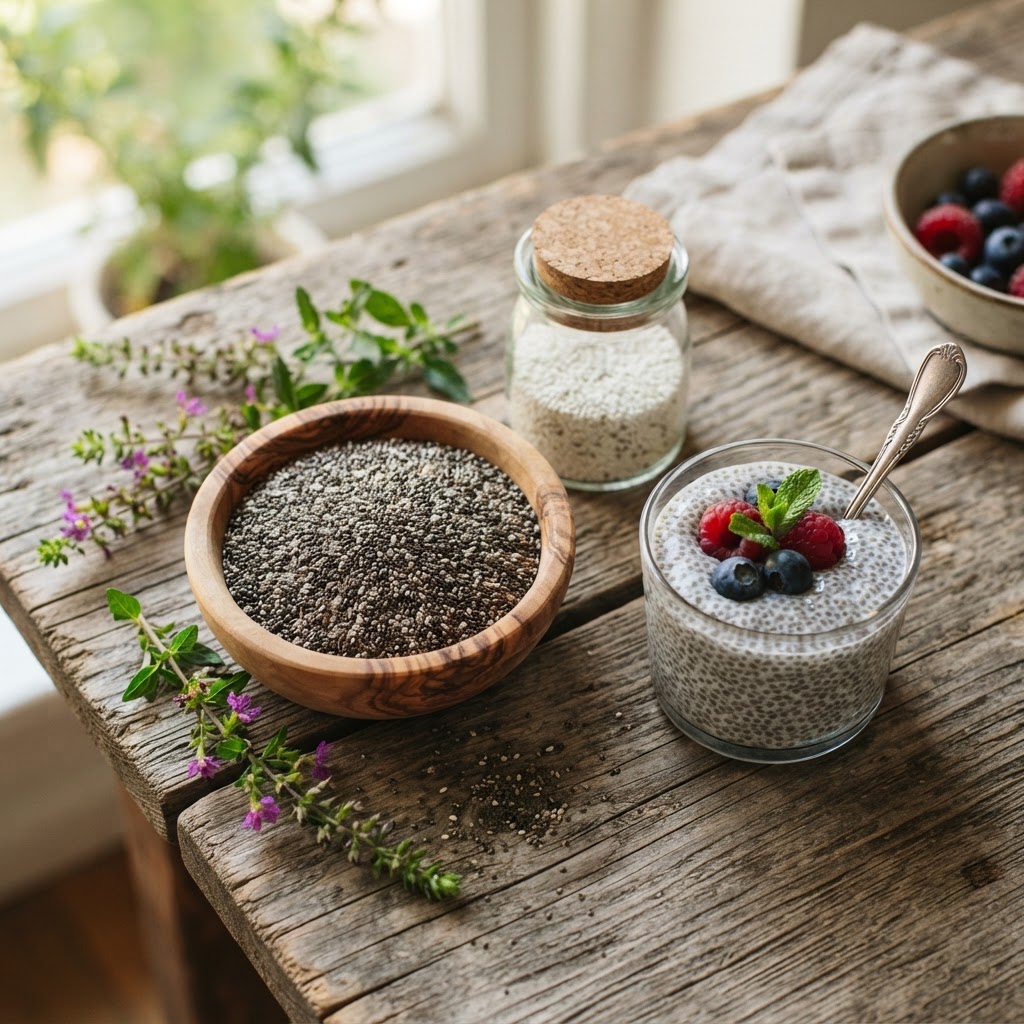
The seeds are tiny — grey-black and white speckled ovals the size of a poppy seed — yet they hold remarkable nutrition: more omega-3 than any other plant source, rich fiber, complete protein, and a long list of minerals. Soaked in water, chia forms a clear gel that thickens drinks, puddings, and jams — the same gel that made iskiate, the chia-and-water endurance drink of the Tarahumara runners. Mild and nutty, chia seeds swell to many times their size and take on any flavor they meet; today they are stirred into smoothies, sprinkled on yogurt, baked into breads, and made into creamy chia seed pudding — a Mesoamerican grain returned to the modern table.
Black Chia Seeds
The most common form — mottled grey-black and white speckled seeds; the natural color of the Salvia hispanica plant, with a mild, nutty flavor and the same nutrition as the white variety.
White Chia Seeds (Salba)
A selected pale-seeded strain, sometimes branded Salba — lighter in color but nutritionally equivalent to black chia; preferred by some for a cleaner look in light-colored foods and drinks.
Whole vs. Milled Chia
Whole seeds keep longest and can be sprinkled dry or soaked; milled (ground) chia releases the omega-3 oils and nutrients more quickly, and is used in baking and as an egg substitute when mixed with water.
Chia Sprouts & Microgreens
Chia seeds sprout in 2–3 days into tender, nutrient-dense microgreens — added fresh to salads, sandwiches, and wraps for a mild, crunchy, mint-family bite.
Chia Oil
Cold-pressed chia seed oil — one of the richest plant sources of omega-3 (alpha-linolenic acid); a delicate, nutty finishing oil used in dressings, never heated, to preserve its precious fatty acids.
Golden Chia (S. columbariae)
A related wild species native to the American Southwest, used by Indigenous peoples of the region in much the same way; smaller and golden-brown, with similar gelling and nutritional qualities.
Buy whole chia seeds — they keep far longer than milled chia and retain their omega-3 oils. Look for clean, uniform seeds with no dust or off-smell; both black and white chia offer the same nutrition, so choose by color preference for your recipes.
For baking and egg-substitution, milled (ground) chia is convenient but should be bought fresh or milled at home in small batches, since the exposed oils go rancid faster. Chia oil should be cold-pressed and sold in dark glass; it is delicate and must be kept cool.
Season: chia is a warm-season crop harvested in late summer to fall; dried seeds are available year-round, while fresh chia sprouts can be grown at home any time from whole seeds.
Keep whole chia seeds in an airtight container in a cool, dry, dark place for up to 2–4 years — their natural antioxidants protect the oils and give chia a remarkably long shelf life for a seed so rich in omega-3. Milled chia and chia oil, with their exposed oils, are far more perishable: keep milled chia in the fridge and use within a few months, and chia oil refrigerated in dark glass for up to a year.
Harvesting: Chia is a desert-adapted sage that flowers in late summer, producing tall spikes of purple-blue blossoms followed by seed heads; the seeds are harvested when the seed heads dry on the plant, then threshed and winnowed to remove the chaff.
Drying & cleaning: The tiny seeds are dried thoroughly and cleaned of dust and chaff before storage; whole clean seeds keep for years, protected by their own antioxidants.
Milling & pressing: Chia may be milled into flour or cold-pressed for oil; milling exposes the nutrients and oils for baking and egg-substitution, while cold-pressing yields the omega-3-rich finishing oil and leaves a protein-rich seed cake.
Chia Seed Pudding
The classic modern preparation — chia soaked in milk or plant milk with a little sweetener and vanilla, left to thicken overnight into a creamy, tapioca-like pudding; flavored with fruit, cocoa, or coconut for breakfast or dessert.
Chia Fresca (Agua de Chía)
The traditional Mesoamerican drink — whole chia seeds soaked in water with lime juice and a little sweetener, refreshing and energizing; the original 'iskiate' of the Tarahumara runners, still drunk across Mexico.
Egg Substitute (Vegan Baking)
One tablespoon of milled chia mixed with three tablespoons of water gels into a binder that replaces one egg in muffins, pancakes, and cookies — a vegan technique that adds omega-3 and fiber to baked goods.
Smoothies & Yogurt
A tablespoon of whole or milled chia blended into smoothies or stirred into yogurt and oatmeal adds thickening, omega-3s, and sustained energy; the seeds swell and soften without cooking.
Chia Jam (Thickener)
Mashed berries stirred with a tablespoon of chia gel thicken into a fresh, low-sugar jam without pectin — the chia's natural mucilage does the work, making quick refrigerator jams in minutes.
Breads, Crackers & Sprinkles
Chia seeds baked into multigrain breads, crackers, and energy bars add crunch and nutrition; sprinkled dry over salads, grain bowls, and avocado toast, they add a nutty seed crust and a quiet boost of omega-3.
Drying: Fully dried chia seeds are a storable staple — their natural antioxidants protect the oils and give whole chia a shelf life of several years in a sealed, cool, dark container.
Milling & oil: Milled chia and chia oil are far more perishable than whole seeds; mill in small batches and keep refrigerated, and store chia oil in dark glass in the fridge to preserve the delicate omega-3 fatty acids.
Sprouting: Chia sprouts and microgreens are a fresh way to preserve the seed's nutrition in living form — grown in a jar or tray in 2–3 days, they extend the usefulness of a stored jar of chia into fresh greens at any season.
Chia is one of the richest plant sources of omega-3 alpha-linolenic acid (ALA) — more per gram than flaxseed or fish oil — supporting heart, brain, and anti-inflammatory health; it is also a complete protein, containing all nine essential amino acids, rare among plant seeds.
A single ounce of chia provides about 10g of fiber (much of it the soluble mucilage that forms the gel), 4–5g of protein, and high levels of calcium, magnesium, phosphorus, and manganese — making it one of the most nutrient-dense seeds available.
The soluble fiber gel slows digestion and steadies blood sugar, helping with satiety and sustained energy; this is the same quality that made chia the endurance food of the Aztec messengers and the Tarahumara runners. Naturally gluten-free.
Chia was one of the four main crops of the Aztec empire — so valued it was used as tribute, offered to the gods, and pressed for oil; the name 'chía' comes from the Nahuatl word chian, meaning 'oily'.
The Tarahumara (Rarámuri) runners of Mexico's Copper Canyon are famous for running hundreds of miles in a single session, fueled in part by iskiate — chia seeds soaked in water with a little lime — believed to give almost supernatural endurance.
Chia seeds can absorb up to 10–12 times their weight in water, forming a clear gel — the mucilage that makes chia pudding, chia fresca, and egg-free baking work; this same gel is what helped the seed survive in desert soils, holding water around the germinating seed.
Chia is a member of the mint family (Lamiaceae) — a desert sage whose purple-blue flower spikes resemble other salvias; related species include golden chia (Salvia columbariae), used by the Indigenous peoples of the American Southwest in much the same way.
From Aztec offerings to modern superfood bowls, chia's heritage spans millennia:
Chia Harvest & Aztec Traditions
Mexico & Central America
🗓 Autumn 2026 (post-monsoon harvest)
Chia was one of the four main crops of the Aztec and Maya, alongside maize, beans, and amaranth — offered to the gods and used as endurance food for warriors and messengers on long journeys; in modern Mexico, chia is still celebrated in traditional drinks like chia fresca (agua de chía) and festive dishes.
Tarahumara (Rarámuri) Running Tradition
Sierra Madre, Mexico
🗓 Year-round (endurance heritage)
The Rarámuri (Tarahumara) runners of Mexico's Copper Canyon are legendary for their long-distance running, fueled in part by iskiate — a traditional drink of chia seeds soaked in water and lime, believed to give superhuman endurance across the canyon trails.
National Chia Day
United States & online
🗓 March 23, 2026
A modern celebration of chia's resurgence as a superfood, recognizing its ancient Mesoamerican roots; the day highlights chia seed pudding, chia fresca, and the grain's remarkable nutritional profile — omega-3s, fiber, and protein in a tiny seed.
Spring Chia Sowing & Seed Festivals
Andes & South America
🗓 September–October 2026 (Southern spring)
Across the highlands of Argentina, Bolivia, and Peru, chia is sown in the Southern spring and harvested in autumn; local seed festivals honor the milpa tradition and the ancient grains — chia, quinoa, and amaranth — that are returning to fields and tables across the Andes.
Desert-adapted & low-water: Chia is a drought-tolerant desert sage that thrives in arid soils with little water, making it a sustainable crop for dry regions; its deep roots and self-protecting antioxidants let it grow where many crops fail.
Pollinator-friendly: The purple-blue flower spikes of chia are rich in nectar and feed bees and pollinators through the late summer; chia is a valuable bee plant in dryland farming systems and a good rotation crop for arid agriculture.
Global range: Chia originated in the highlands of Mexico and Guatemala and was cultivated across Mesoamerica; today it is grown in Mexico, Argentina, Bolivia, Peru, Australia, and the American Southwest — thriving in the dry climates where its wild ancestors evolved.
Available Near You
Enter your ZIP code to find farms with chia seeds near you.
Recipes with Chia Seeds
Coming Soon