Legumes, Beans & Nuts · Fall
Chestnuts
Castanea sativa · Also: Sweet Chestnut, Marron, Châtaigne
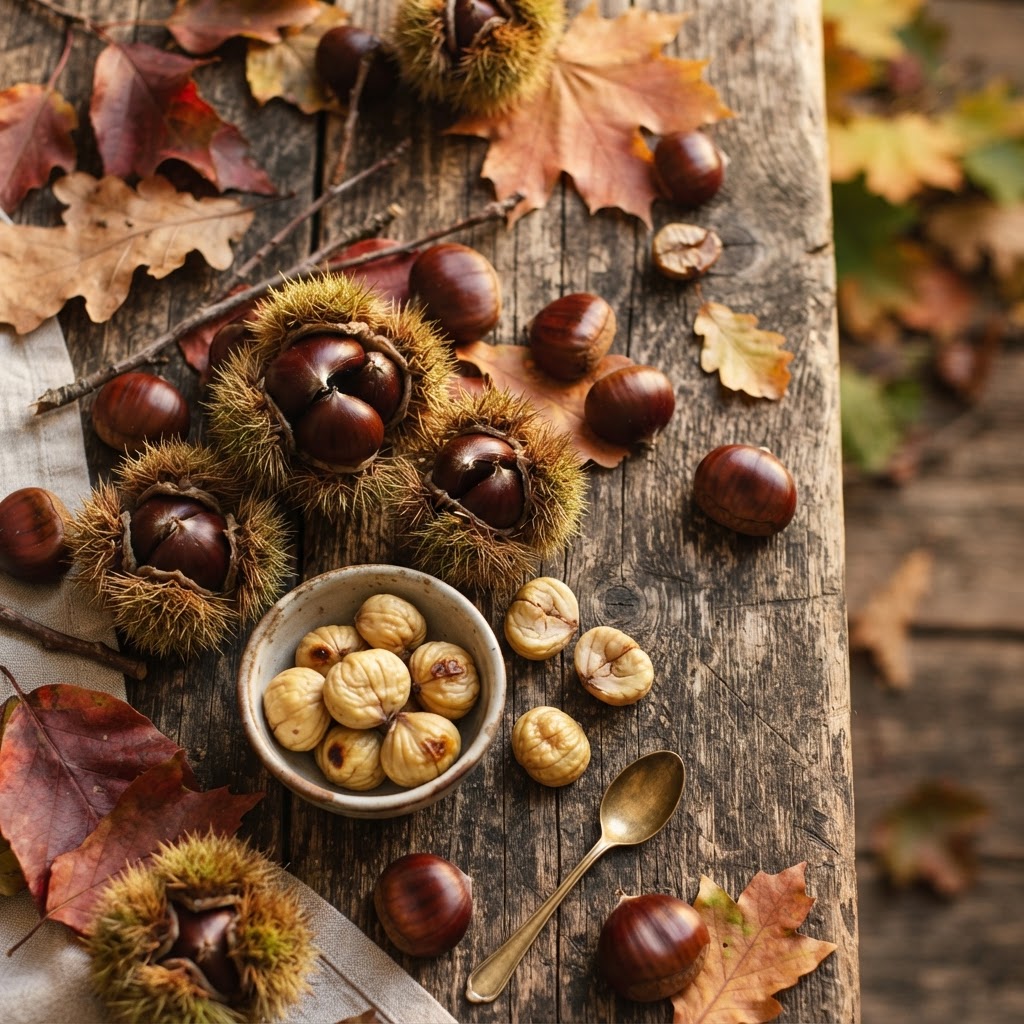
Chestnuts are the autumn nuts of the chestnut tree — and unlike other nuts they are low in fat and high in starch, eating almost like a potato or a grain. For centuries they were the staple "bread tree" of mountainous Europe, ground into flour and baked into flatbreads and porridge when wheat wouldn't grow.
They must be cooked — raw chestnuts are astringent and hard — and a hot roasted chestnut, split open to reveal its pale, starchy flesh, is one of the defining flavors of autumn and winter across Europe. From Italian castagnaccio and Corsican chestnut bread to France's candied marron glacé, the chestnut carries the scent of the harvest into the Christmas season.
Marrone
The prized Italian cultivated chestnut — larger, rounder, and sweeter than wild chestnuts, with a single kernel per bur and a skin that peels cleanly. The marron of Marradi and the marron glacé of France come from this type.
Sweet Chestnut
The common European chestnut (Castanea sativa), the species behind most Old-World chestnuts. Often several small, flat nuts per bur, excellent for flour and roasting.
American Chestnut
Once the dominant tree of the eastern U.S. (Castanea dentata), nearly wiped out by the chestnut blight of the early 1900s. Restoration blight-resistant hybrids are slowly returning.
Chinese Chestnut
Castanea mollissima, blight-resistant and now widely grown in the U.S. and Asia. Medium-sized, sweet, and easy to peel — the supermarket chestnut in many regions.
Japanese Chestnut
Castanea crenata, grown across East Asia for large, starchy nuts often candied (kuri-kinton) or simmered in savory Japanese autumn dishes.
Châtaigne d'Ardèche
A French AOC-protected chestnut from the Ardèche hills — small, sweet, and the base of the region's chestnut flour, cream, and marron glacé traditions.
Choose chestnuts that feel heavy and firm with glossy, unbroken shells. Rattle them — fresh nuts sit snugly in the shell; a hollow rattle means they've dried out and gone stale. Avoid any with small holes (a sign of weevils) or mold.
Fresh chestnuts are perishable: buy them in autumn and early winter, and use them within a week or two, or store them cool and humid. Vacuum-packed peeled chestnuts and dried chestnuts are good year-round alternatives.
For flour, look for stone-ground Italian or French chestnut flour — sweet, earthy, and naturally gluten-free — sold in sealed bags to preserve its oils.
Fresh chestnuts are a living seed and will dry out or mold quickly. Keep them in the refrigerator in a perforated bag for up to a month, or freeze them (raw or briefly blanched) for several months. Dried chestnuts and chestnut flour store in a cool, dry cupboard for months; once opened, refrigerate or freeze the flour to protect its oils.
Scoring (essential): Before roasting or boiling, score each chestnut with an X through the flat side of the shell with a sharp knife — without it, the steam builds up and the nuts explode.
Roasting: Roast scored chestnuts at 425°F for 20–30 minutes until the shells curl open and the flesh is tender. Peel while still warm — once cool, the inner skin clings stubbornly.
Boiling: Simmer scored chestnuts for 30–40 minutes, then peel for use in purees, soups, and stuffings; boiling makes peeling easier than roasting.
Drying & flour: Dry peeled chestnuts in a low oven or dehydrator, then grind to sweet, gluten-free chestnut flour for baking flatbreads, cakes, and pancakes.
Roasted Chestnuts
The classic street-food roast — score, roast hot, and peel for a hot, starchy, sweet snack redolent of winter markets.
Chestnut Soup
Simmer peeled chestnuts with broth, leek, and cream into a velvety autumn soup — a traditional opener for holiday meals.
Chestnut Stuffing
Fold chopped cooked chestnuts into bread or sausage stuffing for Thanksgiving and Christmas poultry — a beloved Anglo-American tradition.
Castagnaccio
A rustic Tuscan flatbread made from chestnut flour, olive oil, rosemary, and pine nuts — no wheat, no sugar, just the chestnut's natural sweetness.
Marron Glacé
Candied chestnuts poached in syrup over many days — France and Italy's luxurious holiday confection, the height of chestnut craft.
Chestnut Purée
Sweetened chestnut purée folded into mousses and Mont Blanc desserts, or unsweetened purée stirred into pasta and risotto for richness.
Drying: Dried chestnuts keep for months and rehydrate into stews and soups — the traditional mountain method for stretching the harvest through winter.
Flour: Chestnut flour stores months in a sealed bag; freeze it for longer life, since its oils can go rancid.
Candied & jarred: Marron glacé and jarred chestnuts in syrup keep for months, while vacuum-packed peeled chestnuts are a year-round pantry shortcut.
Unlike other nuts, chestnuts are low in fat and high in complex carbohydrates — closer to a potato or grain than a walnut, which is why they were historically a staple starch.
They are a good source of vitamin C (rare among nuts), folate, potassium, and dietary fiber, and chestnut flour is naturally gluten-free.
Their starchy composition makes them filling and slow-burning, providing steady energy — and they're among the few nuts that can substitute for grains in gluten-free baking.
Chestnuts are the only nut that must be cooked to be eaten — raw, they're astringent, hard, and indigestible.
The American chestnut once made up a quarter of all trees in the Appalachian forest before a 1904 blight virtually wiped out the species; restoration efforts using blight-resistant hybrids continue today.
"Chestnuts roasting on an open fire" — the opening line of "The Christmas Song" — cemented the roasted chestnut as a symbol of the holidays in the English-speaking world.
In mountainous parts of Italy and Corsica, chestnuts were once called "the bread tree" because chestnut flour was the only flour that would grow on steep, poor soil.
Autumn chestnut harvests are celebrated across the chestnut heartlands of Europe:
Festa della Castagna (Chestnut Festival)
Marradi & the Tuscan Apennines, Italy
🗓 October 2026 (weekends, annual)
Tuscany's famed chestnut festivals honor the sweet Marrone di Marradi, with roasted chestnuts, castagnaccio (chestnut-flour cake), and steaming mulled wine among the autumn hills.
Fête de la Châtaigne (Chestnut Fair)
Ardèche & Corsica, France
🗓 October–November 2026
France's chestnut heartlands celebrate with village fairs roasting the prized châtaigne d'Ardèche (AOC), selling chestnut flour, jam, and the luxurious marron glacé.
Cogne Chestnut Festival
Andorra & the Pyrenees
🗓 Late October 2026
Mountain communities across the Pyrenees gather for chestnut roasts, traditional music, and markets as the annual nut harvest marks the turn of the season.
Bread tree of the mountains: Chestnuts thrive on poor, steep soils where grains fail, historically feeding entire mountain communities with no need for plowing — a naturally sustainable, low-input food source.
Restoration: The American chestnut's near-extinction from blight reshaped eastern U.S. forests; breeding blight-resistant hybrids aims to restore this once-mighty tree and its carbon-sequestering canopy.
Global range: Sweet chestnuts grow across southern Europe, the Mediterranean, and into East Asia and North America, flourishing in cool-temperate climates with the harvest ripening each autumn.
In-Season Recipes with Chestnuts
Seasonal recipes featuring Chestnuts right now
Coming Soon
All Other Recipes with Chestnuts
Coming Soon