
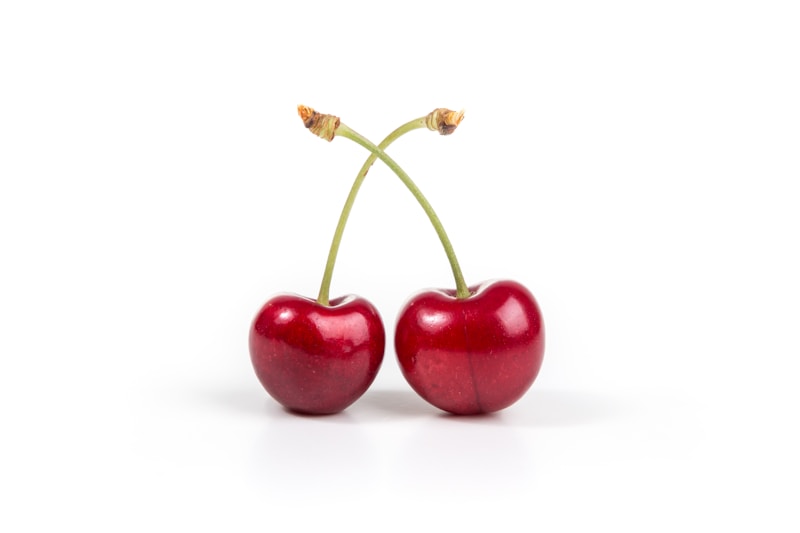
Cherries
Cherries are the most anticipated stone fruit of early summer — their brief season (typically 6–8 weeks) makes them precious. Sweet cherries are eaten fresh; tart cherries are the cook's cherry — essential in pie, preserves, brandied preparations, and the classic Black Forest cake.
Choose cherries that are plump, firm, and glossy with fresh-looking green stems. The color should be deep and uniform for sweet varieties — deep red to almost black for Bing cherries; yellow-pink blush for Rainier. Avoid soft, leaking, or wrinkled cherries or any with brown stems.
Cherry season is brief — June through August in most of the US. Pacific Northwest cherries (Washington, Oregon) are the gold standard. Rainier cherries are the premium fresh-eating variety — yellow-pink, extremely sweet and aromatic.
Sweet Cherries (Prunus avium): Bing, Rainier, Lapins, Sweetheart. Eaten fresh. Rich, sweet, low in acid. Bing is the classic dark red sweet cherry; Rainier is yellow-pink with a honeyed, floral flavor.
Tart/Sour Cherries (Prunus cerasus): Montmorency (the dominant variety). Rarely available fresh; found canned, frozen, dried, or as juice. The essential cooking cherry — high acidity makes them extraordinary in pies, jams, and cocktails.
Cherries are extremely perishable — refrigerate immediately upon purchase. Do not wash until just before eating. Stored unwashed in a single layer in a ventilated container, they keep 5–7 days refrigerated.
For longer storage, freeze: pit, spread on a sheet pan in a single layer, freeze until solid, then bag. Frozen cherries last 6–12 months and are excellent for cooking, smoothies, and baking. Canned tart cherries are an excellent year-round substitute for baking.
Cherry Pie: The classic American preparation — tart cherries are essential. Their high acidity prevents the filling from being cloying and creates the flavor contrast that makes cherry pie exceptional. Thicken with cornstarch or tapioca.
Clafoutis: The French baked custard with whole (unpitted) cherries baked in — the pits add an almond-like flavor from the amygdalin inside. Traditional French recipes use unpitted cherries.
Sauce for Duck & Game: Tart cherries reduced with red wine, port, and stock — one of the great classic French sauces. The acidity cuts through duck fat beautifully.
Brandied Cherries: Whole sweet cherries preserved in brandy, Kirsch, or bourbon with sugar — a pantry treasure for cocktails (the definitive Manhattan garnish), desserts, and gifting.
Smoothies & Açaí Bowls: Frozen tart cherries add intense flavor and high antioxidant content to smoothies.
Brandied Cherries: Pit cherries, pack in sterilized jars with sugar and brandy or Kirsch, let cure 4–6 weeks. The definitive cocktail cherry — far superior to commercial maraschino cherries.
Jam: Tart cherry jam is intensely flavored and naturally acidic — sets beautifully without commercial pectin due to the natural acidity. Sweet cherry jam benefits from added lemon juice.
Freezing: Pit, freeze on a sheet pan, then bag. The best method for preserving cherries for cooking.
Canning: Tart cherries in light syrup are a traditional preserve. Water bath canning works well due to the high natural acidity.
Cherries are among the most antioxidant-rich fruits available. They contain anthocyanins (the red/purple pigments), quercetin, and hydroxycinnamates — compounds with potent anti-inflammatory effects.
Cherries are one of the few food sources of melatonin — the hormone that regulates sleep. Studies have shown that drinking tart cherry juice increases sleep duration and quality. The melatonin content is highest in Montmorency tart cherries.
Tart cherry juice has been shown in multiple clinical trials to reduce muscle inflammation and soreness after intense exercise, accelerating recovery. It has also been studied for reducing symptoms of gout by lowering uric acid levels. One cup of sweet cherries provides 18% of the daily value for vitamin C and 5% for potassium.
The Pacific Northwest (Washington State) is the dominant US cherry-producing region, accounting for about 60% of all US sweet cherries. The Bing cherry — the deep red standard sweet cherry — was named after Ah Bing, a Chinese-American foreman who worked for the Oregon orchardist Seth Lewelling in the 1870s.
Rainier cherries were developed at Washington State University in 1952 by Harold Fogle, who crossed a Bing with a Van. They are named after Mount Rainier. Due to their delicate skin and quick ripening, Rainier cherries must be hand-picked and handled extremely carefully — they command a significant price premium.
Montmorency tart cherries — the dominant variety for cooking and juice — are grown primarily in Michigan, which produces about 75% of US tart cherries. The cherry festival in Traverse City, Michigan is one of the largest fruit festivals in the US.
Cherry production requires specific climate conditions — cold winters for dormancy and mild springs to avoid frost during bloom. A single late frost can destroy an entire cherry crop. Climate change is disrupting these patterns with increasing frequency.
Cherry trees are perennials that produce for 20–30 years, making orchards a long-term agricultural investment that builds soil health and provides ecological services.
Since cherry harvest timing is extremely precise and the window is only 2–3 weeks, cherries are often transported by air from growing regions — a significant carbon cost. Buying domestic cherries in season, rather than imported cherries out of season, dramatically reduces this footprint.