
Grains & Seeds · Summer & Fall
Buckwheat
Fagopyrum esculentum · Also: Kasha, Soba, Saracen Wheat, Blé Noir
Buckwheat is not wheat at all, despite the name — it's a pseudocereal, a broadleaf plant whose triangular seeds are cooked and eaten like a grain. Related to rhubarb and sorrel rather than to grasses, buckwheat was domesticated in the highlands of Asia and spread westward into Europe, where it became the daily grain of the poor, the mountain-dweller, and the cold-climate farmer.
The cooked groats are earthy, nutty, and robust — the kasha of Eastern Europe and the soba of Japan, the galettes of Brittany and the pizzoccheri of the Italian Alps. As a flour, buckwheat makes dark, fragrant pancakes, crêpes, and noodles; as a honey, it is deep, almost molasses-dark, prized by beekeepers. A fast-growing, cool-season crop that thrives in poor soils and short summers, buckwheat is naturally gluten-free and exceptionally nourishing — a humble grain with a remarkable range across the cuisines of Russia, Japan, France, Italy, and the Himalayas.
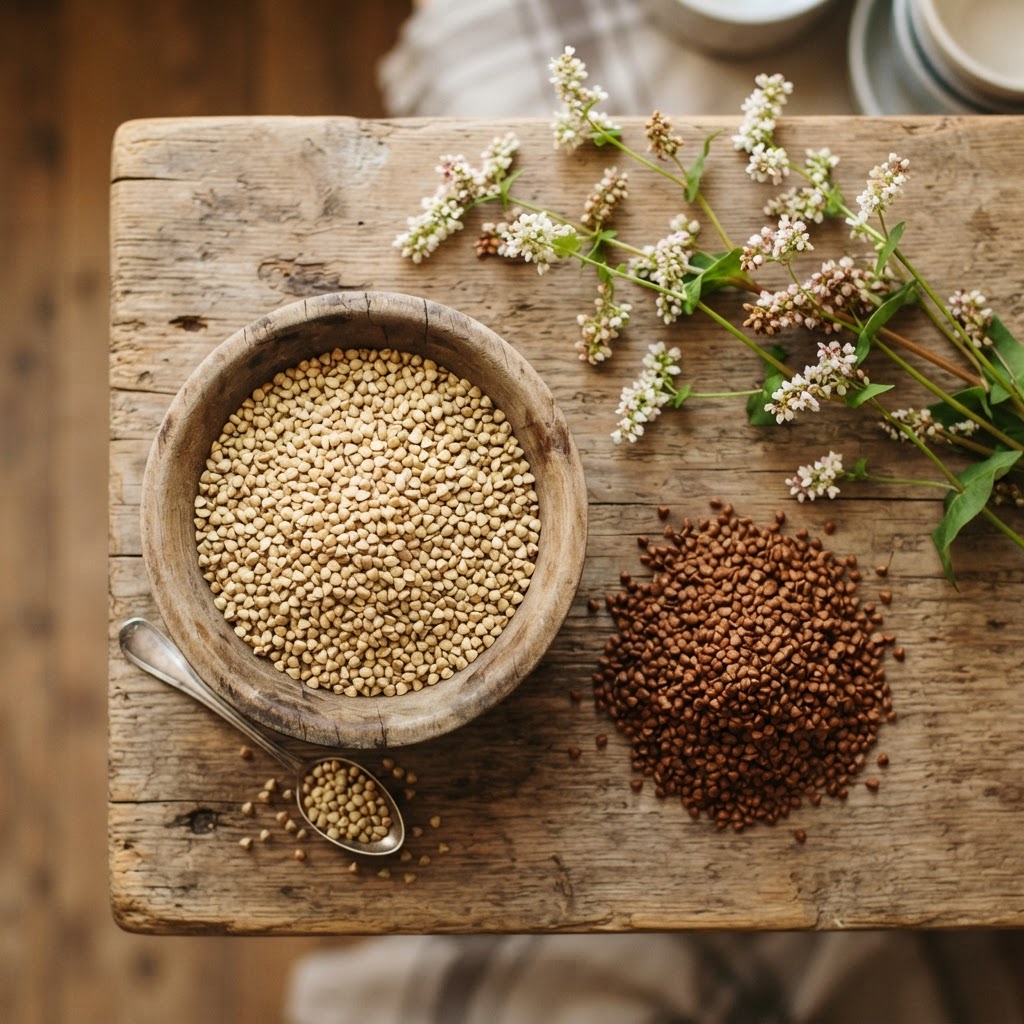
Raw Buckwheat Groats
The hulled, unroasted triangular seeds — pale green-tan with a mild, slightly grassy flavor; the starting point for cooking, sprouting, and home roasting into kasha.
Kasha (Roasted Groats)
Buckwheat groats roasted until deep reddish-brown — a staple of Eastern Europe and Russia with a toasty, nutty flavor; the roasting shortens cooking time and gives kasha its characteristic deep, warm taste.
Buckwheat Flour
Ground groats, with or without the hull; dark, fragrant, and naturally gluten-free — used for Japanese soba noodles, Breton galettes, Russian blini, American buckwheat pancakes, and pizzoccheri pasta.
Soba Noodles
Japanese buckwheat noodles, traditionally 100% buckwheat but often blended with wheat for strength; nutty, earthy, and delicate, served chilled with dipping sauce or hot in broth.
Buckwheat Flakes & Sprouts
Rolled buckwheat flakes cooked like oatmeal, and buckwheat sprouts grown from raw groats — tender, nutty microgreens added to salads and sandwiches for their mild, fresh flavor.
Buckwheat Honey
Dark, thick, almost molasses-like honey from buckwheat flowers — one of the deepest, most antioxidant-rich honeys, prized in Russia and Eastern Europe for its bold, earthy sweetness.
Buy whole raw buckwheat groats (pale, triangular seeds) for the freshest flavor and longest storage; roasted kasha is ready to cook and adds a deep, toasty note to pilafs and porridges. Choose grains with no dust, off-smell, or broken bits.
Buckwheat flour is dark and fragrant; buy small quantities and keep it cold — the natural oils make it go rancid faster than wheat flour. For soba, look for fresh Japanese buckwheat noodles in the refrigerated section, or dried soba in the pasta aisle; for galettes, Breton buckwheat flour (farine de sarrasin) gives the authentic dark, lacy crêpe.
Season: buckwheat is a fast cool-season crop harvested in late summer to fall; dried groats, flour, and noodles are available year-round, while fresh buckwheat honey appears at the end of the buckwheat flowering season in late summer.
Keep whole buckwheat groats in an airtight container in a cool, dry cupboard for up to a year. Buckwheat flour, because of its high natural oils, spoils faster — keep it in the fridge and use within 3–4 months, or freeze for up to a year. Roasted kasha keeps several months sealed, and cooked buckwheat will keep 4–5 days refrigerated and freezes well for quick meals.
Harvesting: Buckwheat is harvested about 10–12 weeks after sowing, when the seeds turn from green to dark brown; the plants are cut and threshed, then the hulls removed to reveal the pale triangular groats.
Hulling: The hard dark hull is inedible and must be removed; the hulled groats are then sold raw or roasted (kasha), or milled into flour.
Roasting (kasha): Raw groats are tossed in a dry hot pan or oven-roasted until deep reddish-brown, developing a toasty, nutty flavor; this is the traditional Eastern European preparation that defines kasha.
Kasha (Pilaf & Porridge)
Roasted buckwheat simmered with broth, onion, and egg (the traditional 'egg-and-buckwheat' method) into a fluffy, nutty pilaf — the Russian and Eastern European kasha, served with butter, mushrooms, or meat.
Soba Noodles
Japanese buckwheat noodles boiled and served chilled with tsuyu dipping sauce, or hot in a dashi broth — the most refined expression of buckwheat, eaten at New Year's (toshikoshi soba) for long life.
Galettes & Crêpes
Breton buckwheat flour galettes — savory crêpes filled with egg, cheese, ham, or vegetables — the signature dish of Brittany, naturally gluten-free and lacy-crisp at the edges.
Pancakes & Blini
American buckwheat pancakes and Russian buckwheat blini — dark, tender, and fragrant, risen with yeast or baking powder; the traditional pancake of Siberia and the American frontier.
Pizzoccheri (Alpine Pasta)
Italian flat buckwheat noodles from Valtellina, tossed with potatoes, cabbage, and melted fontina cheese — a rich mountain-harvest dish of the Italian Alps.
Salads & Grain Bowls
Cooked and cooled buckwheat groats keep a satisfying chew — toss with roasted vegetables, herbs, and vinaigrette, or add to soups and stuffed cabbage for a gluten-free, nutty grain base.
Drying: Fully dried buckwheat groats keep for a year or more in a sealed container in a cool, dry place — a storable staple across Russia, Japan, and the Alps, kept through the long winter.
Roasting & milling: Roasted kasha keeps its flavor for months; buckwheat flour is best refrigerated or frozen to preserve its oils, and can be milled in small batches from whole groats for the freshest taste.
Noodles & dried goods: Dried soba noodles and buckwheat pasta keep for months in the pantry — a traditional way to preserve the buckwheat harvest as shelf-stable, quick-cooking food.
Buckwheat is one of the most nutritious pseudocereals — rich in high-quality protein with all essential amino acids, particularly lysine and arginine, and notably high in the flavonoid rutin, which supports blood vessels and circulation.
It is a good source of dietary fiber, magnesium, manganese, copper, phosphorus, and B vitamins; its complex carbohydrates and soluble fiber give it a low glycemic load that helps steady blood sugar.
Naturally gluten-free, buckwheat is a safe and nourishing grain for those with celiac disease — though buckwheat noodles and flour mixes often contain wheat, so check labels for purity if avoiding gluten.
Despite the name, buckwheat has no relation to wheat — it is a broadleaf plant in the knotweed family, kin to rhubarb, sorrel, and dock; the name comes from the beechnut-like triangular seeds (buckwheat = 'beech wheat').
Buckwheat grows from seed to harvest in just 10–12 weeks — one of the fastest-maturing grain crops — and thrives in poor, acidic soils and short summers, which made it the grain of cold mountain regions from Siberia to the Alps to Tibet.
In Brittany, buckwheat is called blé noir (black wheat) or sarrasin, after the belief that it was brought back from the Crusades; the Breton galette de sarrasin is a savory buckwheat crêpe that is the emblem of the region.
Buckwheat is a great nectar plant — its flowers feed bees for weeks, producing the dark, rich buckwheat honey prized in Russia and Eastern Europe; the honey is one of the darkest and most antioxidant-rich of all honeys, almost like molasses in flavor.
Buckwheat is celebrated from Russian kasha tables to Japanese soba shops and Breton crêperies:
Buckwheat Festival
Hungary & Eastern Europe
🗓 September–October 2026 (autumn harvest)
Across Eastern Europe, the autumn buckwheat harvest is celebrated with kasha dishes, buckwheat blini, and savory groat stews; buckwheat is a beloved staple of Russian, Polish, and Hungarian cooking, served at harvest suppers and family tables throughout the cold months.
Soba-making & New Year (Toshikoshi Soba)
Japan
🗓 December 31, 2026
Japanese families eat toshikoshi soba — year-crossing buckwheat noodles — on New Year's Eve for long life and good fortune; the long, slender noodles of buckwheat flour are a symbol of longevity, and soba-making is a craft celebrated at soba festivals across Japan throughout the year.
Bretagne Galette Festival
Brittany, France
🗓 Summer 2026 (saison des galettes)
In Brittany, buckwheat (sarrasin or blé noir) is the grain of galettes — savory crêpes made from buckwheat flour, filled with eggs, cheese, and ham; the galette is a Breton emblem, celebrated at crêperies and village festivals throughout the region.
Pizzoccheri & Alpine Harvest
Valtellina, Italy
🗓 September 2026
In the Italian Alps, buckwheat pizzoccheri — flat ribbons of buckwheat pasta tossed with potatoes, cabbage, and fontina cheese — is celebrated at the Pizzocchero d'Oro festival in Teglio; a hearty, mountain-harvest dish honoring the autumn buckwheat crop.
Fast & low-input: Buckwheat matures in as little as 10 weeks and needs little fertilizer or water; its deep roots mine nutrients from poor soils and it grows without pesticides, making it one of the most sustainable grain crops available.
Soil-improving cover crop: Buckwheat is widely planted as a cover crop to suppress weeds, build organic matter, and loosen compacted soil — it's then turned under as green manure, improving the land for the next crop while feeding bees with its abundant flowers.
Global range: Buckwheat originated in the highlands of southwestern China and the Himalayas and spread through Asia and Europe; today it is grown across Russia, China, Japan, Eastern Europe, France, North America, and the Himalayan regions — thriving where wheat and rice struggle.
In-Season Recipes with Buckwheat
Seasonal recipes featuring Buckwheat right now
Coming Soon
All Other Recipes with Buckwheat
Coming Soon