
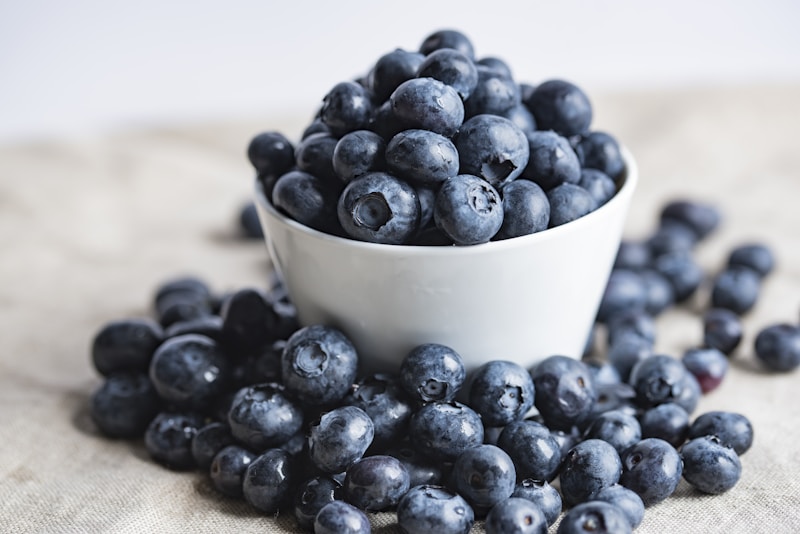
Blueberries
Blueberries are true berries native to North America — one of the only major fruits native to the continent. Small, sweet-tart, and packed with antioxidants, they are among the most nutritionally celebrated fruits in modern nutrition science and one of the highest antioxidant foods known.
Choose firm, plump berries with a dusty blue-gray bloom — the bloom (pruina) is a natural protective coating and a sign of freshness. Avoid shriveled, soft, or leaking berries or any with red or green coloring. The deeper the blue, the more anthocyanin antioxidants.
Frozen blueberries are an excellent year-round option — nutritionally comparable or even superior to fresh out-of-season berries. Wild (lowbush) blueberries, available frozen, have more intense flavor and higher antioxidant content than cultivated varieties.
Wild (Lowbush): Tiny, intensely flavored, extremely high in antioxidants. Grown primarily in Maine and Eastern Canada. Most sold frozen — freezing actually increases antioxidant availability by breaking cell walls.
Cultivated (Highbush): Larger, milder, and widely available fresh. Less intense flavor but excellent texture and good nutritional profile. The most common supermarket blueberry.
Do not wash blueberries until ready to eat — moisture promotes mold. Store in their original container or a paper towel-lined container in the refrigerator and use within 1–2 weeks.
For longer storage, freeze: spread in a single layer on a sheet pan until frozen solid, then transfer to bags. Frozen blueberries keep 6–12 months and are perfect for cooking, smoothies, and baking. Toss frozen blueberries in a little flour before adding to batters to prevent them from sinking.
Baking: Muffins, pancakes, scones, coffee cakes, and cobblers — blueberries burst with juice when baked and their color bleeds beautifully into batters. Frozen blueberries work as well as fresh.
Sauce & Compote: Simmer with a little sugar, lemon juice, and vanilla until berries burst and the sauce thickens — extraordinary on pancakes, cheesecake, yogurt, oatmeal, and pork tenderloin.
Jam: Blueberry jam is straightforward and intensely flavored. The natural pectin content is moderate — add lemon juice for both flavor and gel enhancement.
Smootties: Frozen blueberries in smoothies add color, antioxidants, and sweet-tart flavor that pairs with virtually everything.
Fresh: Scattered over cereal, yogurt parfaits, and salads — peak-season fresh blueberries need nothing added.
Freezing: The best preservation method — spread in a single layer on a sheet pan, freeze, then bag. Retains nutrition and flavor exceptionally well for 6–12 months.
Jam & Preserves: Blueberry jam with lemon zest and a hint of vanilla is a pantry essential. Process in a water bath canner for shelf-stable jars.
Dehydrating: Dried blueberries are a concentrated, shelf-stable snack excellent in trail mix, cereals, and baking. Dehydrate at low temperature for 18–24 hours until leathery.
Infused Vinegar: Blueberries steeped in white wine or champagne vinegar create a beautiful, fruity vinegar perfect for dressings and sauces.
Blueberries are frequently called a 'superfood' — and for once the label is justified. They are among the highest antioxidant foods measured, primarily due to anthocyanins, which give the berries their deep blue color.
One cup of blueberries provides 24% of the daily value for vitamin C, 36% for vitamin K, 25% for manganese, and 4g of fiber at just 84 calories. The anthocyanins are associated with improved memory and cognitive function, reduced blood pressure, lower inflammation, and reduced risk of heart disease.
Blueberries are one of the only foods that has demonstrated measurable improvements in memory in randomized controlled trials. Regular blueberry consumption is associated with slower cognitive aging.
Blueberries are native to North America — they are one of the only major fruits originating from the continent. Indigenous peoples throughout North America used blueberries as food, medicine, and dye for thousands of years before European colonization.
The wild blueberry industry in Maine and Eastern Canada is ancient — the same areas where Indigenous peoples gathered wild berries are still harvested today. Maine wild blueberry fields are raked by hand with special tools, unchanged in method for centuries.
The cultivated blueberry was developed by USDA botanist Frederick Coville and Elizabeth White in 1916 — before this, blueberries were only available wild. Coville's work in understanding the highly acidic soil requirements of blueberries (pH 4.5–5.0) made commercial cultivation possible.
Blueberries are a relatively sustainable crop compared to many fruits. They are perennial bushes that can produce for 50+ years with proper care, requiring no annual replanting. The flowers provide important nectar for pollinators.
However, blueberries require very specific acidic soil conditions that often require sulfur amendments and precise fertilizer management. Irrigation needs are significant in dry years.
Organic blueberries are increasingly available and worth seeking out — the thin skin means surface pesticide residues are more easily consumed. Wild Maine blueberries are grown with minimal inputs and represent one of the more sustainable berry options.