
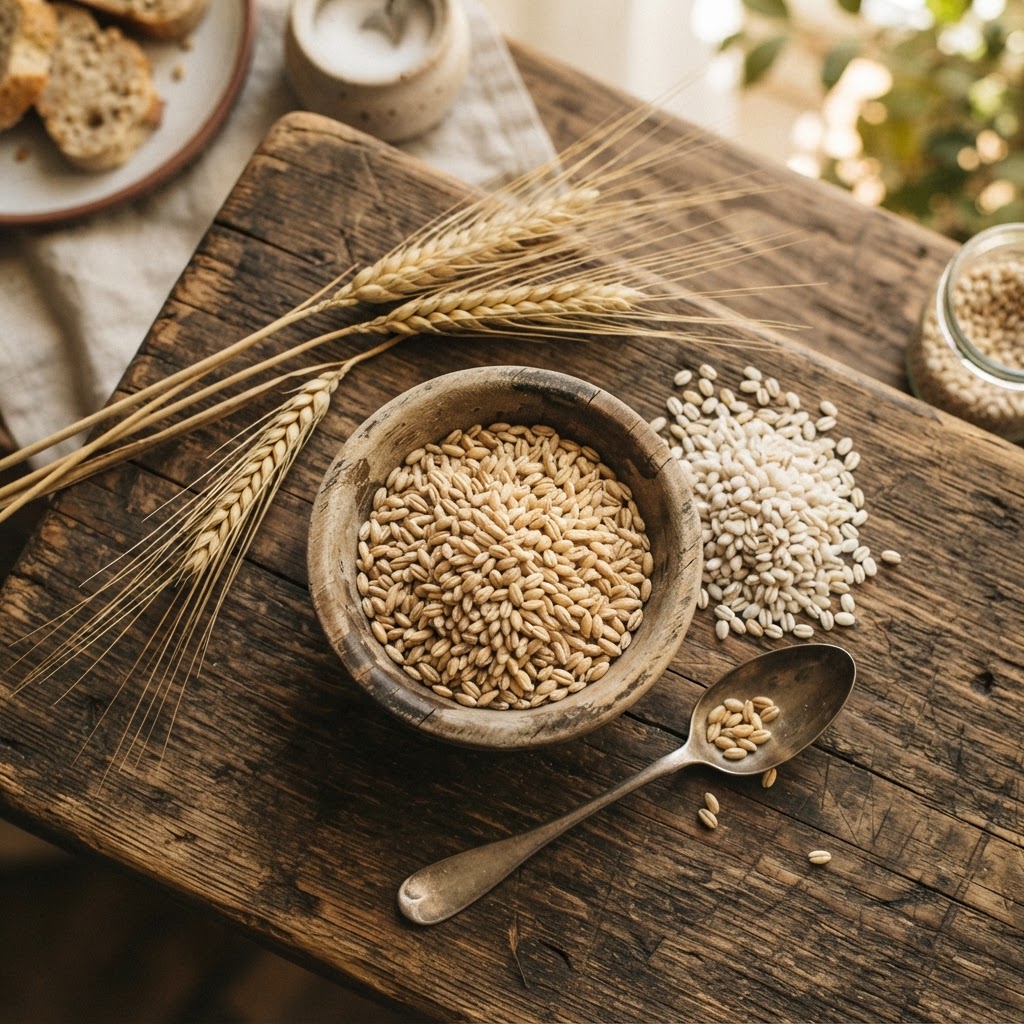
Grains & Seeds · Summer & Fall
Barley
Hordeum vulgare · Also: Hulled Barley, Pearl Barley, Pot Barley, Tsampa
Barley is one of the first grains ever domesticated by humans — a staple of the ancient Near East and the grain that fueled the builders of the pyramids, the armies of Rome, and the gladiators who were literally called "barley men." A hardy, cool-season cereal that thrives where wheat struggles, barley was for millennia the everyday bread grain of Europe before wheat displaced it.
Today barley feeds the world in two great traditions: as a nourishing cooked grain in soups, stews, and porridges, and as the malting base of beer and whisky — the sugar-rich malt that fermentation turns into the world's favorite drinks. Its nutty, slightly chewy grains thicken winter soups, anchor Scottish broths and Tibetan tsampa, and bring a satisfying bite to salads and pilafs. Whether hulled, pearled, flaked, or malted, barley is an ancient grain of remarkable range — humble, hearty, and deeply woven into the food cultures of every continent that grows it.
Hulled Barley
The whole grain with only the tough outermost hull removed — the most nutritious form, retaining the bran and germ; chewy and slow-cooking, the best choice for hearty soups, stews, and grain bowls.
Pearl Barley
The most common supermarket form — the hull and bran polished away, leaving round, pale grains that cook faster and are softer; less nutritious than hulled but creamy in soups, risottos, and puddings.
Pot Barley
A lightly pearled form that retains more of the bran than fully pearled barley — a middle ground between nutrition and quick cooking, traditional in British and Scottish broths.
Barley Flakes
Steamed and rolled like oat flakes — cook quickly into a creamy porridge, or bake into granola, cookies, and breads for a nutty, chewy texture.
Barley Grits & Flour
Cracked barley cooked like grits or polenta, and barley flour used in flatbreads (the traditional bread of Tibet, tsampa), pancakes, and blended baking for its mild, earthy flavor.
Malting Barley
Specific two-row or six-row barley varieties grown for malting — sprouted, dried, and roasted to make malt for beer, whisky, and malt vinegar; chosen for uniform germination and high enzyme content.
For nutrition, seek out hulled barley (sometimes labeled "hull-less barley") — the whole grain; pearled barley is easier to find but has had much of its fiber polished away. Choose plump, pale, evenly colored grains with no dust, broken bits, or musty smell.
Barley flakes, grits, and flour are increasingly available at health-food stores and online; for baking, barley flour adds a tender, moist crumb and a subtle sweet-malt flavor to breads, cookies, and pancakes. Malted barley products — malt vinegar, malted milk, and malt syrup — are pantry staples with the grain's deep, toasty sweetness.
Season: barley is a cool-season grain harvested in early summer (winter-sown) or late summer (spring-sown); dried grains, flakes, and flour are available year-round, while fresh barley greens (juiced as a supplement) appear in spring and summer.
Keep whole hulled and pearled barley in an airtight container in a cool, dry cupboard for up to a year — a stable, long-keeping grain. Barley flour, with its oils from the germ, goes rancid faster; keep it refrigerated and use within 3–6 months, or freeze for longer storage. Barley flakes and grits keep several months in a sealed container, and cooked barley will keep 4–5 days refrigerated and freezes well.
Harvesting: Barley is harvested in summer when the stalks turn golden and the grain is hard and dry; the grain is threshed from the stalk and winnowed to remove the chaff, then dried for storage.
Hulling & pearling: The tough outer hull is inedible and must be removed; hulled barley keeps the bran, while pearled barley is further polished to remove the bran — a trade-off between faster cooking and lost nutrition.
Malting: Barley grain is steeped in water, allowed to germinate, then dried and roasted in a kiln to make malt; malting develops the enzymes and sugars needed to brew beer and whisky — one of humanity's oldest food-processing arts.
Soups & Stews
Barley's natural starch thickens broths into silky, hearty soups — the classic Scottish beef-and-barley broth, mushroom barley soup, and vegetable-barley stews; pearled barley cooks in 25–40 minutes, hulled in 50–60.
Barley Risotto (Orzotto)
Italian orzotto — barley cooked risotto-style with onions, wine, and broth, finished with butter and cheese; the grains stay chewy with a creamy sauce, a rustic alternative to arborio rice.
Grain Salads & Pilafs
Cooked and cooled barley keeps a satisfying chew — toss with roasted vegetables, herbs, feta, and vinaigrette for salads, or cook pilaf-style with onions, spices, and stock as a side dish.
Porridge & Breakfast
Barley flakes cook into a creamy, nutty porridge like oats — top with honey, fruit, and nuts; or simmer cracked barley grits for a hearty breakfast bowl.
Tsampa (Roasted Barley Flour)
The staple of Tibet — barley roasted, ground into flour, and kneaded with butter tea into tsampa dough; eaten at every meal, carried on journeys, and offered at Losar (New Year) celebrations.
Baking with Barley Flour
Barley flour adds a tender, moist crumb and a mild malt sweetness to breads, scones, cookies, and pancakes; low in gluten, it's usually blended with wheat flour for lift in yeasted breads.
Drying: Fully dried barley grain keeps for a year or more in a sealed container in a cool, dry place — one of the great storable grains, the foundation of ancient and medieval granaries.
Malting & brewing: Malted barley — dried, roasted, and sometimes further brewed into beer — is a traditional way to preserve the grain's energy as a storable, drinkable form; malt, malt syrup, and beer all keep far longer than fresh grain.
Milling into flour: Barley flour keeps several months refrigerated; for best freshness, mill small batches as needed, or buy whole grain and store it dry until you cook or grind it.
Whole (hulled) barley is one of the most nutritious grains — rich in dietary fiber, especially the soluble fiber beta-glucan, the same heart-healthy fiber found in oats that helps lower cholesterol and steady blood sugar.
Barley provides good amounts of protein, B vitamins (niacin, thiamin, B6), iron, magnesium, phosphorus, manganese, and selenium; pearled barley retains less of these, but hulled barley keeps the bran and germ where most nutrients live.
Its low glycemic index and high fiber make barley a satisfying, slow-burning grain — a nourishing base for soups, salads, and porridges that supports digestion and heart health, and a gluten-containing grain (though lower in gluten than wheat) suitable for most but not for those with celiac disease.
Barley was domesticated in the Fertile Crescent around 10,000 years ago — one of the first crops ever cultivated, alongside einkorn wheat and emmer; ancient Egyptian bread and Sumerian beer were both made from barley, and the grain was used as currency and in religious offerings.
Roman gladiators were called "hordearii," or "barley men," because they were fed a barley-rich diet to build strength and endurance — and Greek athletes trained on a barley-based regimen, considering it the perfect fuel for the body.
Barley is the malting grain behind nearly all the world's beer and whisky — its husk protects the malt during malting and its high enzyme content converts starches to sugars; without barley, the brewing traditions of Bavaria, Scotland, and Japan would not exist.
The word "barrack" comes from an old word for a barley store, and the grain's Old English name, "bere," survives in Scottish place-names and in "barley-bree" (barley beer); bere barley is still grown in Scotland's Orkney as a heritage variety for bannocks and whisky.
Barley is celebrated from the Scottish Highlands to the Tibetan plateau, and wherever beer and whisky are brewed:
Highland Games & Harvest Ceilidhs
Scotland
🗓 August–September 2026 (barley harvest)
The Scottish barley harvest — the graith — is celebrated at summer's end with ceilidhs and harvest suppers; barley is the soul of Scotch whisky and the oat-and-barley bannocks of the Highlands, and harvest-home gatherings mark the close of the grain year.
Tsiknopempti & Barley Soups
Greece
🗓 February 2027 (pre-Lenten season)
Barley has fed the Mediterranean for millennia; Greek and Cretan home cooks celebrate the cold months with hearty barley soups (kritharaki), and Orthodox fasting traditions use barley in Lenten dishes — a humble grain central to Mediterranean winter eating.
Tibetan Barley (Tsampa) New Year — Losar
Tibet & Himalayan regions
🗓 February 2027 (Losar)
Roasted barley flour, tsampa, is the staple food of Tibet; Losar (Tibetan New Year) is celebrated with tsampa offerings and the ritual chang (barley beer) — barley is the grain at the very heart of Tibetan culture, eaten at every meal and drunk at every celebration.
Oktoberfest & Barley Beer
Munich, Germany
🗓 September 19 – October 4, 2026
The world's largest festival is a celebration of barley in liquid form — malted barley is the backbone of the Bavarian lager served by the liter at Oktoberfest; the harvest of summer barley and its malting is the agricultural rhythm behind the festival itself.
Cool-climate & hardy: Barley is a cool-season cereal that tolerates drought, poor soils, and short growing seasons better than wheat — it grows further north and higher than almost any other cereal, from Scotland to Tibet to the high Andes.
Low water & fast cycle: Barley needs less water than wheat and matures quickly, making it well suited to dryland farming and to marginal lands; it is grown as both a spring-sown and winter-sown crop, harvested early to free the land for the next planting.
Global range: Barley originated in the Fertile Crescent and is now grown across every temperate grain region — Russia, Europe, North America, the Mediterranean, Ethiopia, the Tibetan plateau, and the Andes — ranking among the world's top four cereals and thriving where other grains cannot.
In-Season Recipes with Barley
Seasonal recipes featuring Barley right now
Coming Soon
All Other Recipes with Barley
Coming Soon