Vegetable · Spring
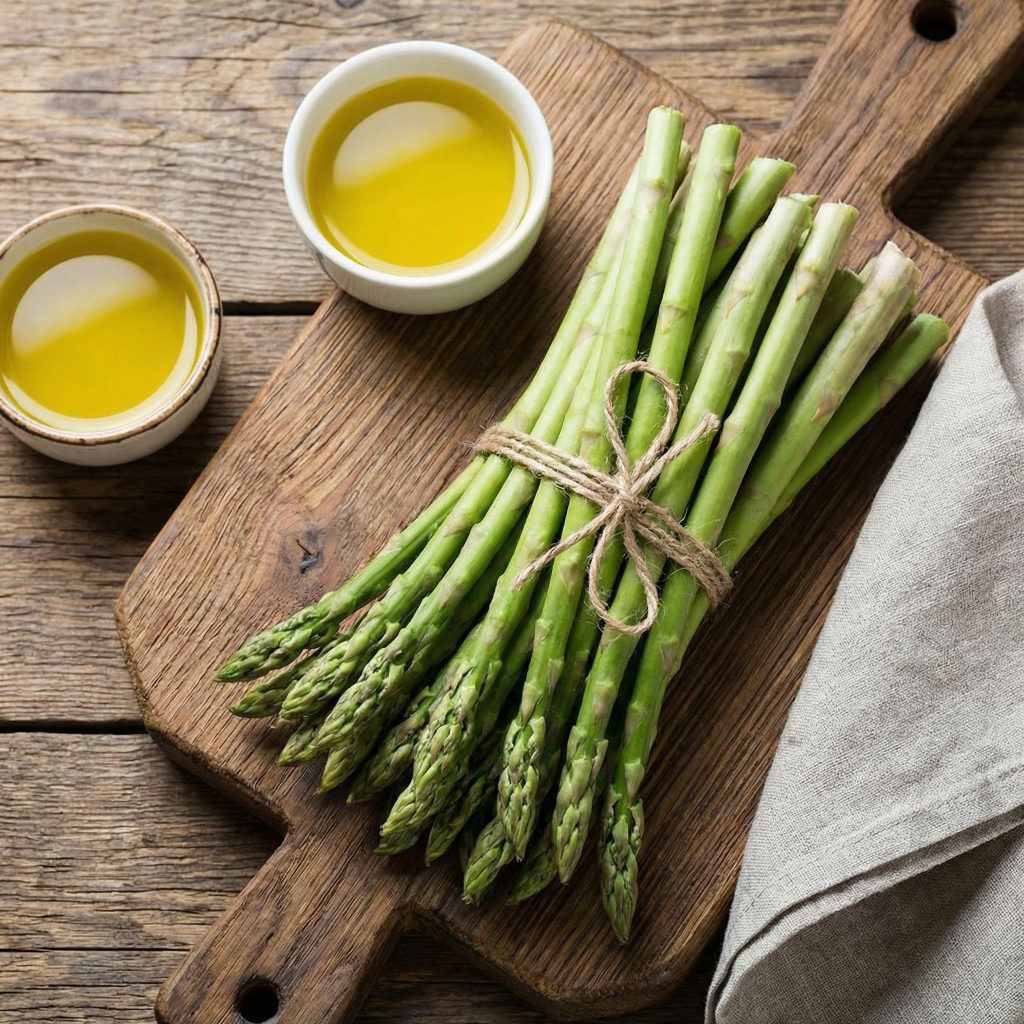
Asparagus
Asparagus officinalis · Also: Garden Asparagus, Sparrow Grass
Arguably the most iconic of the spring vegetables, asparagus has been celebrated for millennia. Ancient Egyptians are said to have enjoyed it as many as 20,000 years ago, and Rome's first emperor Augustus employed a whole fleet of ships — the so-called "asparagus fleet" — to transport huge shipments across the empire.
A flowering perennial and cousin to garlic, asparagus season runs from April to mid-June in the northern U.S., starting as early as February in California. It unfurls into a beautiful fern-like plant when left unharvested — one of the garden's most dramatic seasonal spectacles.
Green Asparagus
The most common U.S. variety — mildly sulphuric, mostly sweet and slightly nutty. Ranges from light to medium green with dark or purple tips.
White Asparagus
Covered with dirt during the final growth stages, robbing it of chlorophyll. Highly prized in Europe, especially Germany, for its mild and delicate flavor.
Purple Asparagus
More tender and sweeter than green. Tends to grow fatter stalks with fewer per crown. Must be treated carefully to preserve its striking color during cooking.
Wild Asparagus
Thinner than a pencil and intensely flavored. Foraged rather than farmed; a seasonal delicacy across Europe and parts of North America.
Look for the thinnest stalks possible — these are the most tender. Steer clear of the limp and the wilted. Tips should be tightly closed with no offshoots or flowering. Give the bunch a sniff; it should smell fresh, not musty.
If buying a bunch, look for uniform width so the spears cook evenly. Asparagus season generally runs from April to mid-June in the northern U.S. — locally grown spring asparagus is incomparably better than out-of-season imports.
It takes three years from the time a grower sows an asparagus seed before its first real harvest, which is part of why truly fresh seasonal asparagus is worth seeking out.
Things go downhill for asparagus pretty rapidly — try to eat it as soon as possible after purchase. To extend freshness, trim the ends of the stalks and stand the bunch upright in a cup of water in the refrigerator, loosely covered. Treat it like cut flowers. It will keep for 2–4 days this way.
The most important thing about preparing asparagus is not to overcook it. Overdone asparagus turns mushy and loses its bright color and subtle sweetness.
Roasting
Toss with olive oil, salt, and pepper. Roast at 425°F for 10–15 minutes. The edges caramelize and the tips crisp up beautifully.
Grilling
Enhances the natural nutty flavor. Cook over high heat for 3–5 minutes, turning once. A squeeze of lemon finishes it perfectly.
Steaming
The French use special tall, narrow pots that allow woody stems to boil while tender tips steam above. Results in even, gentle cooking.
Raw / Shaved
Slice very thin with a peeler or mandoline for a delicate spring salad. Dress with lemon, olive oil, and shaved Parmesan.
Blanching
Plunge briefly into boiling salted water, then into ice water to stop cooking. Brilliant green, perfectly tender, and great served cold.
Sautéed
In a hot pan with butter or olive oil and garlic. Done in minutes — watch carefully to keep the spears crisp-tender.
Trimming tip: Grasp a stalk with one hand at the root end and the other mid-way down. Gently bend — wherever it snaps naturally is exactly where you should trim it. No guesswork needed.
Freezing: Blanch spears in boiling salted water for 2–3 minutes, then shock in ice water, drain, and freeze in a single layer before bagging. Keeps for up to 12 months.
Pickling: Pickled asparagus is a classic — great in Bloody Marys, charcuterie boards, and salads. Pack in a brine of vinegar, water, salt, garlic, and dill.
Drying: Dried asparagus can be crumbled into soups and risottos during the off-season to add a concentrated spring flavor.
Asparagus is packed with folate, Vitamin C, Vitamin K, and potassium. It's also a source of inulin, a prebiotic fiber that aids in digestion and supports gut health.
It has antioxidant and anti-inflammatory properties and has been studied for potential anti-cancer effects. Asparagus has also been used medicinally as a diuretic and gentle laxative across many cultures for centuries.
One famous quirk: a compound in asparagus is metabolized into sulfur-containing byproducts that give urine a distinctive odor in many people — though genetic variation means not everyone produces or can detect it.
France's King Louis XIV had special greenhouses built to grow asparagus year-round — a luxury obsession that predates modern supply chains by centuries.
The Romans were known to freeze asparagus in the Alps and transport it for off-season eating. Julius Caesar reportedly loved it dressed with melted butter.
Asparagus is a flowering perennial — the same plant produces spears year after year. An established asparagus bed can produce for 20–30 years, making it one of the longest-lived food plants in any garden.
It takes three full years from seed before a plant's first harvest — patience is required, but longtime gardeners say it's always worth the wait.
Artichokes have inspired dedicated harvest festivals across the globe. Here are some notable 2026 events:
Castroville Artichoke Festival
📍 Castroville, CA, USA
🗓 September 5, 2026
Returning to its original home after years in Monterey. Famous for crowning Marilyn Monroe as the first 'Artichoke Queen' in 1948. Features a 21+ dinner-dance the preceding night.
Romanesco Artichoke Festival (Sagra)
📍 Ladispoli, Italy
🗓 April 10–12, 2026
Now in its 73rd edition — featuring massive artichoke sculptures, cooking contests, and free samples of fried artichoke wedges. Local restaurants offer dedicated artichoke menus.
Benicarló Artichoke Festival
📍 Benicarló, Spain
🗓 January 8 – March 3, 2026
The 'Torrà Popular' (Feb 21) roasts up to 3,000 kg of artichokes over wood fires. 'Pincho Days' see local bars compete for the best artichoke tapa.
Festa de la Carxofa
📍 Alaquàs, Spain (near Valencia)
🗓 February 6–8, 2026
9th edition celebrating the cultural and gastronomic importance of the artichoke in the Horta Sud region.
Clean 15: Asparagus is listed on the Environmental Working Group's Clean 15 — with no detectable pesticide residues on 90% of samples tested. One of the lowest-pesticide vegetables available.
Water footprint: Asparagus doesn't require much water compared to many other crops, giving it a relatively small water footprint when grown locally.
Seasonality matters: Buying local asparagus in spring dramatically reduces its environmental footprint compared to imported, off-season asparagus flown in from Peru or Chile.
Global production: China leads global production, followed by Peru and the U.S. (especially California, Washington, and Michigan). Germany is particularly famous for white asparagus.
In-Season Recipes with Asparagus
Seasonal recipes featuring Asparagus right now
Coming Soon
All Other Recipes with Asparagus
Coming Soon