
Grains & Seeds · Summer & Fall
Amaranth
Amaranthus spp. · Also: Huauhtli, Rajgira, Kiwicha, Alegría
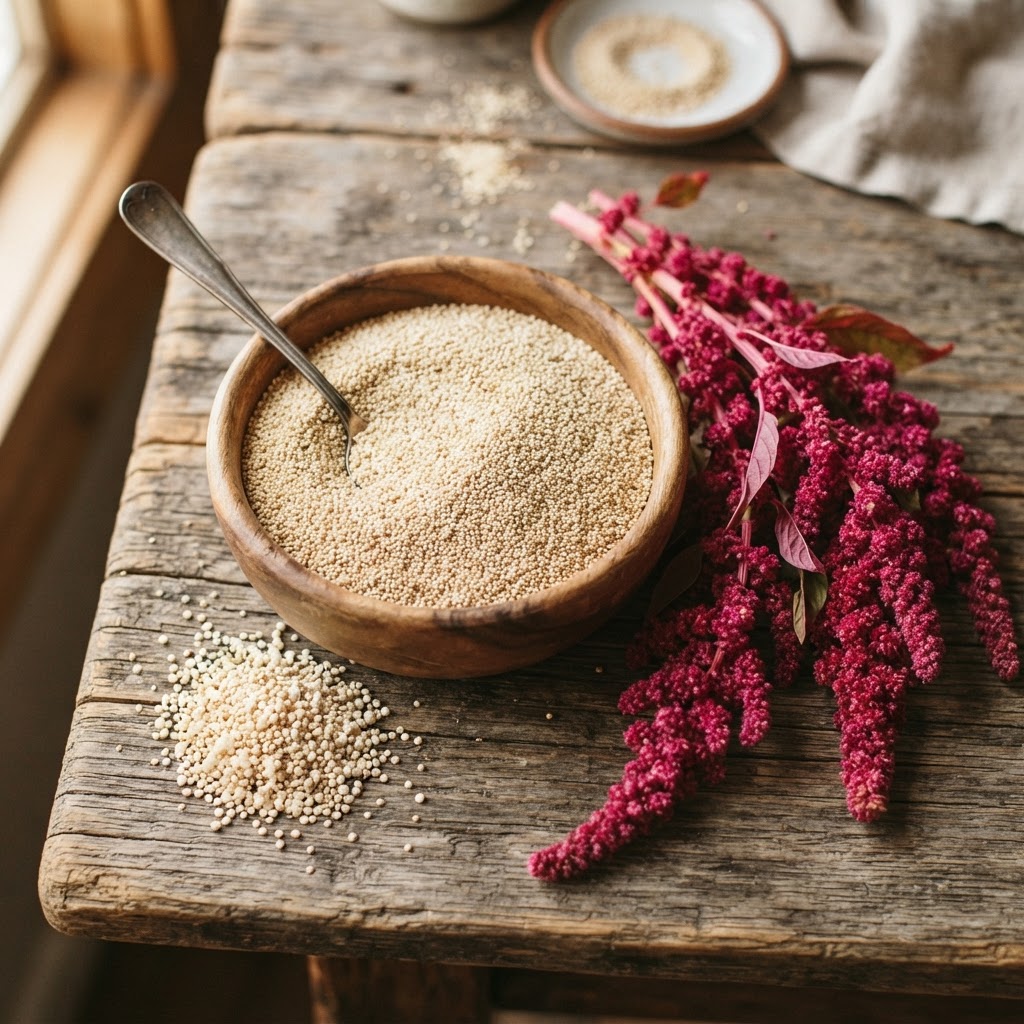
Amaranth is an ancient seed-grain domesticated independently in the Americas and Asia — technically a "pseudocereal," the tiny pale seeds of a flowering plant rather than a true grass. For the Aztecs it was huauhtli, a sacred grain second only to maize and beans; in India it is rajgira, a fasting grain; and in the Andes it is kiwicha, one of the great ancient grains of South America alongside quinoa.
Amaranth's virtues are striking: it is higher in protein than any common true grain, a complete protein with all essential amino acids including lysine, naturally gluten-free, and rich in iron, calcium, and fiber. The seeds cook up tiny and porridge-like with a nutty, slightly earthy flavor and a faintly grassy aroma, and they can be popped like miniature popcorn to make Mexico's alegrías. The young leaves are also eaten as a vegetable green — and the brilliant magenta flower heads light up gardens and fields across three continents. After being banned by the Spanish for its Aztec ritual use, amaranth survived in villages and is now resurgent worldwide as a nourishing, drought-tolerant ancient grain of the modern table.
A. hypochondriacus (Mexican)
The grain amaranth of Mexico and North America — tall plants with plump, drooping magenta or golden seed heads; the traditional huauhtli of the Aztecs and the source of alegría (popped amaranth) and atole.
A. cruentus (Mexican/West African)
A close relative grown across Mexico and West Africa — deep-red flower heads and pale seeds; widely cultivated as a leafy green in Africa and as a grain in the Americas.
A. caudatus (Kiwicha, Andean)
The Andean amaranth of Peru and Bolivia — kiwicha — with long, drooping tassel-like red flower heads; a staple grain of the ancient Andes, still grown and celebrated at high altitudes.
Rajgira (Indian Fasting Grain)
The Indian name for amaranth (A. hypochondriacus) — a grain eaten during Hindu fasting days (vrat), when common grains are forbidden; made into rajgira ladoos, puris, and porridge.
Leaf Amaranth (Chinese Spinach)
Young amaranth leaves are eaten as a cooked green across Asia, Africa, and the Caribbean — called Chinese spinach, bayam, or callaloo; tender, nutritious, and heat-loving, harvested summer through fall.
Love-Lies-Bleeding (Ornamental)
A. caudatus with long, cascading red flower tassels — a Victorian garden favorite that is also edible; the same brilliant plants of the ancient Andes now grown ornamentally worldwide.
Buy whole amaranth seeds from a store with good turnover — look for tiny, pale-cream or pale-gold seeds with no dust, dark specks, or musty smell; amaranth flour goes rancid quickly because of its high oil content, so buy small quantities and use it fresh.
Puffed amaranth (alegría) is available from Mexican grocers and online; if buying pre-popped, choose crisp, light seeds with no sogginess or off smell. Amaranth leaves (Chinese spinach, callaloo) are increasingly found at farmers' markets and Asian grocers — buy fresh, bright green leaves with no wilting or yellowing, and use within a day or two.
Season: amaranth is a warm-season crop harvested late summer through fall for grain; fresh amaranth leaves are available summer through early fall at farmers' markets in warm climates. Dried amaranth seeds and flour are available year-round.
Keep whole amaranth seeds in an airtight jar in a cool, dry cupboard for up to 6 months, or in the fridge or freezer for up to a year — the high oil content makes them more perishable than wheat or rice. Amaranth flour goes rancid fastest of all: keep it refrigerated and use within 2–3 months, or freeze for longer storage. Popped amaranth and amaranth flakes should be kept sealed and eaten within a few weeks for best crunch.
Harvesting: Amaranth is harvested in late summer to fall when the seed heads dry and turn from green to gold or deep red; growers cut the tassels and thresh the tiny seeds by rubbing or beating, then winnow to remove the chaff.
Rinsing: Amaranth seeds have a bitter saponin-like coating and fine dust, so rinse them thoroughly in several changes of cold water before cooking; the rinse water will run milky at first and clear after a few rinses.
Popping (alegría): Amaranth pops like miniature popcorn — heat a dry pan very hot, toss in a spoonful of seeds, and shake for a few seconds; the seeds puff and burst into tiny white crisps, the basis of Mexican alegría sweets.
Porridge (Atole & Kheer)
Cooked with 3 parts water to 1 part amaranth for 20–25 minutes into a creamy porridge; Mexico's atole, India's amaranth kheer, and a gluten-free breakfast porridge with honey, nuts, and fruit.
Popped (Alegría)
Popped amaranth is the heart of Mexican alegría — puffed seeds bound with honey, molasses, or chocolate, pressed into bars; also sprinkled over yogurt, fruit, and salads for crunch.
Amaranth Flour & Baking
Amaranth flour adds protein and a nutty flavor to gluten-free baking — used in flatbreads, pancakes, cookies, and blended with rice or millet flour; alone it is dense, so it's usually mixed 1:3 with other flours.
Rajgira Ladoos & Fasting Dishes
India's fasting grain — puffed amaranth bound with jaggery into ladoos, or cooked into puris and rotis (rajgira paratha) during Navratri when wheat is forbidden; a nourishing vrat food.
Leafy Green (Callaloo, Bayam)
Young amaranth leaves are sautéed, steamed, or added to stews across Asia, Africa, and the Caribbean — Jamaican callaloo, Chinese stir-fries, and Indian dal; tender and spinach-like, with more iron.
Pilafs & Salads
Cooked amaranth holds its tiny shape and can be used as a base for savory pilafs and grain salads — mixed with vegetables, herbs, and vinaigrette; a gluten-free alternative to couscous or quinoa.
Drying: Fully dried amaranth seeds keep for months to a year in a sealed container in a cool, dry place — one of the great storable grains, kept by Aztec and Andean civilizations in granaries for years.
Popping & binding: Popped amaranth bound with honey or molasses into alegría bars is a traditional Mexican way to preserve the harvest as a portable, long-keeping sweet — the basis of the Aztec "warrior food" carried on long journeys.
Milling into flour: Amaranth can be milled into flour for storage, though the flour's high oil means it spoils faster — best milled in small batches or kept frozen to preserve the nutrients.
Amaranth is one of the most nutritious of all grains — about 13–14% protein by weight, and a complete protein containing lysine, the essential amino acid lacking in most true grains; this made it a cornerstone of Aztec and Andean diets.
It is rich in iron, calcium, magnesium, phosphorus, and fiber, and notably high in the antioxidant squalene; amaranth provides more iron and calcium per serving than almost any other common grain, and is naturally gluten-free.
Amaranth's protein quality rivals milk and cheese, and its fiber and complex carbohydrates give it a low glycemic load — a nourishing grain especially valued for vegetarians, those with celiac disease, and anyone seeking a nutrient-dense ancient grain.
Amaranth was one of the three sacred grains of the Aztec Empire, alongside maize and beans — so revered it was used in religious rituals and offerings; the Spanish conquistadors banned its cultivation to suppress Aztec religion, yet it survived in remote villages and is now celebrated again.
The name "amaranth" comes from the Greek amarantos, meaning "unfading" — the brilliant flower heads keep their color long after cutting, a symbol of immortality in ancient Greek and Christian tradition; the plant was woven into wreaths and used as a symbol of eternity.
Amaranth is a "pseudocereal" — it's not a grass like wheat, rice, or corn, but its seeds are cooked and eaten like a grain; quinoa, buckwheat, and chia are also pseudocereals, a botanical family that produces grain-like seeds from broadleaf plants.
A single amaranth plant can produce up to half a million tiny seeds — one of the highest seed yields of any cultivated plant — and amaranth thrives in heat, drought, and poor soils where true grains struggle, making it a resilient ancient crop with a modern future.
Amaranth is celebrated at harvests across Mexico, India, and the Andes:
Festival of Huauhtli (Amaranth Harvest)
Mexico (formerly Aztec Empire)
🗓 September–October 2026 (autumn harvest)
Amaranth was sacred to the Aztecs, who celebrated the autumn harvest of huauhtli with feasts and offerings; the grain was so central to Aztec ritual that the Spanish conquistadors banned its cultivation to suppress indigenous religion — yet it survived in villages and is now celebrated at Día de los Muertos as alegria amaranth sweets.
Día de los Muertos Alegria
Mexico
🗓 October 31 – November 2, 2026
Mexican families make alegrías — puffed amaranth bound with honey or molasses, often with nuts and seeds — for Día de los Muertos; the puffed amaranth skulls and offerings are a direct continuation of pre-Columbian amaranth traditions, linking the modern holiday to its Aztec roots.
Makar Sankranti & Ladoos
India
🗓 January 14, 2027 (mid-winter harvest)
In India, amaranth (rajgira) is a fasting grain eaten during Hindu festivals like Navratri and Makar Sankranti; rajgira ladoos — amaranth puffed and bound with jaggery — are made for the mid-winter festival and for the fasting days when grains like wheat and rice are forbidden.
Andean Harvest Traditions
Peru & Bolivia (Andes)
🗓 April–June 2026 (harvest)
Kiwicha (Amaranthus caudatus) is an ancient Andean grain, domesticated thousands of years ago alongside quinoa; Andean communities still celebrate the harvest with traditional dishes of kiwicha porridge, drinks, and ceremonial offerings to Pachamama (Mother Earth).
Drought- & heat-tolerant: Amaranth thrives in hot, dry, poor soils where most grains fail — a C4 plant with remarkable water efficiency, making it one of the most climate-resilient crops and a promising grain for a warming world.
High-yield & low-input: A single plant yields up to 500,000 seeds and grows with minimal water and fertilizer; amaranth's deep roots mine nutrients from poor soils, and its fast growth outcompetes weeds, reducing the need for herbicides.
Global range: Amaranth originated independently in Mesoamerica (Mexico), South America (the Andes), and Asia (India, Nepal); today it is grown across the tropics and subtropics — in Mexico, Peru, India, Nepal, Africa, and increasingly in North America and Europe as an ancient grain revival.
In-Season Recipes with Amaranth
Seasonal recipes featuring Amaranth right now
Coming Soon
All Other Recipes with Amaranth
Coming Soon